

Project Information:
Project Partner:
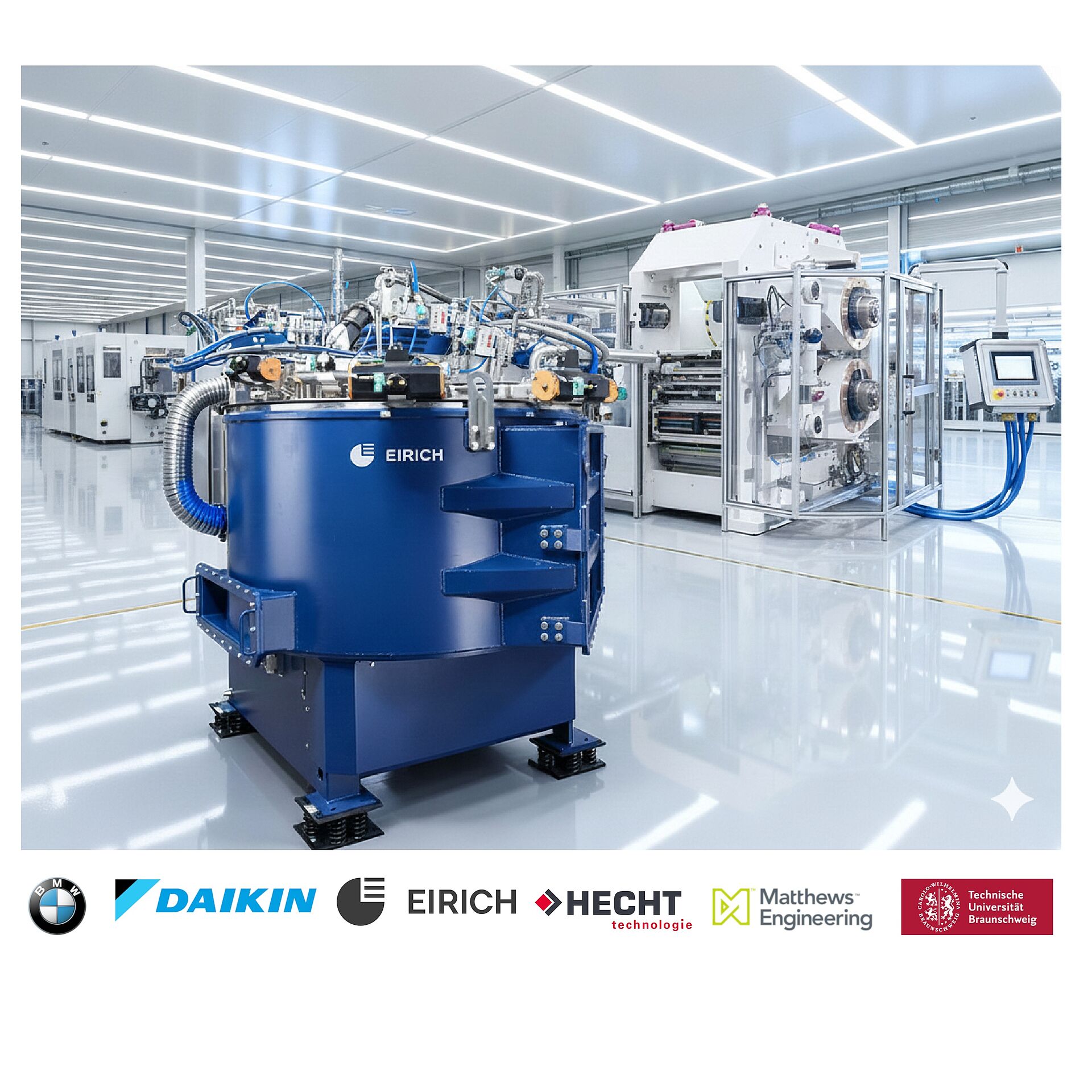
Institute for Particle Technology (iPAT),
TU Braunschweig
DAIKIN Chemical Europe GmbH
Maschinenfabrik Gustav Eirich GmbH & Co. KG
Hecht Technologie GmbH
Matthews International GmbH
Technical description of the overall project
Motivation
As part of the project, a recycling strategy for production scrap from solvent-free electrode manufacturing will be developed and scaled up. The material scrap generated during the various processing stages of the dry coating process using a multi-roll calender, is to be specifically removed, processed, and recycled in order to conserve limited resources (battery raw materials and energy) and minimize the amount of materials (e.g., metal foils) that must be sent for external recycling. Dry coating, which has not yet been established on an industrial scale, is to be implemented as part of a holistic process development approach that directly integrates a sustainable recycling strategy.
Objectives and Approach
Based on the investigation of the influence of various PTFE-based binders on different active materials (WP1) and the determined properties of the scrap generated at various processing stages (WP2), the following are being developed in the laboratory (WP3) and on a prototype demonstrator (WP5), processes, plant components, and measuring devices are being developed for the processing, quality assurance, and recycling of powder mixtures with inadequate processing properties in the film-forming process, as well as of resulting edge trimmings (WP2). For defective electrodes (WP4), recycling strategies for separating electrode material from the release film, as well as methods for returning them to the production process, are being developed. These include conveyor, dosing, and extraction systems, and mixers for processing, along with an AI-based quality management system to monitor the properties of the mixed materials relevant to the film-forming process (WP3 and WP5). The processes are tested on a laboratory scale (WP3) and using a prototype demonstrator (WP5). Finally, the reusability of the processed material will be evaluated through corresponding cell production and testing, depending on the type and proportion of secondary materials and the number of processing and manufacturing cycles (WP6), and economic and environmental improvements will be quantified (WP7).
Innovations and Prospects
Overall, the success of this research project will help reinforce the advantages of dry manufacturing of lithium-ion battery (LIB) electrodes. The goal is to increase the proportion of material processed into high-quality electrodes at the factory to over 95 %, thereby significantly boosting the appeal of this technology once again. ReTroLIB aims to reduce waste in battery cell production to less than 10 %, enable a new inline quality control system for production characteristics of electrode mixtures, and implement innovative machinery and plant technologies “Made in Germany.”
Contact:
Svenja Schreiber
svenja.schreiber(at)tu-braunschweig.de
Katharina Wolf
katharina.wolf(at)tu-braunschweig.de
Jan-Aut Deeken
j.deeken(at)tu-braunschweig.de