

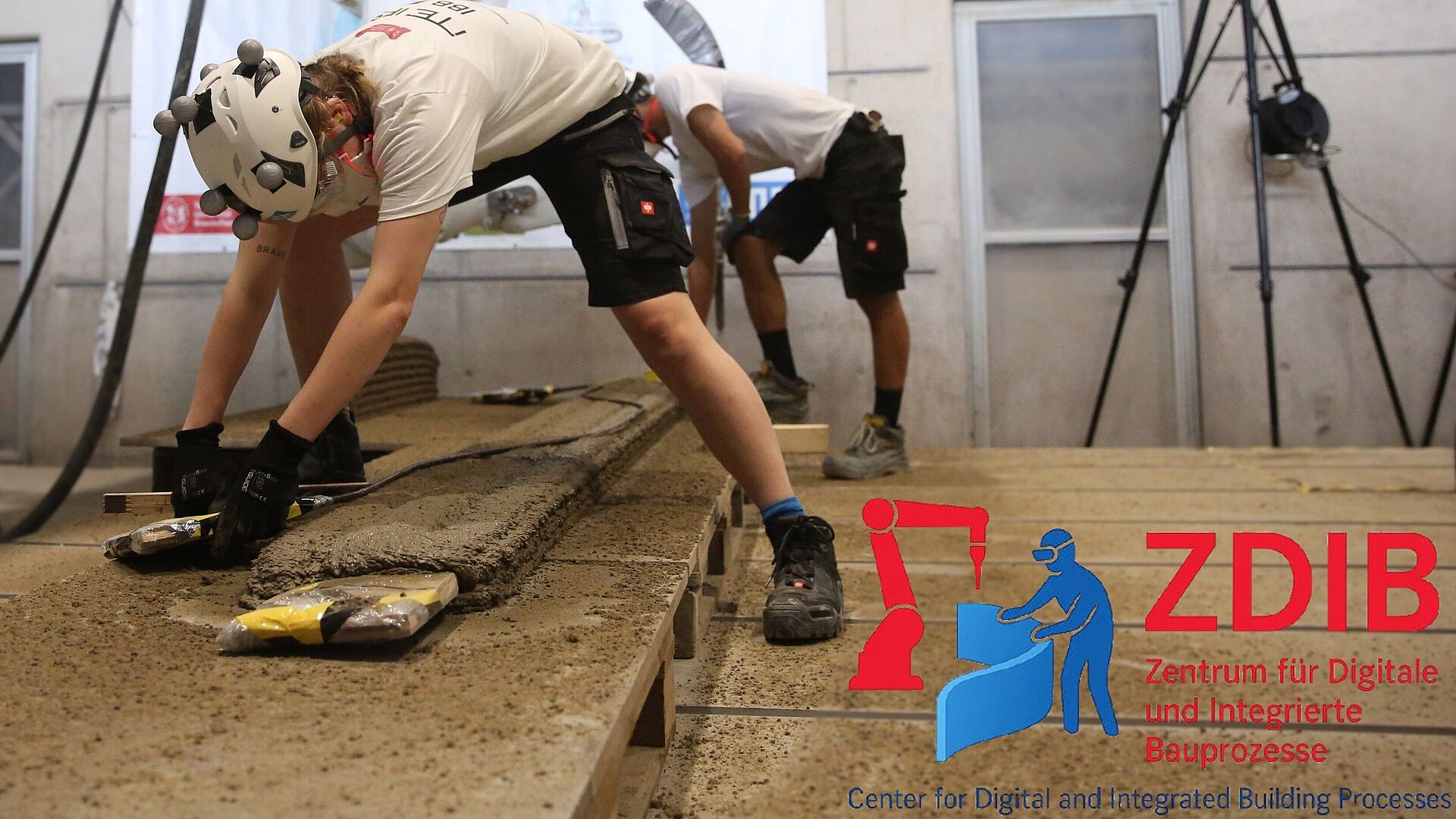
Despite its strong economic importance, the construction industry remains one of the least digitized sectors. In particular, processes on construction sites are still heavily reliant on manual work, which limits significant gains in productivity. Advanced technologies such as additive manufacturing, robotics, and artificial intelligence offer many opportunities to make construction processes more efficient and more human-centred. However, there is still no integrated approach that systematically links technological efficiency gains with the physical, mental, and social aspects of work and makes them measurable and comparable.
The aim of the ZDIB research project is to develop an evaluation and decision-making framework that enables planners and practitioners to design digitally supported, human-centred construction processes in an informed way. This framework jointly assesses productivity, sustainability, as well as physical, mental, and social workloads.
The main objective of the project is to conceptualise and test methodology, i.e., what, how, and when should exactly be measured, in the dynamic environment of the construction site in order to better understand when the use of machines is beneficial. To this end, the project will base on preliminary work to further define the measurement procedures and tools. These procedures will be then tested in the laboratory environment provided by TRR 277 AMC (https://amc-trr277.de/), and finally verified in the field measurement thanks to the collaboration with industrial partners working in the domain of innovative digital solutions for construction, such as COBOD, INSTATIQ, and Baubot. The measurements will be performed with novel digital technologies oriented towards ergonomics and occupational safety, as provided by the industrial partner MinkTec.
As a hub for innovation, ZDIB will focus on understanding how the use of technologies such as concrete 3D printing and digital assistance systems influences construction in different national and international contexts. This use is shaped by factors such as costs, availability of labour, and other boundary conditions. This part of the work will be conducted with the partner form Indian Institute of Technology Delhi, prof. Surajit Chakravarty.
Principal Investigator: Dr.-Ing. Bartłomiej Sawicki
Project Leader: Dr.-Ing. Bartłomiej Sawicki
ITE - Institut für Tragwerksentwurf TU BS
IBB - Institut für Bauwirtschaft und Baubetrieb TU BS
IfSB - Institut für Sportwissenschaft und Bewegungspädagogik TU BS
Period: 05/2026 - 04/2028
Funded by OdIn / BMFTR

Related Research:
2024 Digital Construction Workers
2024 Shotcrete 3D Printing - TRR277 AMC A04 (FP2)
2020 Shotcrete 3D Printing - TRR277 AMC A04 (FP1)