

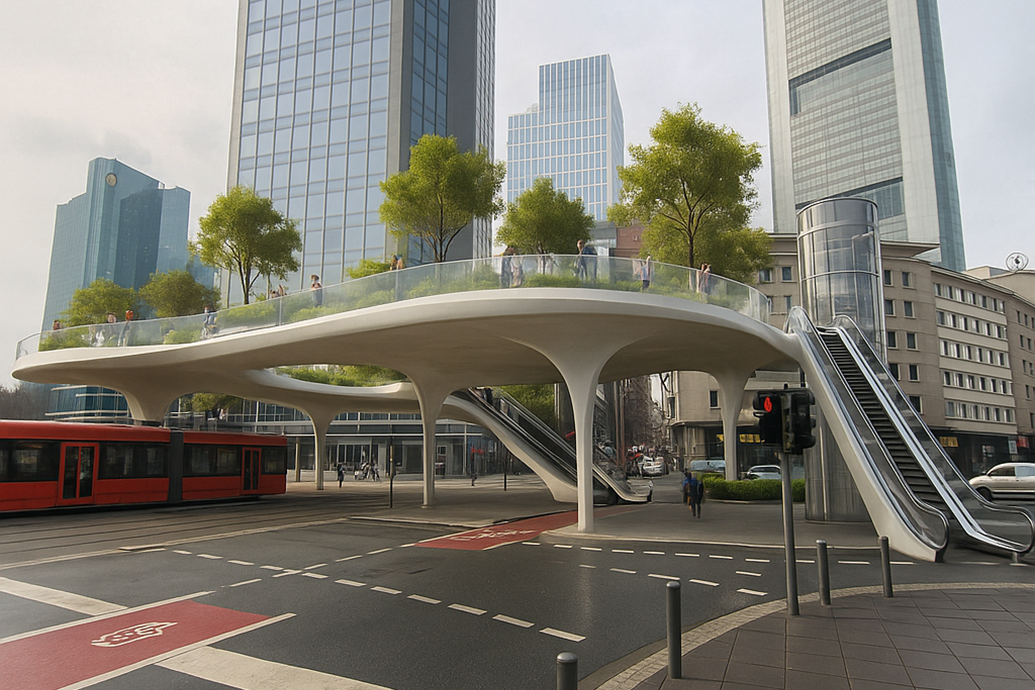
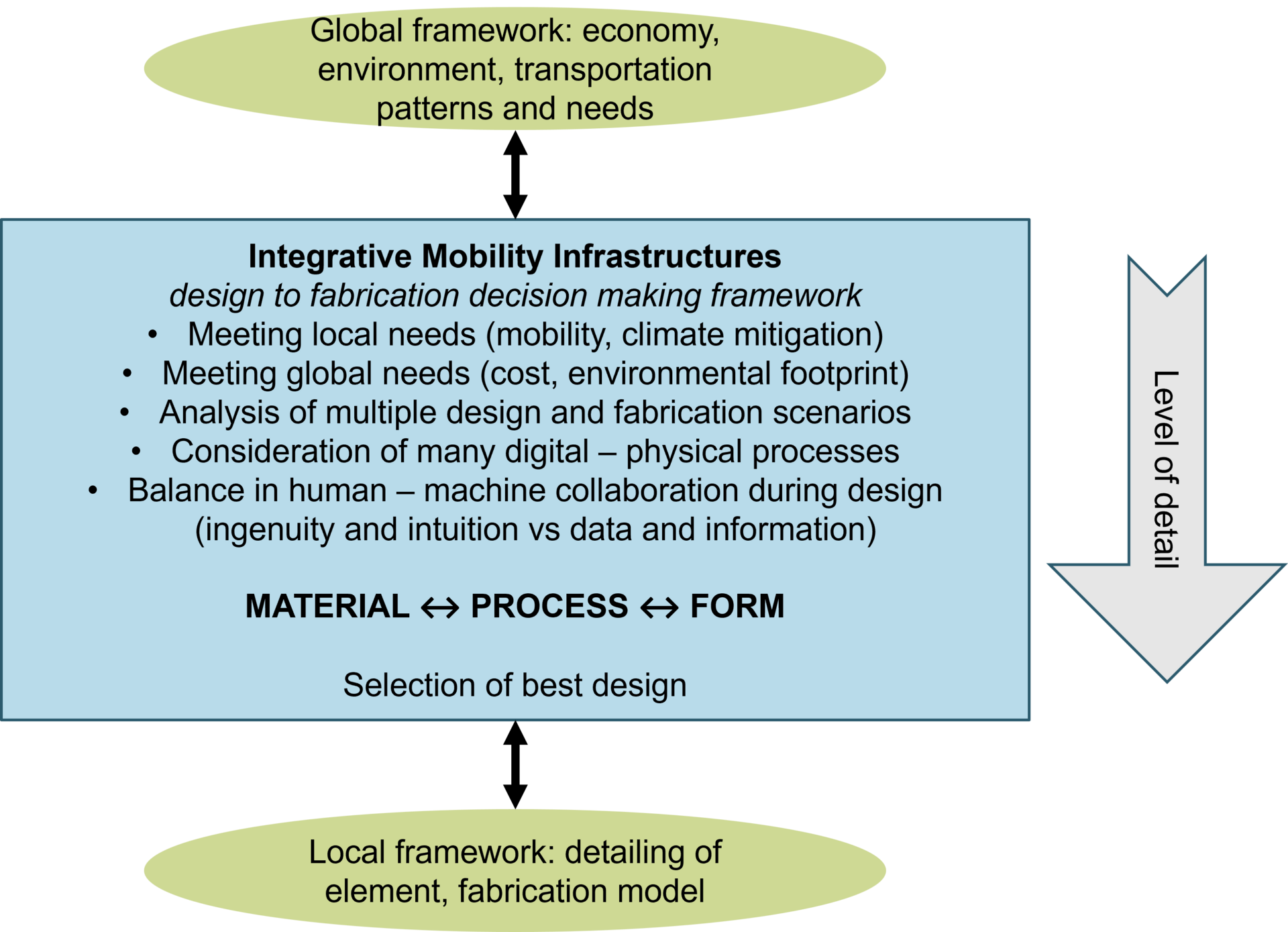
European cities are increasingly shaped by dense mobility infrastructure, spatial scarcity, and climate challenges, while space for social interaction, recreation, and urban nature is becoming limited. Conventional infrastructure is typically realised through standardised prefabrication or disruptive in-situ construction, often resulting in rigid and dominant structures that respond poorly to complex urban environments. The Integrative Mobility Infrastructures (IMI) project explores how elevated mobility infrastructure can be transformed into adaptable, multifunctional urban space without interrupting ground-level traffic and existing flows.
The project is embedded in ReSpace! – Connected Response-able Spaces and Infrastructures for Sustainable Living , a cross-disciplinary research initiative at TU Braunschweig positioned at the intersection of the university’s core research areas. ReSpace! aims to envision, develop, evaluate, and communicate scientifically founded and socially acceptable concepts for sustainable urban transformation. Central to the initiative is the use of real-world urban environments and infrastructures as experimental laboratories, linking technical innovation with social, ecological, and cultural perspectives, in line with TU Braunschweig’s Ecoversity agenda.
Within this framework, the present research focuses on elevated urban structures that combine pedestrian mobility with leisure and greenery. Using computational architectural and structural design, parametric modelling, and large-scale additive manufacturing with concrete, the project develops lightweight, smooth, and continuous platform geometries that adapt to local constraints rather than imposing repetitive forms.

Related Research:
2024 Shotcrete 3D Printing - TRR277 AMC A04 (FP2)
2020 Shotcrete 3D Printing - TRR277 AMC A04 (FP1)