
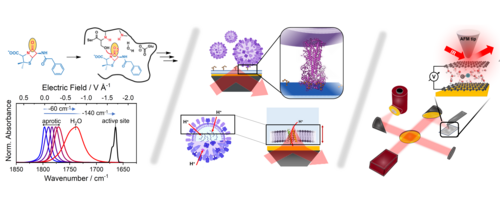
Vibrational spectroscopy reveals molecular mechanisms of (anti)microbial action by probing structural and electrostatic changes. Using vibrational Stark-based electric-field measurements and surface-enhanced infrared absorption we investigate electrostatic catalysis in antibiotic resistance and track virus–membrane interactions - with extension to nanometer resolution via infrared nanoscopy.
Kozuch*
Bunsen-Magazin, 2025, 6, 237-240, DOI: 10.26125/pxp4-p755
Interrogating (anti)microbial mechanisms using vibrational spectroscopy – from electrostatic effects in catalysis to virus-membrane interactions
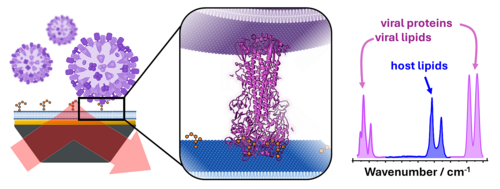
Many virus binding and fusion assays rely on the introduction of fluorescent dyes into viruses or membrane models. Combining model membranes with surface-enhanced infrared absorption spectroscopy enables label-free monitoring such processes with molecular structure information.
Heinen, Heermant, Lauster, Block, Kozuch*
Angew. Chem. Int. Ed., 2025, 10.1002/ange.202502998
Label-Free Detection of Virus-Membrane-Interactions Using Surface-Enhanced Infrared Absorption (SEIRA) Spectroscopy