

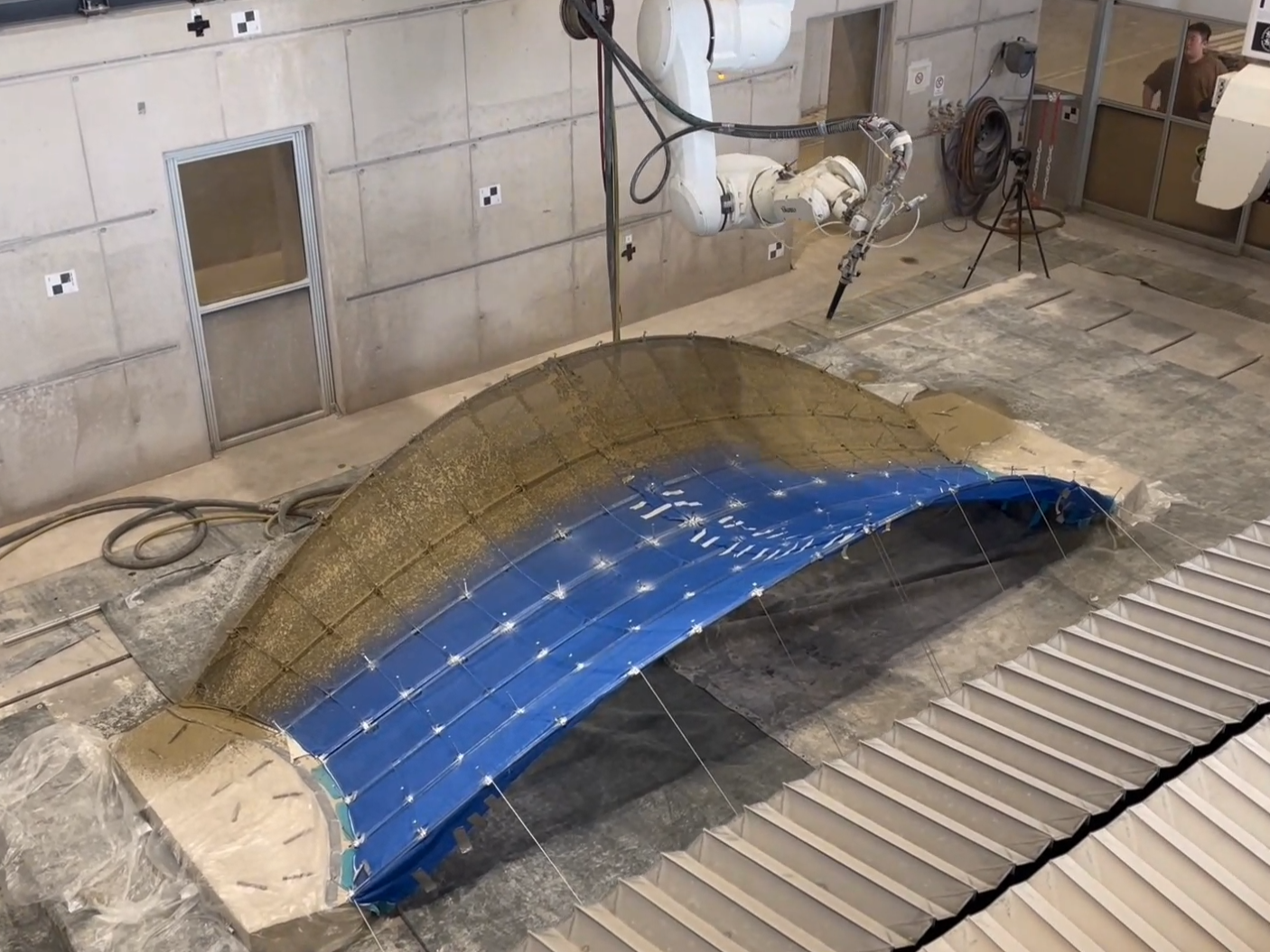
The pedestrian bridge demonstrator presented in Frontiers in Built Environment showcases a digitally integrated workflow for producing lightweight and geometrically complex concrete shell structures while minimizing conventional formwork. The project combines CNC-knitted stay-in-place textile formwork (KnitCrete) with robotic Shotcrete 3D Printing (SC3DP), enabling material-efficient concrete geometries that are difficult to realize using traditional construction methods.
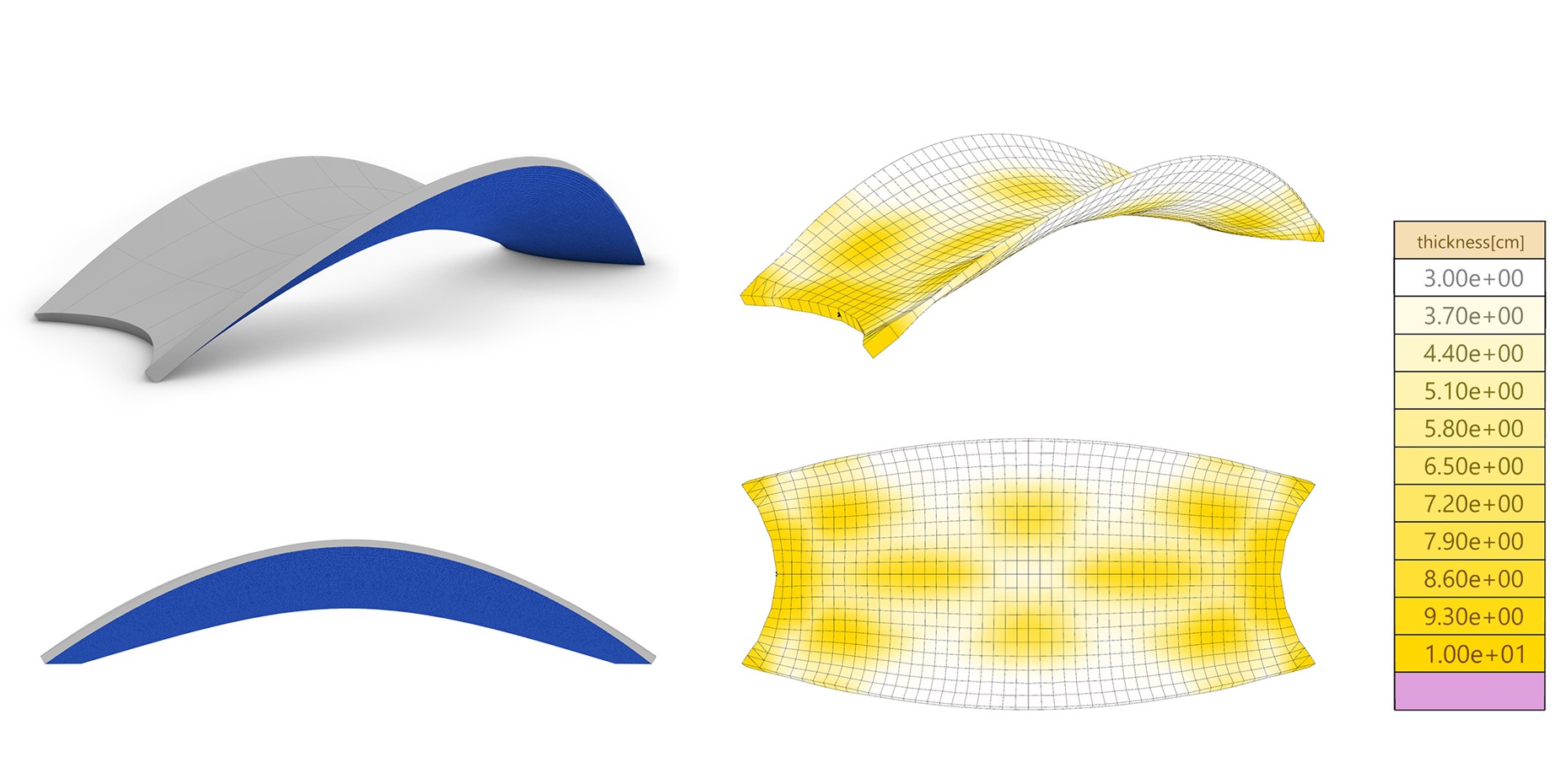
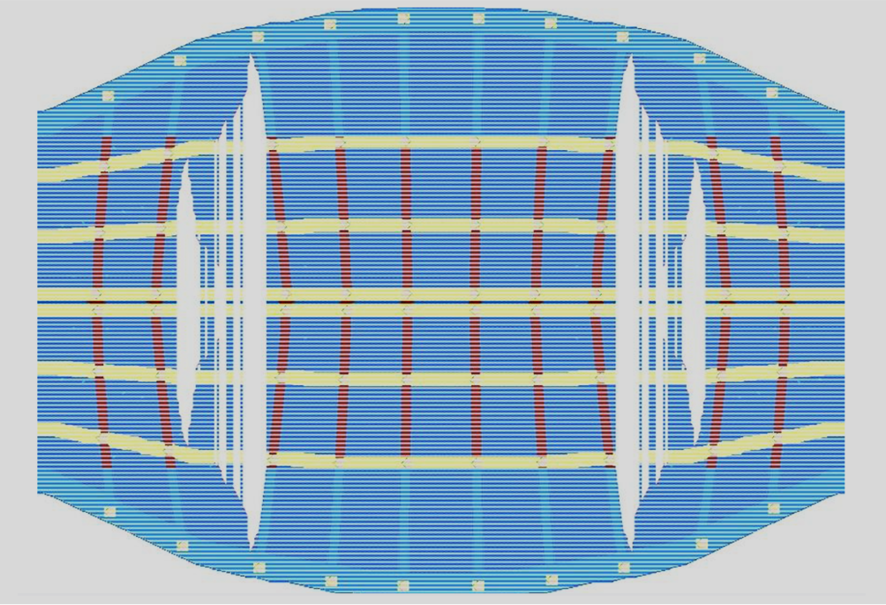
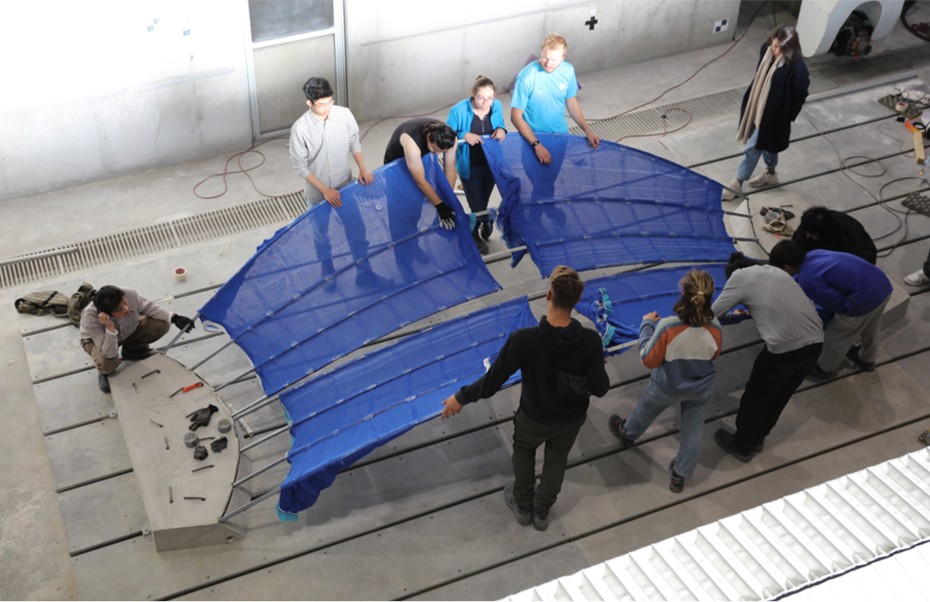
The fabrication process is driven by computational form finding and structural design. A bending-active steel rod substructure is assembled to tension a custom CNC-knitted textile, which serves as permanent formwork. Robotic shotcrete is then applied in locally differentiated thicknesses aligned with structural requirements, resulting in a continuous and efficient concrete shell.
The bridge was designed and produced within a cross-university design–build seminar involving six students from each institution. The seminar brought together TU Braunschweig, TU Munich and TU Delft. Prof. Marianna Popescu participated as an AMC Mercator Fellow, and this collaborative academic framework was instrumental in enabling the conception, realization, and successful execution of the bridge demonstrator.

Related Research:
2024 Structural Jointing and Assembly Systems for AM Concrete - TRR277 AMC C05 (FP2)
2024 Shotcrete 3D Printing - TRR277 AMC A04 (FP2)
2024 Digital Construction Workers
2024 Cyber-Physical Construction Processes - TRR277 AMC C06 (FP2)
2022 Shotcrete 3D Printing - Next Level AM
2020 Shotcrete 3D Printing - TRR277 AMC A04 (FP1)
Related Demonstrator: