


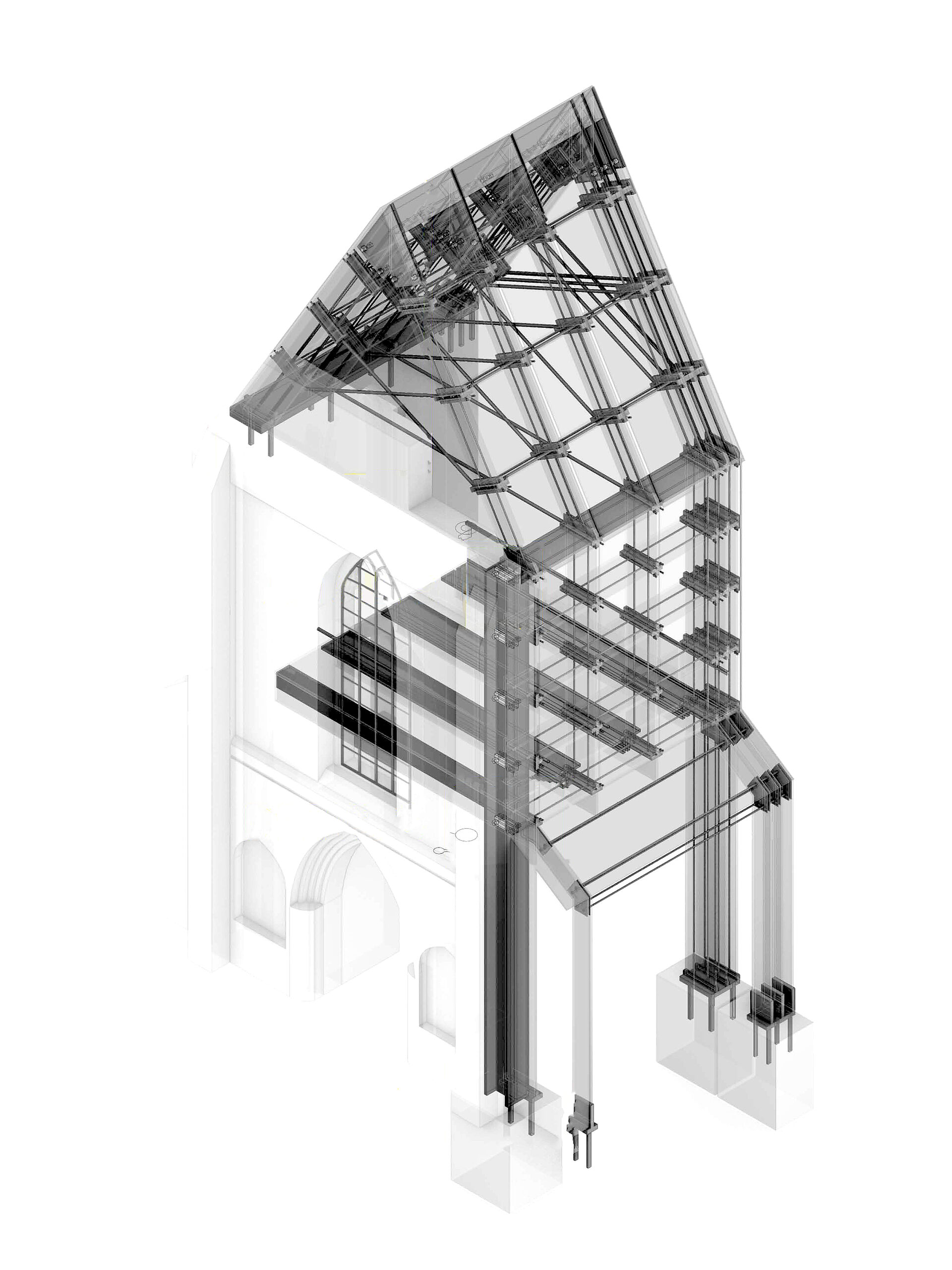


In this semester’s design studio, students will have the opportunity to participate in the 2025 FKG Student Competition, which focuses on developing a transparent glass enclosure for the ruins of a Gothic monastery church in Berlin. The competition challenges participants to transform a historically significant site into a functional venue for cultural events, while navigating the delicate balance between architectural preservation and contemporary design intervention. The task encourages a thoughtful consideration of how new structures can coexist with heritage fabric without overpowering or diminishing its character, and how architectural additions can contribute meaningfully to the site’s future use.
A central theme of the studio will be the exploration of structural glass as both a material and a design medium. Students will investigate its architectural potential through computational modelling, concept development, and structural feasibility studies. Particular emphasis will be placed on connection strategies, detailing and broader sustainability considerations, including material efficiency and environmental performance. Computational design and structural optimization will form a backbone of the course, enabling students to test variations, assess performance and refine their proposals toward technically viable and innovative solutions that respond to both context and program.
The semester will be supported by workshops and keynote lectures introducing topics such as structural analysis, digital and computational workflows and contemporary fabrication techniques. These sessions will provide a technical foundation while also encouraging students to adopt a critical and reflective approach to the design process, strengthening their ability to integrate technology, material understanding and architectural intent.
By making both the construction process and the final building visible—supported by Augmented Reality—the project highlights the potential of digital technologies in sustainable construction. It also introduces a hybrid building approach that combines prefabricated timber components with in-situ robotic earthen construction, enabling year-round production workflows.
Tim Bichbeimer, Adriana Gens, Hans Kyaw Lat, Lisa-Marie Melzer, Jasmina Mundhenk, Merle Seedorf, Sonja Sorgenfrey, Victoria Walter, Mingyan Zhang