


Earthen construction has a long tradition across many cultures, yet much of this knowledge has been lost in Germany over the past century. Historic buildings such as a rammed-earth high-rise in Weilburg an der Lahn built by Wilhelm Jacob Wimpf, or numerous structures in Central Germany, were once built using techniques like rammed earth, cob, or adobe. As these buildings were plastered or replaced over time, the construction method and the associated craftsmanship gradually disappeared from public awareness.
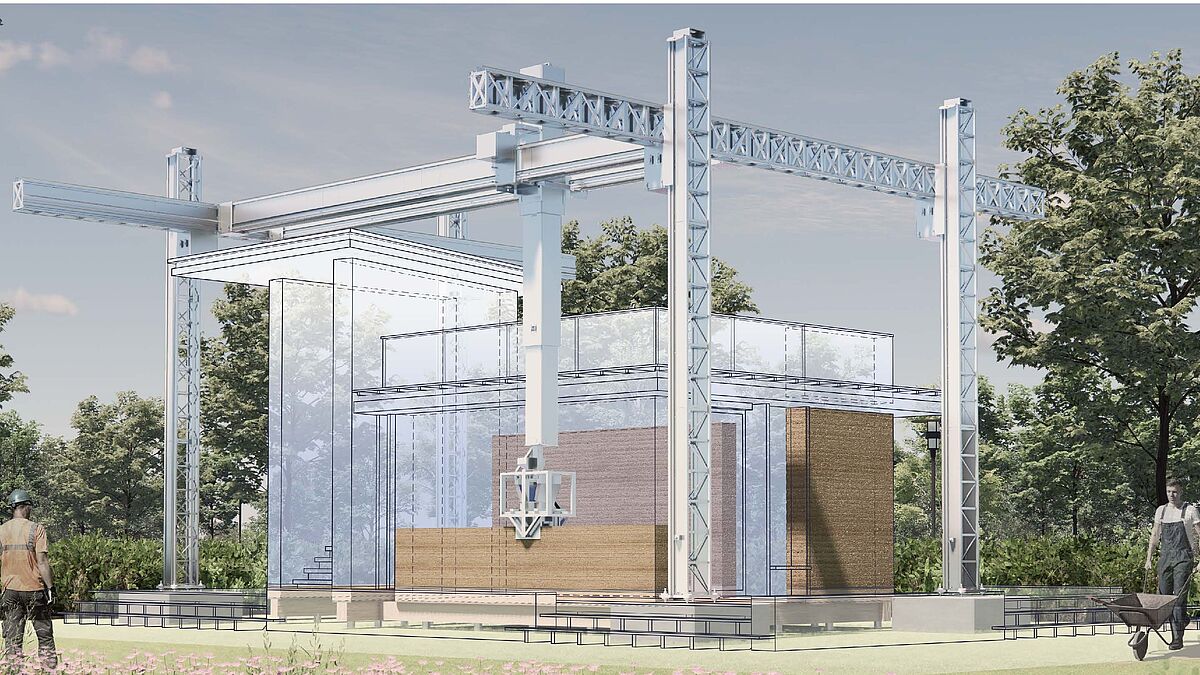
The project “Digital Reallabor – Robotic Rammed Earth” aims to transfer this traditional building technique into today’s digital age and to present it as a forward-looking, competitive, and sustainable alternative. Instead of exhibiting only the finished structure, the project showcases the building process itself. The robotic rammed-earth technique was developed at the Institute of Structural Design at TU Braunschweig within two consecutive research projects funded by the The Federal Institute for Research on Building, Urban Affairs and Spatial Development (BBSR) and the Federal Ministry of Education and Research (BMBF). For the 2026 State Garden Show in Neuss, the research prototype provides an ideal opportunity to bring this technology into real-world application.
Rammed earth offers significant ecological benefits: complete recyclability, CO₂ neutrality, and the use of local soils without chemical additives. Technologically, robotic fabrication increases productivity substantially—one cubic meter can be produced in about two hours, compared to roughly ten hours of manual work.
By making both the construction process and the final building visible—supported by Augmented Reality—the project highlights the potential of digital technologies in sustainable construction. It also introduces a hybrid building approach that combines prefabricated timber components with in-situ robotic earthen construction, enabling year-round production workflows.
Abdalruhman Alshehadat, Jan Duensing, Lukas Feyrer, Jonas Gruhl, Deniz Kudu, Nikoo Nikkhahkheibari, Marie-Jeannine Hieke, Sophie Knaus, Jan Strauch, Nour Ardah, Ibaa Labadi, Fatemeh Teymouri, Mingyan Zhang, Felix Luther, Pauline Zahn

Related Research:
2025 Selective Robotic Rammed-Earth (sRRE)
2024 Spray Earth - TRR277 AMC A10 (FP2)
2022 Mobile Robotic Rammed Earth – From the Laboratory to on-site Fabrication
2019 Robot Aided Fabrication of Rammed Earth Elements
Related Demonstrators: