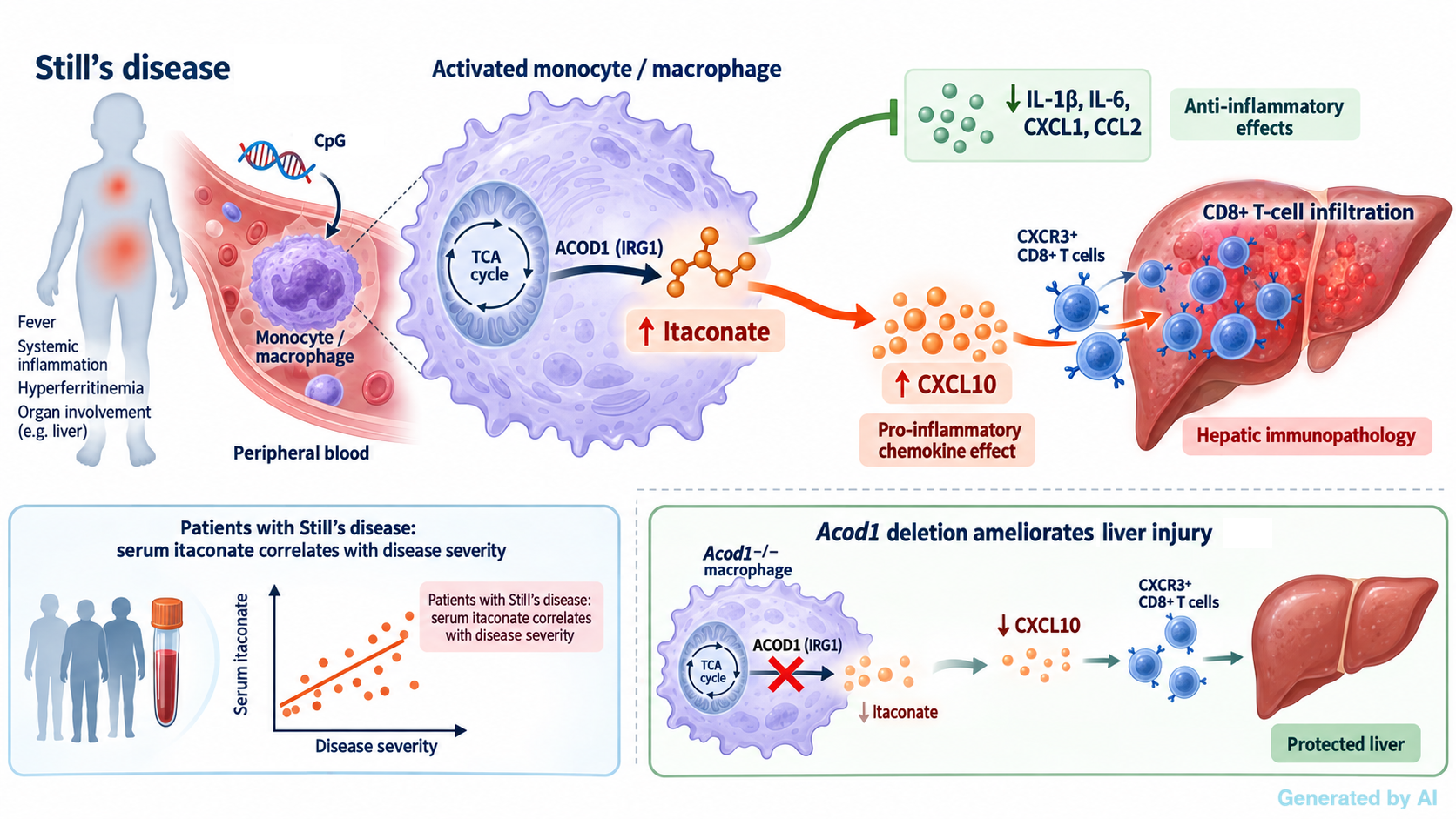
News: Itaconate aggravates immunopathology via the CXCL10–CD8 T cell axis – our new study published in Exp Mol Med. 2026 Jun 5.
In our last study, we identified itaconate (and its isomer mesaconate) as immunosuppressive agent against LPS-stimulated IL-6 and IL-12 in macrophages. Interestingly, we also noticed that some factors were upregulated by itaconate. Due to limitations in disease models, we didn’t move on to explore the potential pathologic role of itaconate via these up-regulated factors.
Coincidentally, in a Cell Symposium in 2023, I met Dr. Junna Ye and Dr. Yue Sun from Ruijin Hospital, Shanghai Jiaotong University. They found out a correlation between itaconate and the Still’s Disease, a serious autoinflammatory disease and they had demonstrated a pathogenic role of itaconate in this disease, in contrast to the reported anti-inflammatory role of itaconate. Upon re-visiting my discovered itaconate-triggered chemokines, I suggested CXCL10 as a potential mediator of the pathogenic role of itaconate. With extensive analysis of patient samples, animal studies and cell culture experiments, we worked together to exhibit a myeloid-CD8 T cell crosstalk mediated by an itaconate-CXCL10 axis, triggering hepatic pathology in Still’s Disease, in parallel to the anti-inflammatory effects of itaconate on canonical cytokines. Therefore, this study reveals itaconate as a dual regulator in inflammatory diseases, where spatiotemporal context might dictate its efficacy – either anti-inflammatory or pro-pathologic.