FindMe@Campus: AI-Driven Indoor Localization Using Wi-Fi
Wireless Campus Localization System:
Collects Wi-Fi (eduroam) signal strength and smartphone sensor data to estimate indoor user location
The system runs as a lightweight mobile application that periodically scans the surrounding wireless environment and records signal strength measurements from nearby Wi-Fi access points. At the same time, data from onboard motion and orientation sensors are collected to capture user movement and heading. Wireless fingerprints provide spatial reference points, while inertial sensor readings support tracking of relative motion between observations. These complementary data sources are combined to continuously estimate the user’s indoor position.
Operates without GPS or additional infrastructure
Supports building-, floor-, or zone-level localization
The localization framework is designed to operate at multiple spatial resolutions depending on the available signal density and calibration data. At a coarse level, the system identifies the current building by matching observed wireless signatures against pre-recorded building profiles.
Smart Campus Architecture:
Defines the end-to-end system from mobile data collection to AI inference
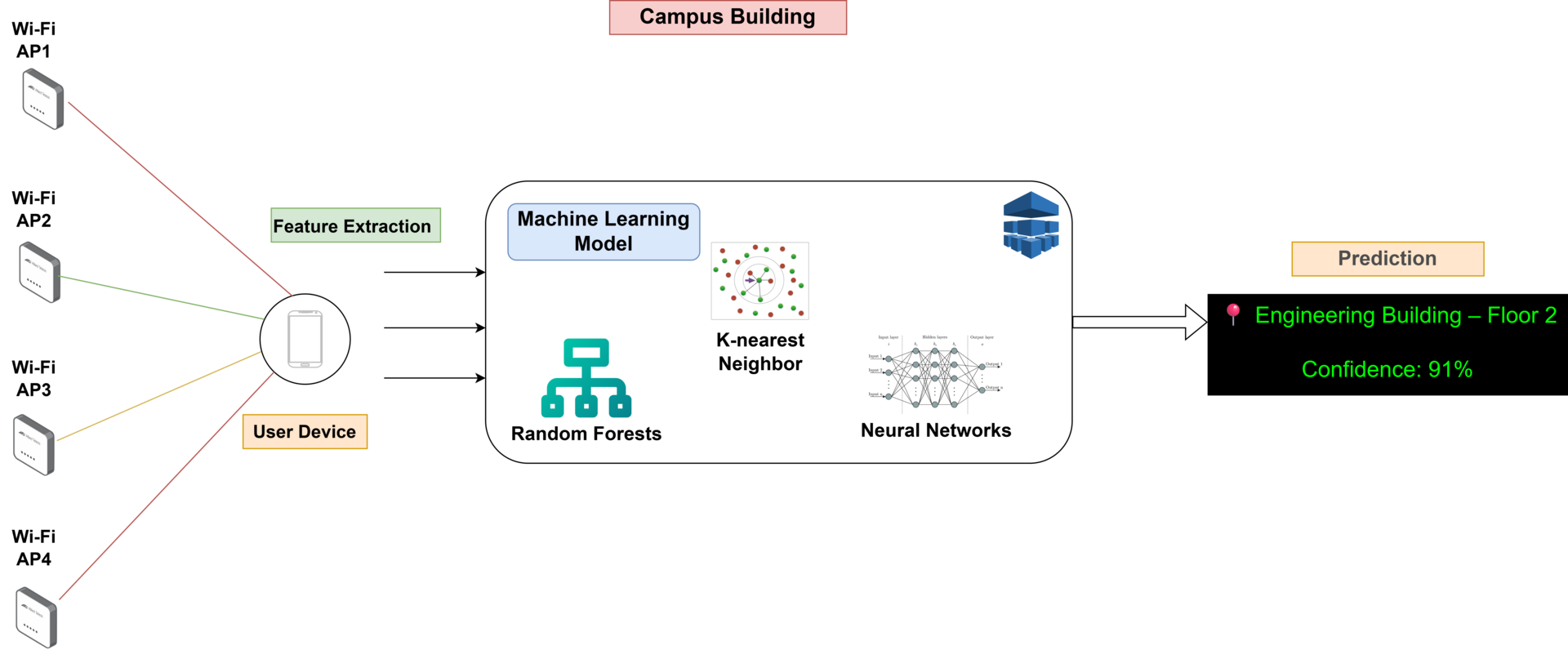
The system specifies a complete processing chain that starts from wireless and sensor data acquisition on user devices and ends with location inference performed by a trained learning model. This includes data transmission, preprocessing, feature construction, and real-time position estimation within a unified framework.
Designed for scalability, low cost, and practical campus deployment
The architecture relies exclusively on existing wireless infrastructure and commodity devices, enabling deployment across large building complexes without additional hardware investment. Lightweight processing and modular design allow the system to scale to many users while maintaining low operational complexity and maintenance cost.
AI-Based Location Prediction:
Includes feature extraction, model training, and prediction pipeline
Collected data is processed into meaningful features that capture signal patterns and environmental context. These features are then used to train models offline and produce predictions online, maintaining consistency between training and deployment.
Applies machine learning models to analyze wireless signal patterns
Uses AI techniques to learn patterns in Wi-Fi, BLE, and sensor signals that correlate with user location.
Adapts to signal variations across different campus environments
Predicts user location in real time based on phone-extracted features
Generates location estimates on the device or server quickly, leveraging the processed signals and learned models for instant feedback.
Required:
Python & Data Processing: pandas, NumPy, basic data handling
Machine Learning Models: Random Forests, Neural Networks.
Mobile / Backend Integration: Android Wi-Fi scanning and simple REST APIs.