

The workshop on Post-Shannon Theory and Molecular Communication took place from March 31 to April 4, 2025 at the Technische Universität Braunschweig. It covers topics such as message identification theory, common randomness generation, age of information, molecular communication, and more. The program includes poster presentations and talks.
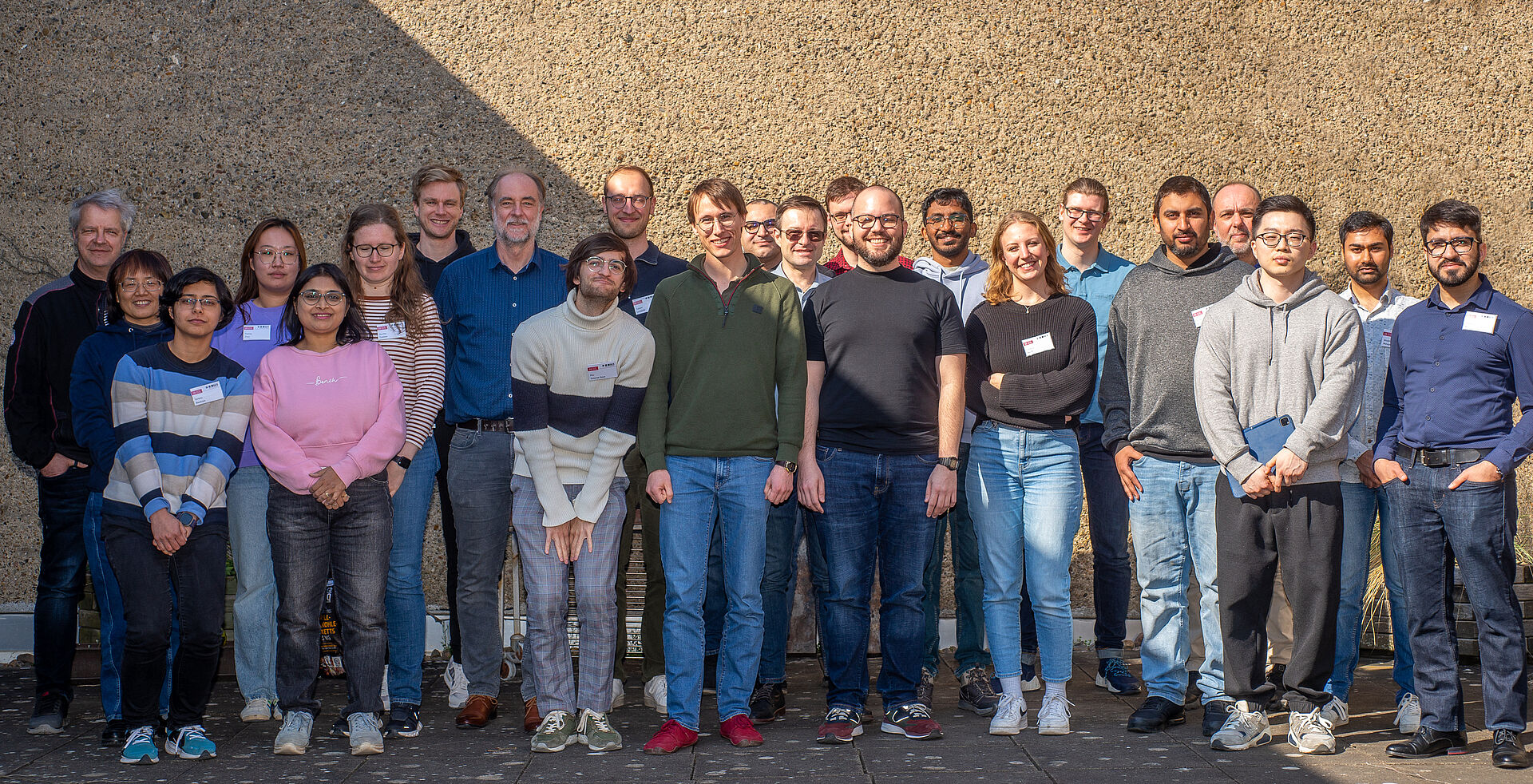
The workshop was held at the Technical University of Braunschweig, Germany.
Lecture halls are located at the Institute for Communications Technology.
ADDRESS
Institut für Nachrichtentechnik
Technische Universität Braunschweig
Schleinitzstraße 22
38106 Braunschweig
Germany
Recordings: Workshop on Post-Shannon Theory and Molecular Communication
Monday, March 31
13:00 — Welcome —
13:15 — Maximilian Schäfer - The Chorioallantoic Membrane (CAM) Model: Towards a 3D in vivo Testbed for the Design and Analysis of Molecular Communication Systems
14:15 — Coffee —
14:45 — Jessica Bariffi - Sequence Reconstruction over Coloring Channels for Protein Identification
15:15 — Alexander Wietfeld - Modeling Molecular Communication Systems using Chemical Reaction Networks
15:45 — Coffee —
16:15 — Saswati Pal - Infection Source Localization in the Human Cardiovascular System Using Machine Learning
16:45 — Daniel Prades - Fluorescence Multi-Detection Device Using a Lensless Matrix Addressable microLED Array
17:45 — End —
Tuesday, April 1
09:00 — Welcome —
09:15 — Stefan Fischer -The Internet of Bio-Nano-Things: Concepts and Realization
10:15 — Coffee —
10:45 — Mohammad Javad Salariseddigh - Identification over Affine Poisson Channels: Applications to Molecular Mixture Communication Systems
11:15 — Anisha Banerjee - Error-Correction with Nanopore Sequencing
11:45 — Lunch —
13:00 — Announcements —
13:15 — Annika Tjabben - Microbubbles as Enabler for Molecular Communication
13:45 — Pit Hoffmann - Neuronal Communication - A Pathway Toward Synthetic Biological Intelligence
14:15 — Coffee —
14:45 — Martin Korte - Communication between neurons: synaptic acticity as a molecular correlate of learning am memory
15:15 — Coffee —
15:45 — Panel: Molecular Communication
16:45 — End —
Wednesday, April 2
09:00 — Welcome —
09:15 — Massimiliano Pierobon - On the Usefulness and Subjectivity of Life-supporting Information
10:15— Coffee —
10:45 — Rami Ezzine - Common Randomness Generation from Finite Compound Sources
11:15 — Prashanth Sheshagiri - Redesigning physical layer secret key generation for post-Shannon communication
11:45 — Lunch —
13:00 — Announcements —
13:15 — Posters / Demo / Lightening Talks
14:15 — Coffee / Poster / Demo —
17:00 — Social Event —
Thursday, April 3
09:00 — Welcome —
09:15 — Pau Colomer Saus - Randomized ID and deterministic ID and rate reliability functions
10:15 — Coffee —
10:45 — Caspar von Lengerke - Towards Practical Identification Codes
11:15 — Abdallah Ibrahim - Identification Under the Semantic Effective Secrecy Constraint: Coding Theorems and Capacity Bounds
11:45 — Lunch —
13:00 — Announcements —
13:15 — Yanling Chen - Application of the Identification codes to the two party Privacy-Preserving Record Linkage (PPRL)
13:45 — Usman Ali - Performant Message Identification: From Theory to Practice
14:15 — Coffee —
14:45 — Johannes Rosenberger - Consensus-Testing via Relay Networks
15:45 — Coffee —
16:15 — Panel Message Identification
17:15 — End —
Friday, April 4
09:00 — Welcome —
09:15 — Alberto Perotti - Identification Codes applications in next generation wireless networks
10:15 — Coffee —
10:45 — Discussion —
11:45 — Lunch —
Martin Korte
Prashanth Kumar
Yaning Zhao (Joint Sensing and Identification Over Multiple-Access Channels: Capacity Enhancements)
Christian Deppe (Secure Event-Triggered Molecular Communicaion)
Olaf Gröscho (Source Identification)
Frederik Walter (Detecting Deletion with Marker Codes)
Luca Miszewski (Deterministic Identification for Molecular Communicaion Based on Diffusion)
Reza Omidi (Galaxy Codes: Advancing Achievability for Deterministic Identification)
The organizers acknowledge the financial support by the German Federal Ministry of Education and Research (BMBF) in the program “Souverän. Digital. Vernetzt.”, joint projects 6G-life, project identification number: 16KISK263, and 6G-RIC, project identification number: 16KISK020K.