

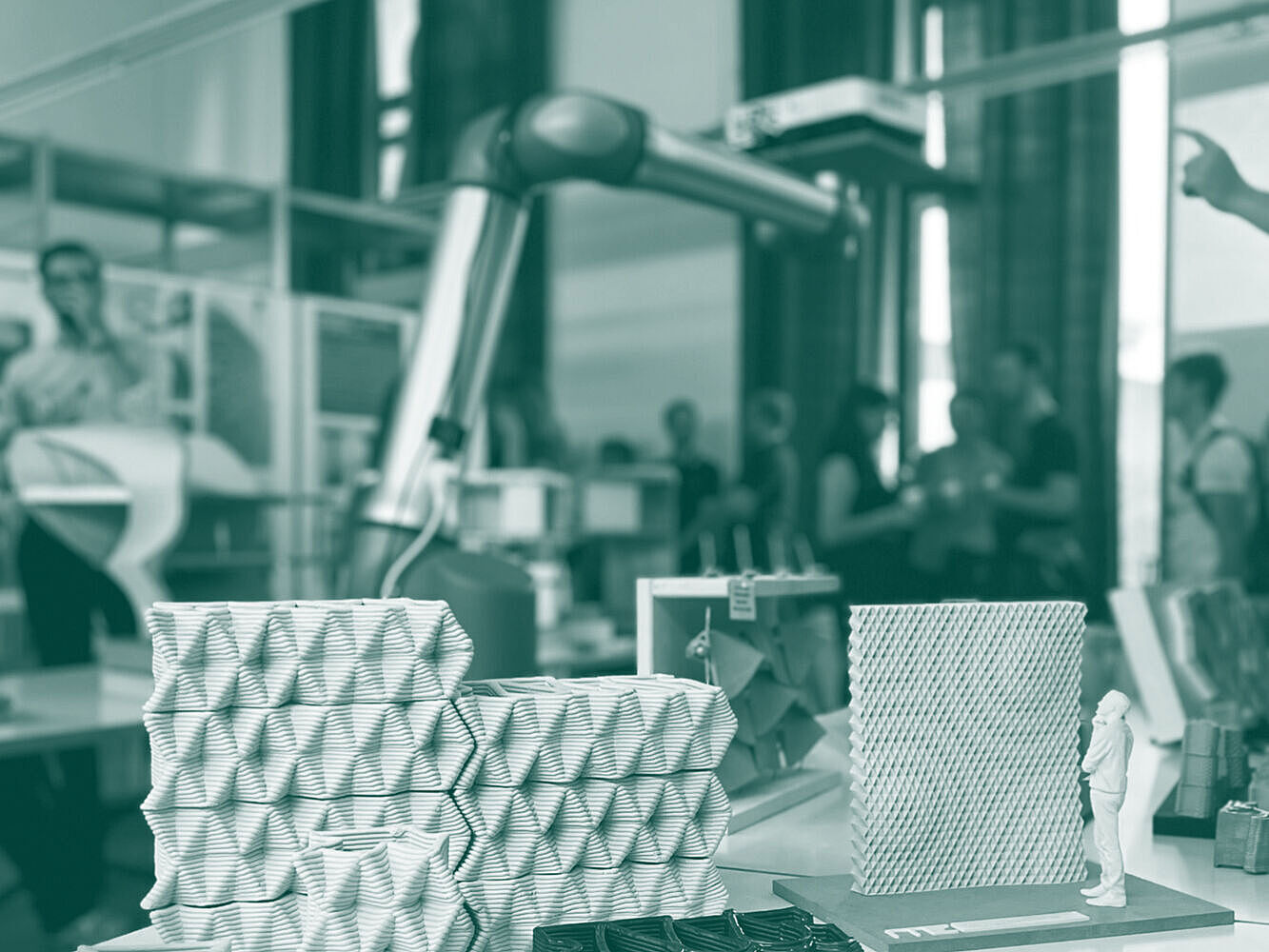
The seminar Structural design for Additive Manufacturing in Construction (AMC) focuses on strategies and concepts for safety and durability verification, using existing standards as well as research-based methods. This knowledge is further employed by engineering students for conceptual and structural design as a Studienarbeit, in collaboration with architecture students. Special consideration is put on use of fundamental structural engineering principles and realistic assumptions.
Upon successful completion of the module, students will be familiar with the relevant standards and codes applicable in Europe and internationally for the structural and durability verification of additively manufactured structures, with a particular focus on Digital Fabrication with Concrete. They will be prepared to participate in the structural design and execution of projects involving additive manufacturing—especially concrete 3D printing—and to operate effectively in international contexts, including normative environments beyond Germany. This will also involve the ability to draw analogies from standards and codes not directly valid in Germany.
To this end, students will learn to apply fundamental physical principles and engineering laws to navigate within the currently unregulated domain of structural design using novel materials and fabrication processes. They will gain an understanding of the underlying concepts and logics behind existing design formulas (e.g., those found in the Eurocodes) and will be capable of using them appropriately in situations where the materials or methods lie outside the scope of current normative documents. This ability will enable them to assess and design using a variety of materials, including advanced cementitious composites, and reinforcement types from both structural performance and durability perspectives.
Finally, students will be introduced to the fundamentals of design assisted by testing—a methodology that is not only crucial in the context of Digital Fabrication with Concrete, but also broadly applicable in structural engineering practice, for instance in the verification and assessment of existing structures through physical testing.
Contents: Strategies and concepts for safety and durability verification in Additive Manufacturing for Construction (AMC), including existing norms and standards, and practical approach based on selected examples.
A series of lectures will introduce 1) relevant existing norms, standards, and guidelines, including: DIN EN ISO/ASTM 52939 and ICC-ES AC509, as well as 2) selected examples of design assisted by testing of additively manufactured structures.
The homework is a written report from design and validation plan of a selected structural element (e.g. a beam, a wall) produced with selected additive manufacturing method, including: 1) design and validation plan, 2) fabrication method selection, 3) design for fabrication and structural calculation, 4) planning of testing for validation and/or quality control.
It is strongly recommended that students possess preliminary and broad knowledge of Additive Manufacturing in Construction. This should be documented by the successful completion of both:
or an equivalent set of courses completed at another university.
The two courses mentioned above may also be taken in parallel with the current course in order to acquire the required background knowledge
Link to official webpage:
Module package: Digital Building Fabrication (DBF)