

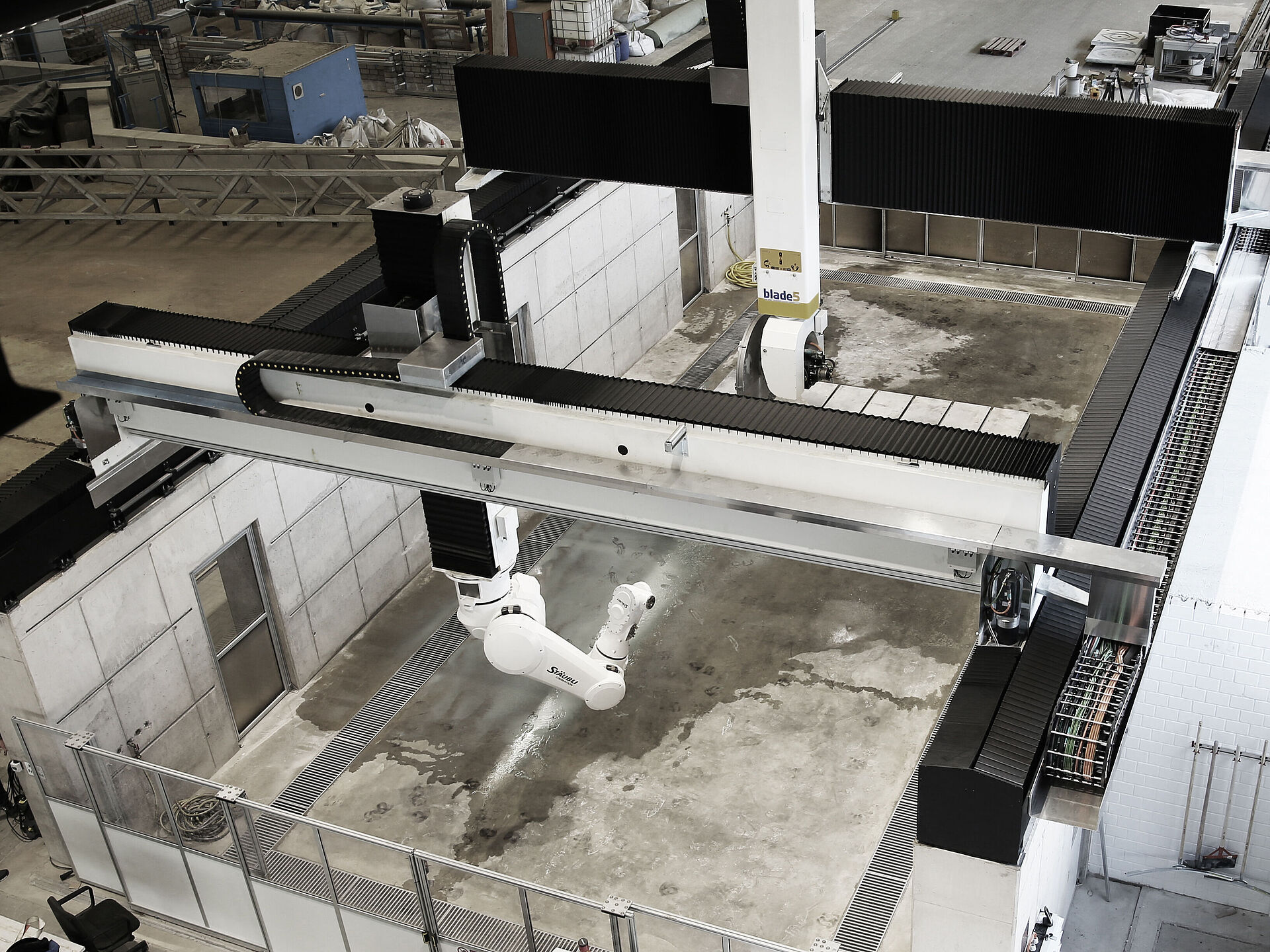
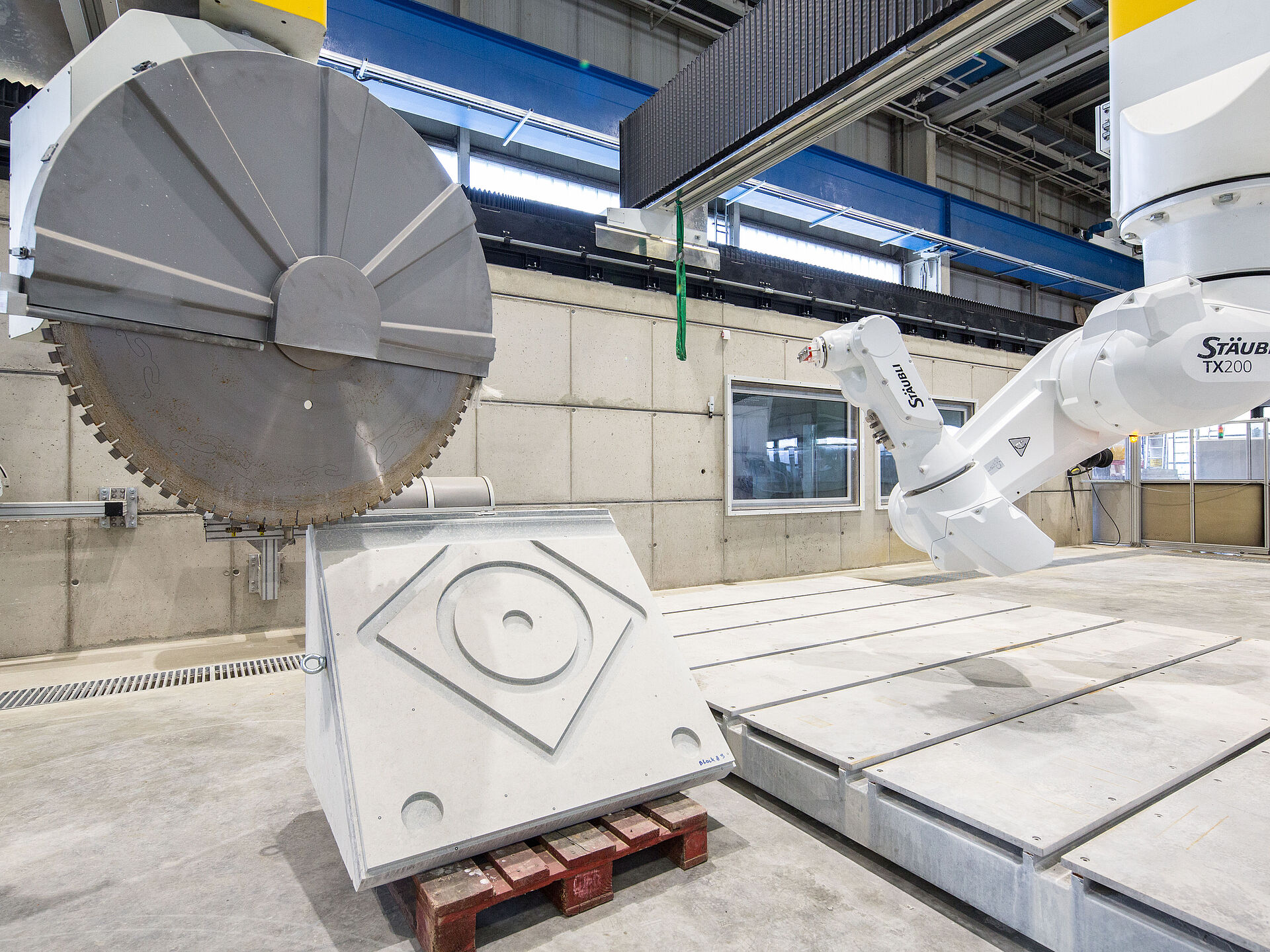
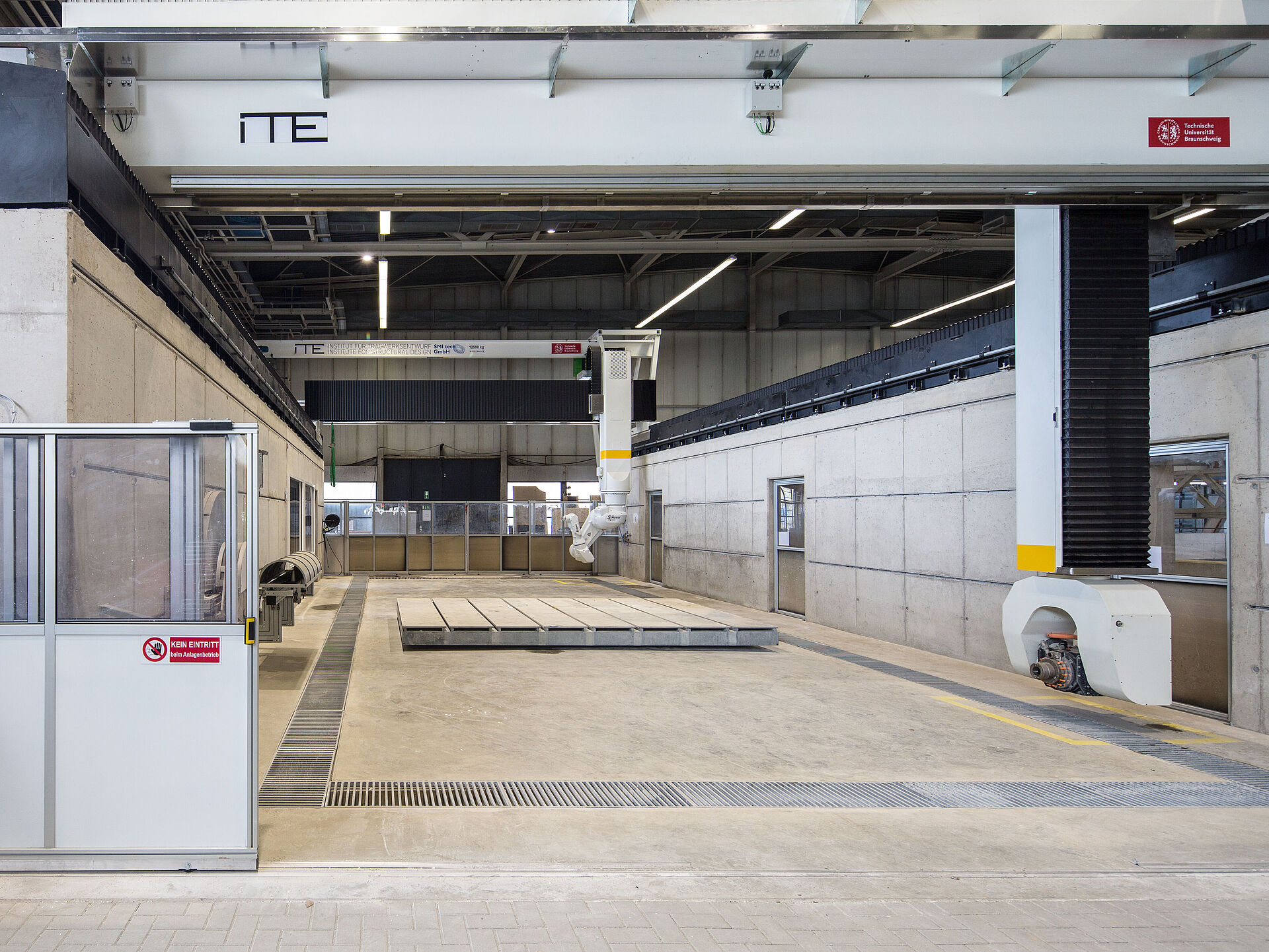
The DBFL laboratory is unique in its concept and implementation and forms the foundation for research in digital construction fabrication at the Institute of Structural Design (ITE) and the Technical University of Braunschweig. Its goal is to combine advanced material technologies with innovative structural design concepts through robot-controlled production processes, enabling the development of resource-efficient load-bearing structures for the construction industry.
The facility is used by multiple research groups and institutes, with project work conducted primarily in an interdisciplinary setting across civil engineering, mechanical engineering, and computer science. Its primary focus is on fundamental research. Ongoing research topics include shotcrete 3D printing, jointing principles for additive manufacturing processes, and robotic rammed earth. By increasing manufacturing complexity and transferring highly optimized production methods from the automotive and aerospace industries, the DBFL aims to significantly improve material and energy efficiency in construction.
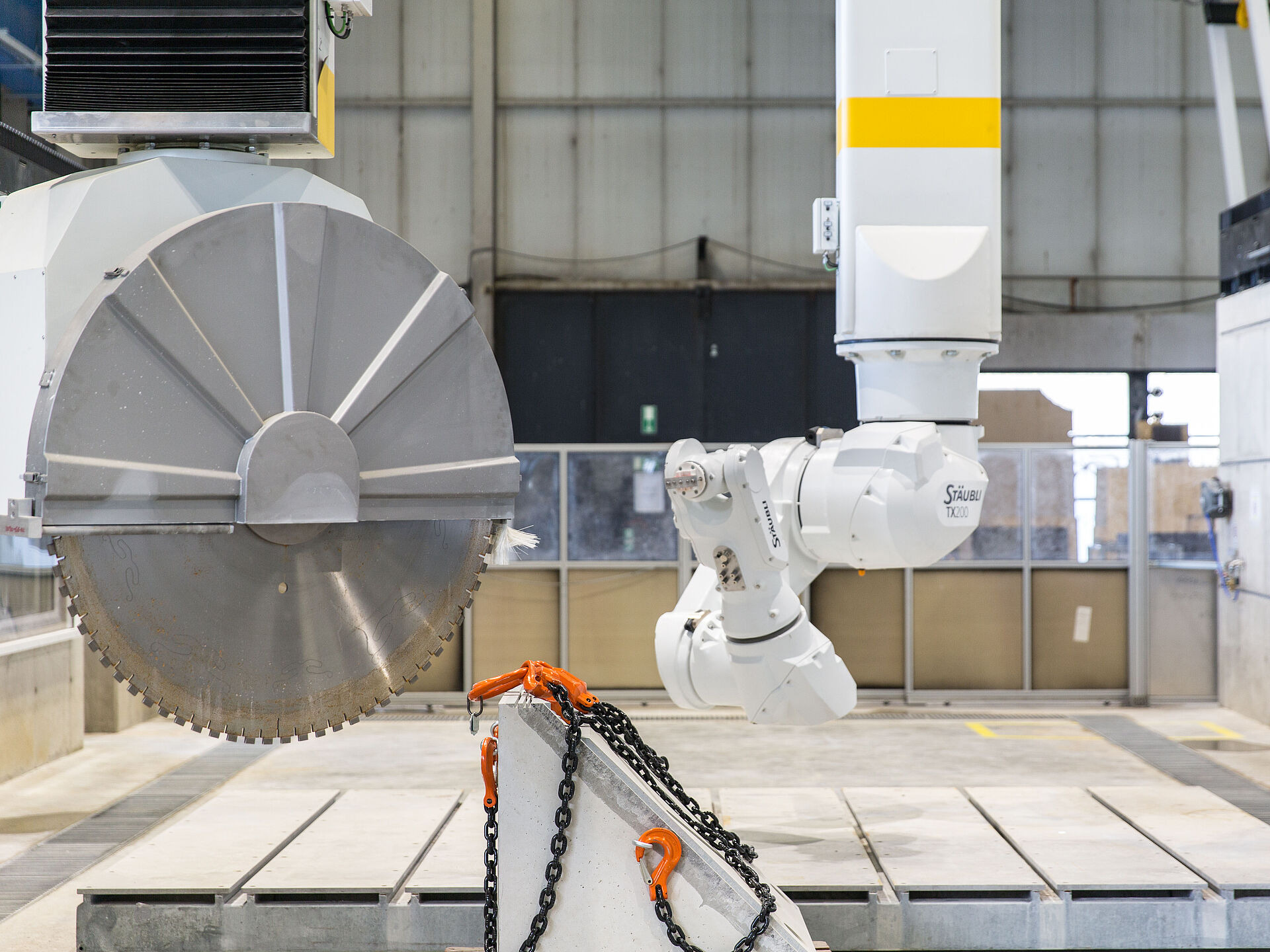
The DBFL combines the high stiffness and precision of conventional machining centers with the flexibility of robotic systems. It supports additive manufacturing (e.g., concrete spraying), subtractive processing of high-strength materials, optical surface inspection, and dynamic handling processes such as pick-and-place. Multiple freely orientable tool heads enable synchronized or closely sequenced cooperative manufacturing under harsh environmental conditions with sensor-based monitoring. A large workspace allows the production of full-scale architectural components.
Designed for fast process cycles, low maintenance, and rapid reconfiguration, the DBFL enables diverse experiments within a single workspace. Modular tools and standardized interfaces ensure flexibility, making the laboratory uniquely adaptable for current and future research.