
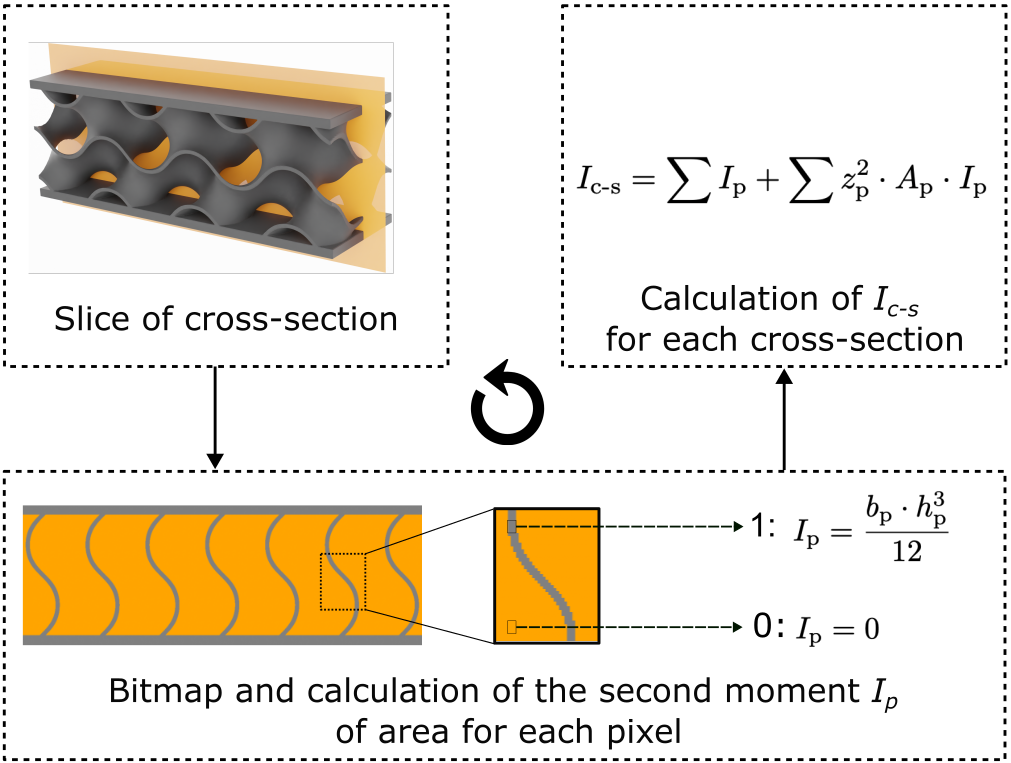
TPMS structures (triply periodic minimal surfaces) can be used as the core of sandwich panels. They offer several functions at once, have nearly direction-independent mechanical properties, and, because of their channel-like geometry, can also allow media transport. A new approach for making aviation more sustainable and energy-efficient uses such sandwich structures as suction panels to maintain laminar flow over aircraft wings. Since these panels are usually exposed to wing bending during operation, assessing their feasibility requires a method for numerically estimating the bending behavior of TPMS-based sandwich panels. In this study, a new bitmap-based numerical method is used to calculate the flexural properties from the second moment of area, together with two common theoretical approaches. To validate these approaches, the calculated values are compared with experimentally determined flexural properties obtained from four-point bending tests on additively manufactured TPMS-based sandwich panels. The results show very good agreement: the bitmap-based method predicts the flexural properties with high accuracy and performs better than the two conventional approaches at high relative densities. Because the validation was successful, the bitmap-based method can now be used to numerically estimate the flexural properties of sandwich panels with arbitrary structures directly from their geometry, without the need for prior experiments or complex simulations.
Jann Schöneich, Jan Kube, Hendrik Traub, Christian Hühne
Numerical approximation of the flexural properties for additively manufactured sandwich panels with a sheet-based TPMS core
Results in Engineering, Volume 30, June 2026, https://doi.org/10.1016/j.rineng.2026.110717