
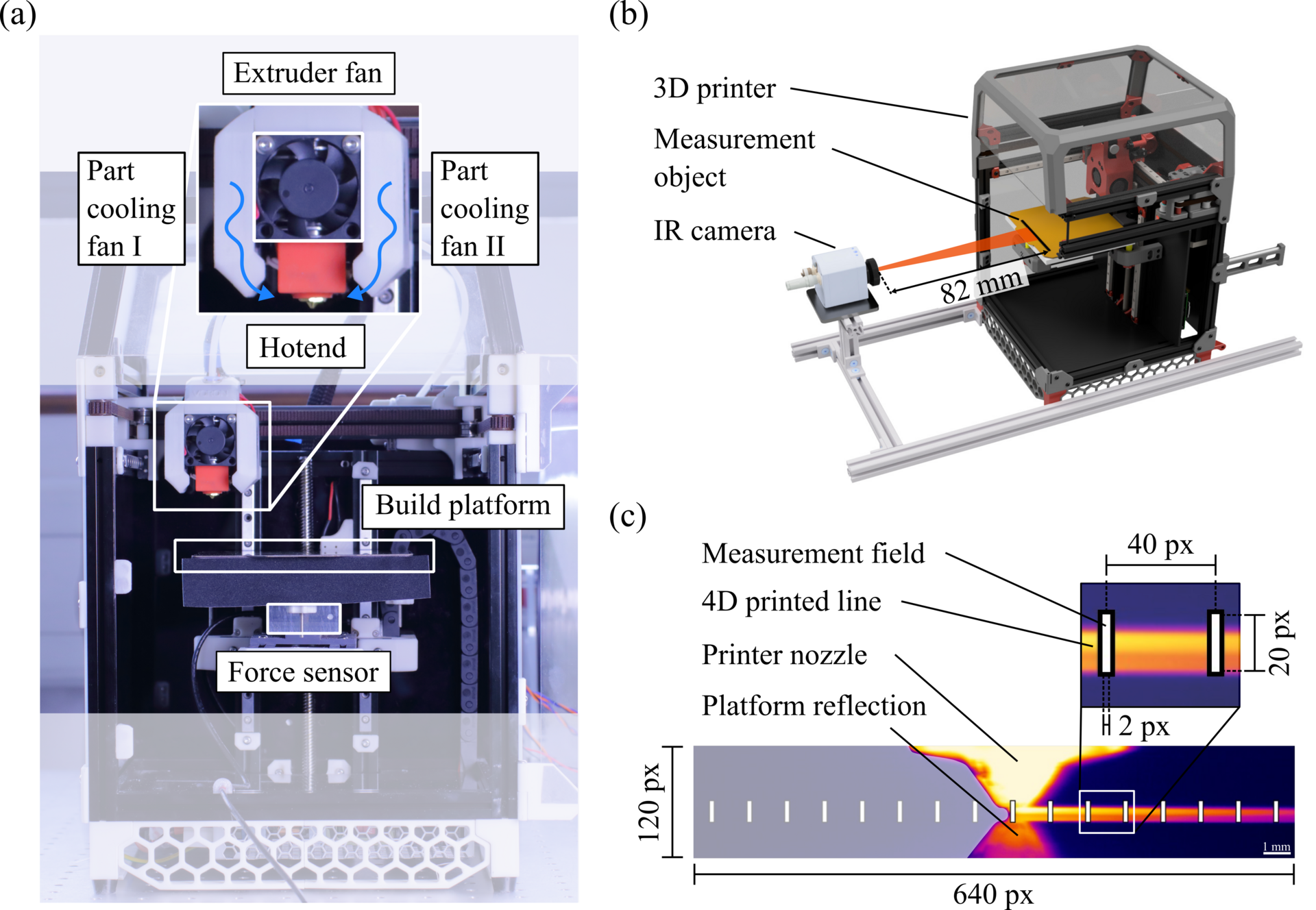
The thermal history during fused deposition modeling (FDM)-based 4D printing influences the formation of pre-strain and the resulting shape change of thermoplastic structures. Our recent study provides new insights into the mechanisms that govern shrinkage and bending after thermal activation.
By systematically varying nozzle temperature, printing speed, part cooling, and build plate temperature, the researchers showed that the lower layers retain higher pre-strain than the upper layers due to differences in thermal relaxation. Reducing the nozzle temperature by 30 °C increased shrinkage by 8–10% and curvature by 25–30%, while activating the part cooling fan increased shrinkage by 1–2% and reduced curvature by 2–5%.
These findings demonstrate that thermal history is a key factor in programming shape change in FDM-based 4D printing. The results provide valuable guidelines for controlling the behavior of smart structures through process optimization and support the development of more reliable and predictable 4D-printed components.
P. Herder, F. Cerbe, M. Sinapius, C. Hühne
Experimental investigation of the thermal history in FDM-based 4D printing
Smart Materials and Structures, 35, 065039, (2026) [Link]