
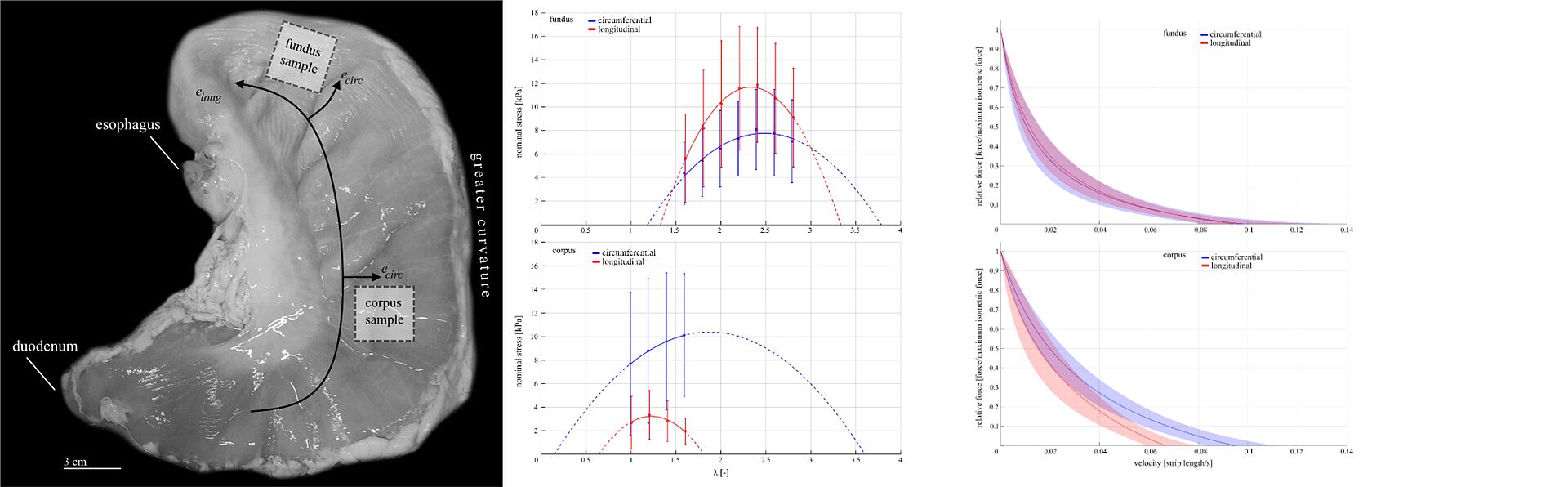
The stomach is a hollow organ within the gastrointestinal tract that plays a central role in the breakdown of ingested food. Its secretion of gastric acid facilitates chemical digestion, while the contraction of its smooth muscle aids in mechanical digestion. The upper, cranial part of the stomach acts as a reservoir for ingested food, while the lower, caudal part grinds the food through peristaltic contractions. Understanding the mechanical properties of the stomach is critical to gaining insight into its function and the overall digestive process. In this study, we performed equibiaxial tensile tests on porcine stomach tissue samples (n = 28) from the fundus, representing the cranial area, and the corpus, representing the central area. We analyzed the passive and active stress-stretch relationship as well as the force-velocity relationship. The main findings of our experiments are: (1) fundus samples show more isotropic mechanical properties, i.e., similar stress-stretch and force-velocity relationships in both directions (longitudinal vs. circumferential), (2) corpus samples show more anisotropic mechanical properties, i.e., there are direction-dependent differences in optimal stretch, maximal stress and the maximal shortening velocity, and (3) the corpus is much stiffer than the fundus. This study is the first to use biaxial tensile experiments to determine the active stress-stretch relationship in stomach smooth muscle and the first to characterize the biaxial force-velocity relationship in smooth muscle in general. The data provided advance our understanding of both smooth muscle and organ-level mechanics and provide more comprehensive insights than existing uniaxial tests in the literature. These findings are critical for the development and validation of constitutive muscle models that can predict stomach function in health and disease.
M. Borsdorf, S. Papenkort, M. Böl. T. Siebert
Biaxial determination of active and passive mechanical properties of porcine stomach smooth muscle tissue
Journal of the Mechanical Behavior of Biomedical Materials, 181, 107512, (2026) [Link]