
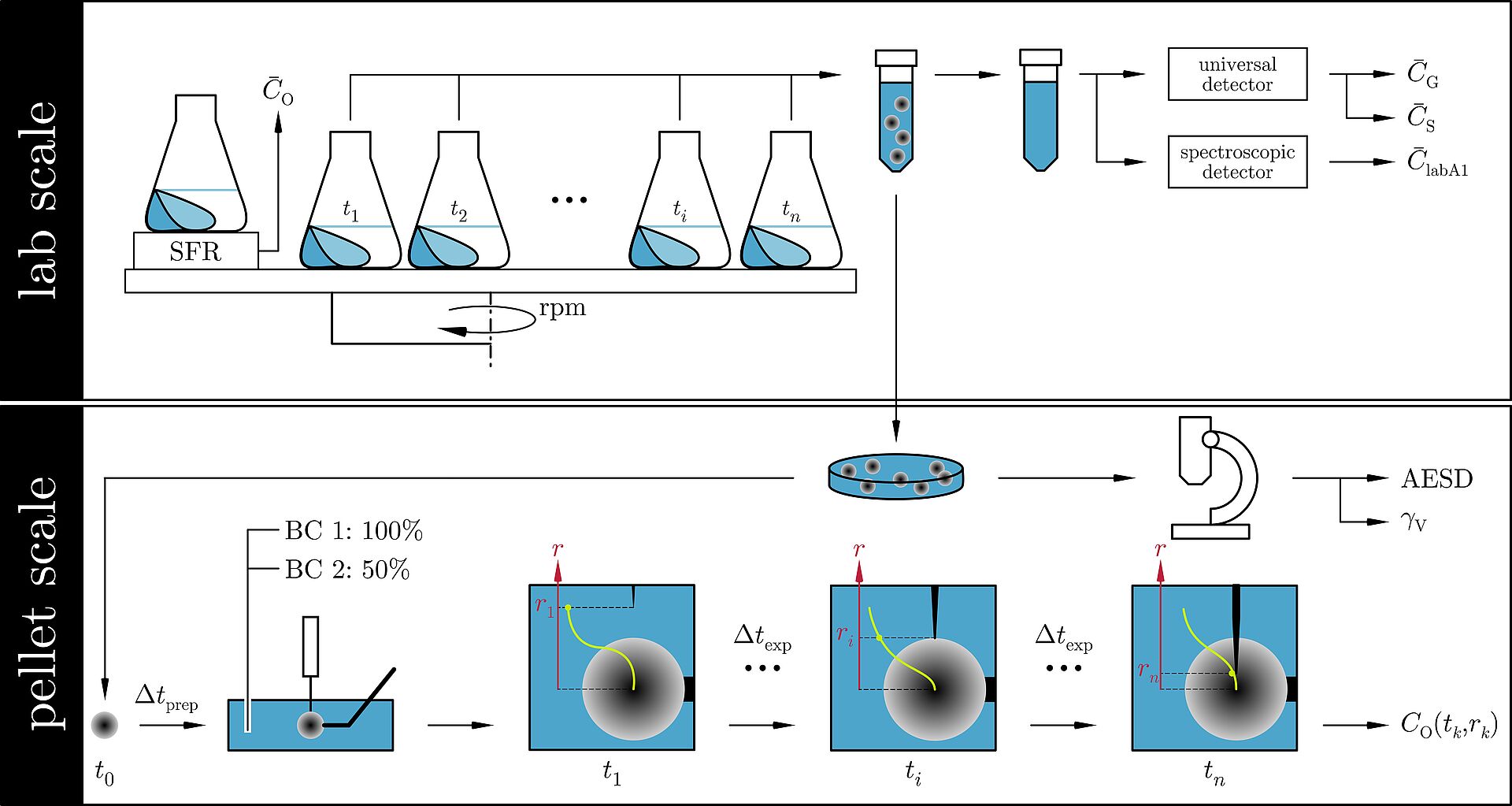
The filamentous actinomycete Actinomadura namibiensis has attracted increasing interest as the only known natural producer of the carbocyclic lantibiotic labyrinth\-opeptin A1, a secondary metabolite with a broad antiviral spectrum of activity. Developing a model of microbial growth and product formation at the pellet level requires a deeper mechanistic understanding of the interactions between cultivation conditions, substrate availability, and oxygen limitation. These factors influence the cultivation process and product formation. As part of this work, a predictive model in the form of diffusion-reaction equations is developed to quantitatively describe nutrient uptake, oxygen diffusion limitation, and pellet growth. This framework couples the consumption kinetics of carbon sources, such as glucose and glycerol, to pellet growth, maintenance metabolism, and the formation of the secondary metabolite labyrinthopeptin A1. The model is calibrated based on the results of multiscale experiments, i.e., offline analysis of shake flask cultures and oxygen profiling of pellets at different time points under various conditions. This forms the basis for understanding nutrient uptake, metabolic heterogeneity, and mass transfer limitations within the pellets. Thus, the model provides a quantitative basis for predicting productivity. The validated multiscale model reproduces the experimental results well and can be used to predict pellet growth, substrate uptake, and product formation.
Q. Liu, Z. J. Kozanecka, J. Liu, K. Dohnt, R. Krull, M. Böl
Filamentous multiscale characterization of the cultivation of Actinomadura namibiensis pellets for model-based prediction of labyrinthopeptin A1 biosynthesis
Microbial Cell Factories, 25, 167, (2026) [Link]