
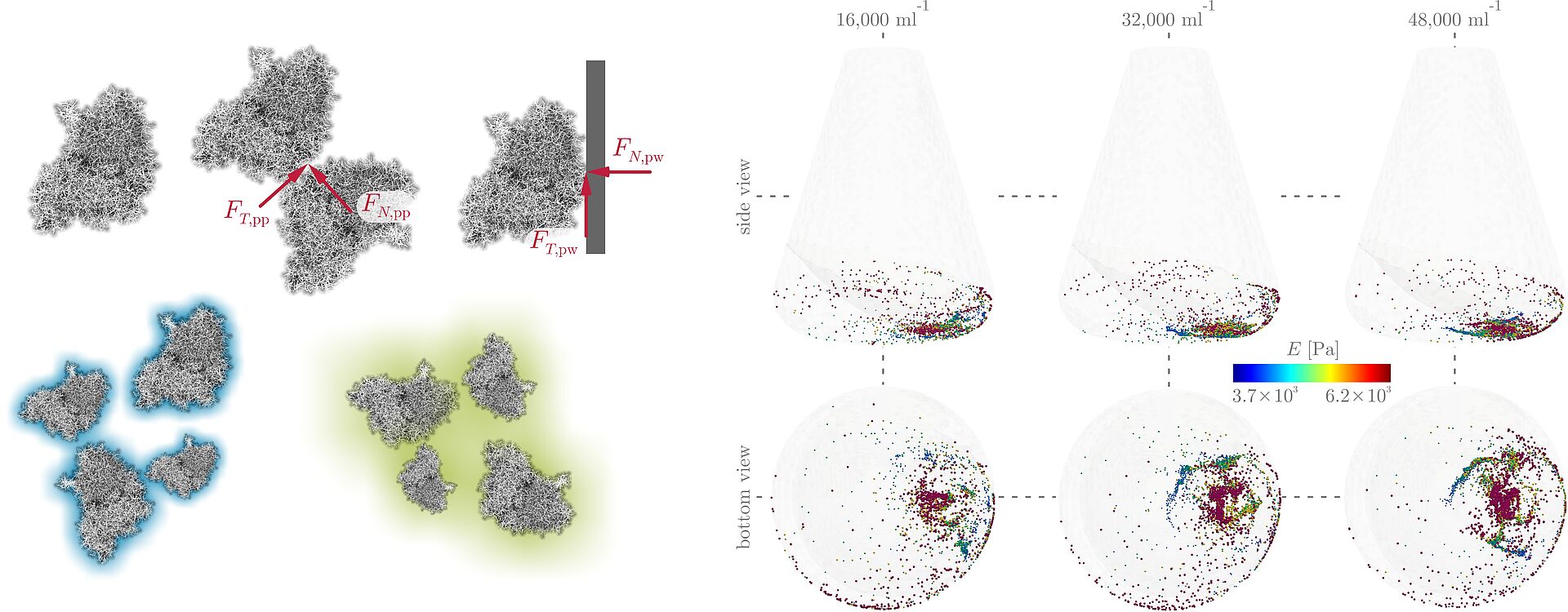
Mechanical interactions in shaken culture systems have been shown to actively drive the morphological restructuring of filamentous microbial pellets. This, in turn, has been demonstrated to influence thereby influencing productivity, including enzyme formation and the final concentration of secondary metabolites. The present study proposes a novel hybrid CFD-DEM-VOF framework for quantifying interactions between pellets with specific mechanical properties within populations. The framework assigns unique stiffnesses, densities and sizes to each pellet, computing the contact forces between the pellets themselves as well as between the pellets and the shake flask walls. The primary function of the approach is to calculate the corresponding contact frequencies within an evolving hydrodynamic field. Using mechanical measurements obtained for the filamentous actinomycete A. namibiensis at culture days D1, D3 and D8, the simulations reflect the measured evolution of the pellet population and quantify the associated changes in collision dynamics, kinetic energy levels and contact forces. The results reveal a distinct shift from highly dynamic, collision-intensive behaviour in the early stage of cultivation, to reduced pellet mobility and altered collision statistics in mature cultures. Subsequent analysis of the conditions on cultivation day D8 demonstrates how the shaking intensity and pellet mechanical properties modulate this mechanical landscape beyond changes arising from natural culture development. The framework provides a mechanistic basis for linking operating conditions to pellet restructuring and serves as a predictive tool for guiding the design and improvement of filamentous bioprocesses.
M. R. Kardooni, J. Liu, Z. J. Kozanecka, K. Dohnt, R. Krull, M. Böl
A hybrid CFD-DEM-VOF framework for multi-material modelling of population-heterogeneous filamentous microorganism pellets in shake flask cultures
Biochemical Engineering Journal, 235, 110323, (2026) [Link]