
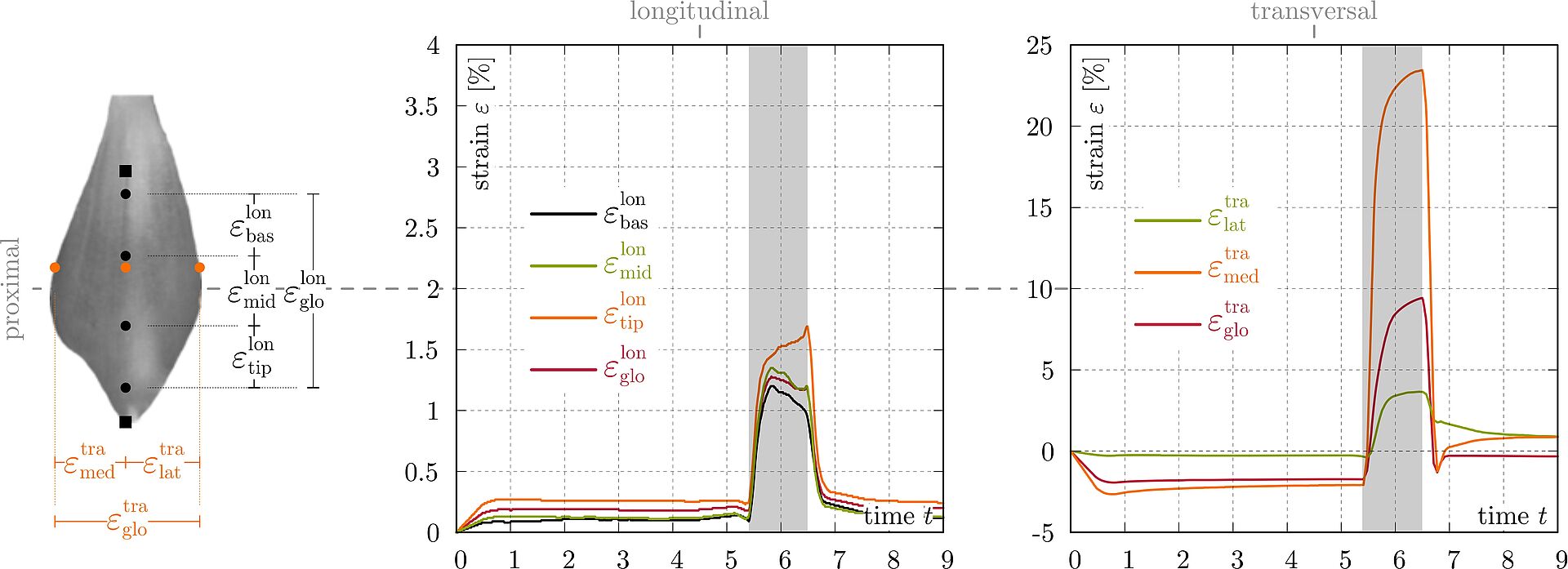
Aponeuroses are thin, tendinous sheets that connect muscle bellies to tendons, playing a central role in force transmission. In order to improve the understanding of these mechanics, the present study examined the deformation of rabbit aponeuroses during passive muscle elongation and isometric and isotonic contractions against increasing forces. The strains of the aponeurosis from 99 isometric and isotonic muscle contractions were analysed in the rabbit gastrocnemius medialis (GASM) and plantaris (PLA) muscles, which have unipennate and multipennate fascicle architectures, respectively. Three-dimensional digital image correlation was employed to quantify aponeurosis strain between defined points along longitudinal and transverse paths on digitised muscle surfaces. Passive muscle elongation was characterised by longitudinal elongation and transverse narrowing, whereas muscle contraction generally resulted in longitudinal and transverse expansion of the aponeuroses. During isometric contraction, longitudinal strain ranged from 1% to 2%, whereas transverse strain averaged between 0% and 15%, depending on the muscle examined. Ultimately, active deformation exhibited a linear relationship between longitudinal aponeurosis strain and muscle force. The relative contributions of longitudinal and transverse deformation during passive and active states were muscle-specific. Together, these findings provide new insight on the shape change of aponeuroses and their interactions with the muscle tissue, while also providing indirect information on deformation patterns associated with force generation and transmission in pennate muscles.
F. Walter, K. Leichsenring, T. Siebert, M. Böl
Aponeurosis shape change as an indicator for the force transmission mechanics in pennate muscles - a pilot study
Journal of the Mechanical Behavior of Biomedical Materials, 181, 107514, (2026) [Link]