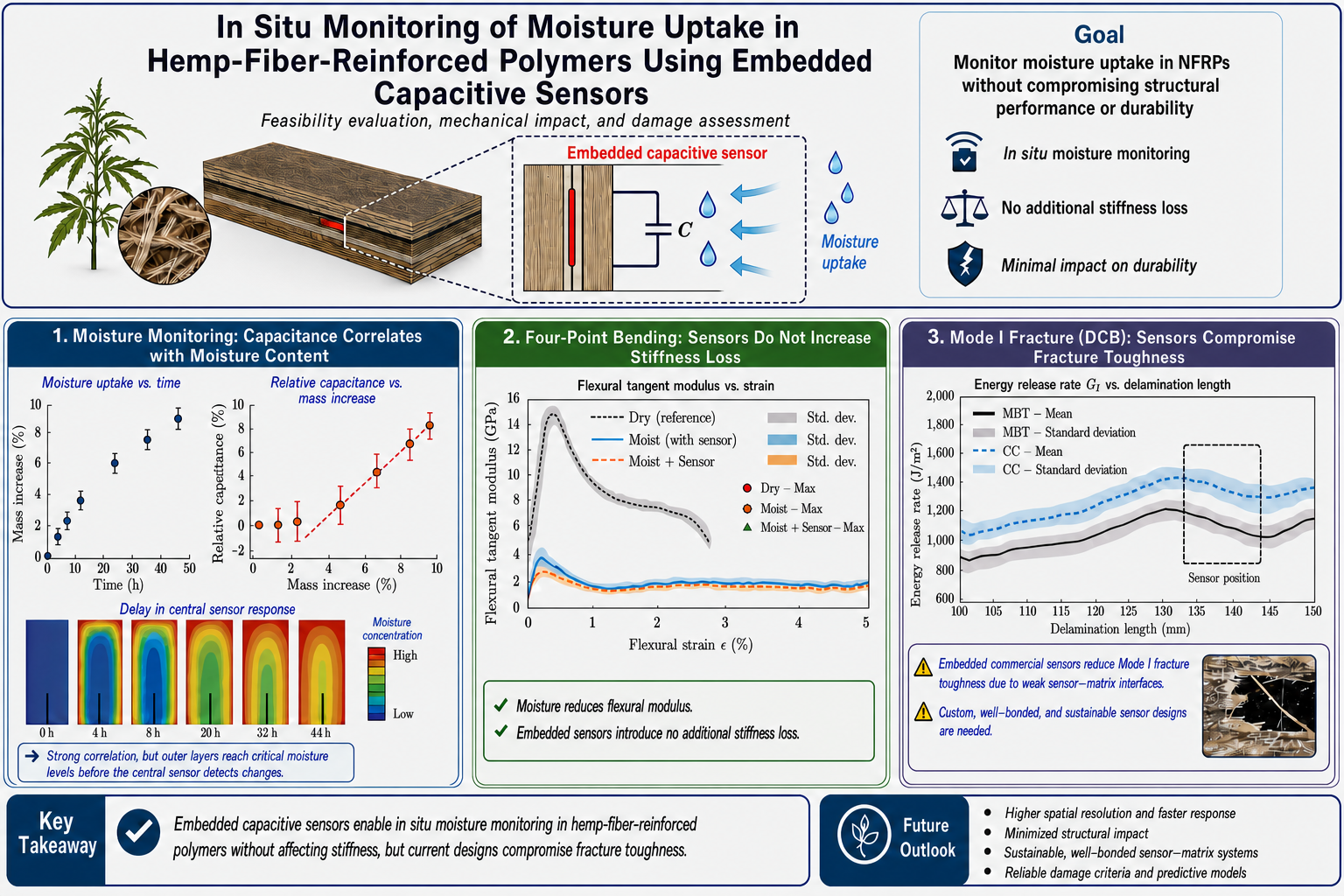
Natural fiber reinforced polymers (NFRPs) offer high specific strength and sustainability, making them promising for structural applications. However, moisture uptake alters the NFRP’s mechanical properties and threatens its durability through irreversible damage, including microcracks and fiber-matrix debonding. To ensure stable mechanical properties over the product lifecycle, this study evaluates the feasibility of monitoring moisture uptake in hemp-fiber-reinforced polymers without weakening the host structure using embedded capacitive sensors. Moisture uptake tests yield a strong correlation between sensor capacitance and laminate moisture content, though a significant delay occurs between moisture uptake and the response of centrally embedded sensors. A 3D diffusion analysis confirms that outer laminate layers reach critical moisture levels before the central sensor detects changes. Four-point bending tests reveal that moisture uptake reduces the flexural modulus, whereas the embedded sensors introduce no additional stiffness loss. However, double-cantilever-beam (DCB) tests indicate that commercial sensors compromise Mode I fracture toughness due to weak sensor-matrix interfaces. These findings demonstrate the feasibility of in situ moisture monitoring but highlight the need for improved sensor designs. Future work should prioritize higher spatial resolution, minimized structural impact, and sustainable sensor-matrix materials to enable reliable damage criteria and predictive models for moisture monitoring in NFRPs.
Osten, Alexander, Julian Steinmetz, Samir Charif, and Oliver Völkerink.
Moisture Monitoring in Hemp Fiber Reinforced Polymers with Embedded Capacitive Sensors: Performance and Structural Implications
Journal of Natural Fibers 23, no. 1 (2026): 21. [Link]