
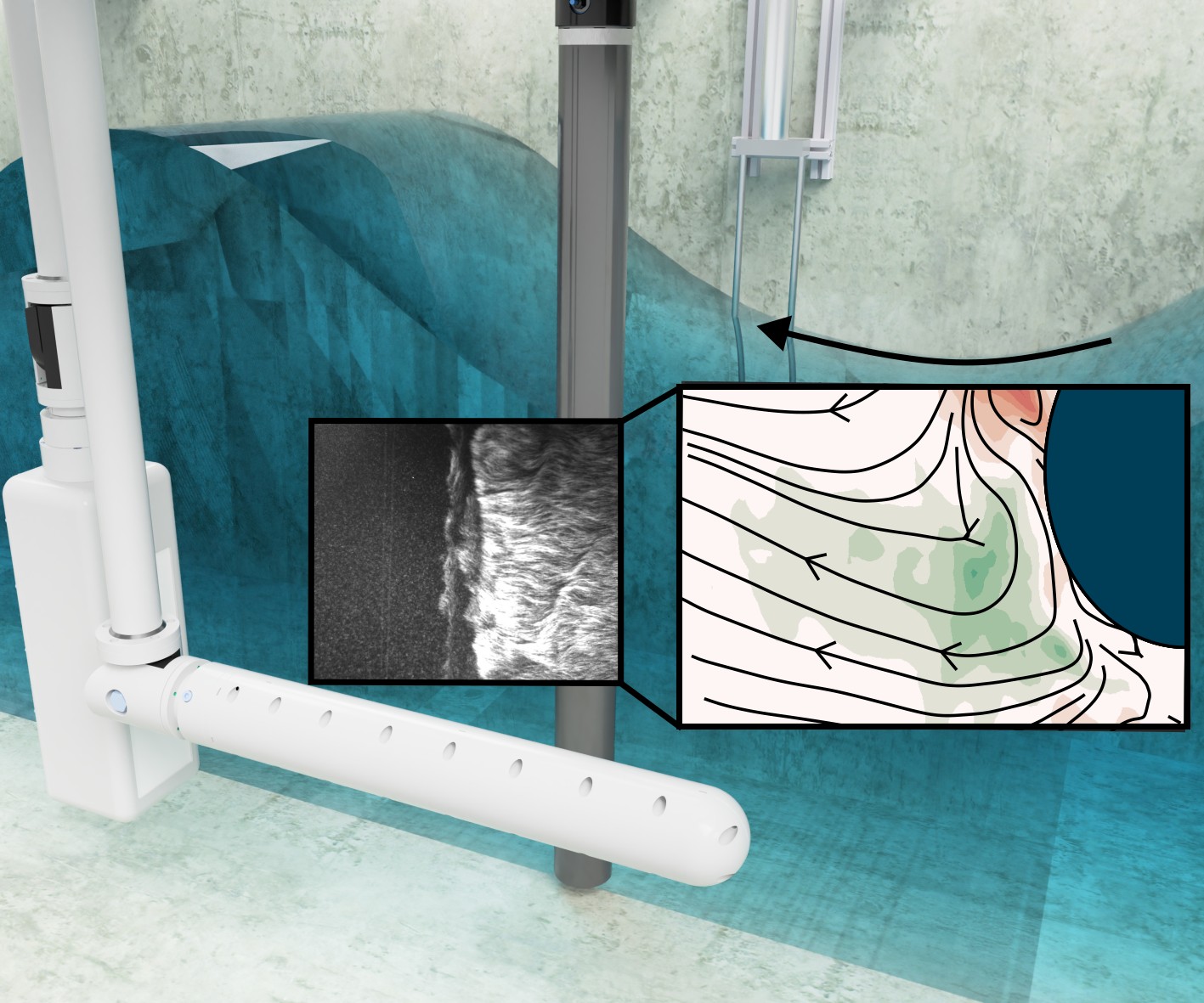
The rapid growth of offshore wind energy, motivated by the demand for sustainable energy solutions and the aim of achieving greenhouse gas neutrality, has led to increased attention to the impact of marine biofouling on substructures such as monopiles and jacket structures. Although the effects of hard biofouling have been studied, soft biofouling remains underexplored. This study investigates flow dynamics and vorticity patterns around eight cylindrical structures subjected to wave loading, with hard and soft biofouling surrogates. Soft biofouling is further divided into stiff and flexible models. Physical experiments are conducted with slender piles in a mid-scale wave flume. Volumetric flow velocities are measured using Particle-Tracking Velocimetry with the Shake-the-Box method. Results show that biofouling alters flow patterns, creating recirculation zones with reverse flow velocities. Vorticity analysis reveals vortex formation in the wake, expanding with wave period and roughness. For the same fibre lengths, flexible biofouling models allow high levels of vorticity to spread further downstream (up to 133%), while stiff models create distinctive recirculation zones with a 18% larger recirculation length. These findings improve understanding of wave-induced wake development for rough surfaces.
C. Krautwald, C. Schweiger, J. Liu, C. Windt, D. Schürenkamp, M. Böl, N. Goseberg
Wave-induced wake dynamics of cylinders with surrogates of marine biofouling
Coastal Engineering, 295, 104939 (2026) [Link]