
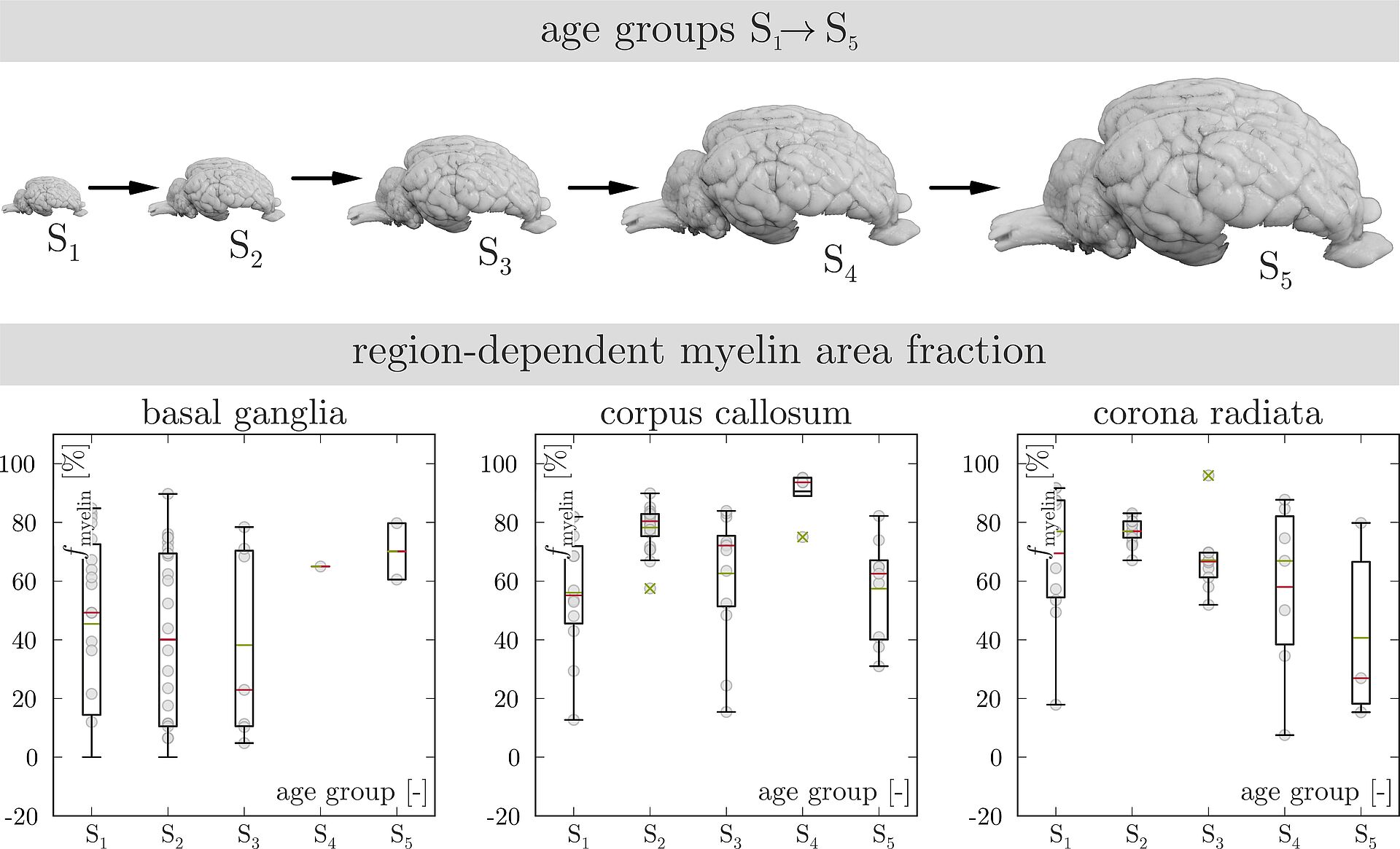
Accurate knowledge of brain tissue mechanics is essential for understanding the pathologies that cause mechanical changes and for developing reliable computer models for neurosurgical procedures. However, the age-related changes in brain mechanics and their microstructural basis are not fully understood. In this study, we examined age-related changes in brain mechanics and microstructure in porcine tissue across five age groups, from early development to young adulthood. Mechanical tests in tension and compression were performed in different anatomical regions, including an anisotropic characterization of the corpus callosum. We used Bayesian parameter identification to estimate material parameters based on isotropic, hyperelastic Ogden and anisotropic, hyperelastic Gasser-Ogden-Holzapfel models under the assumption of large deformations with finite strains. Histological analyses additionally quantified myelin, cell, glia, and neuron measures. Our results revealed nonlinear age dependencies of tensile and compressive mechanics accompanied by clear age-dependent microstructural differences. Notably, myelin- and glia-related measures were the most consistent positive correlates of stiffness. Further, mediation analysis suggested that microstructure, particularly glia-related features, may serve as a measurable intermediate link between age and mechanics. These findings provide a microstructurally informed basis for more realistic, age-dependent computational brain models.
M. Hoppstädter, K. Linka, M. Schmicke, E. Kuhl, M. Böl
Age-dependent brain mechanics are linked to microstructural changes
Acta Biomaterialia, 225, 595-616, (2026) [Link]