

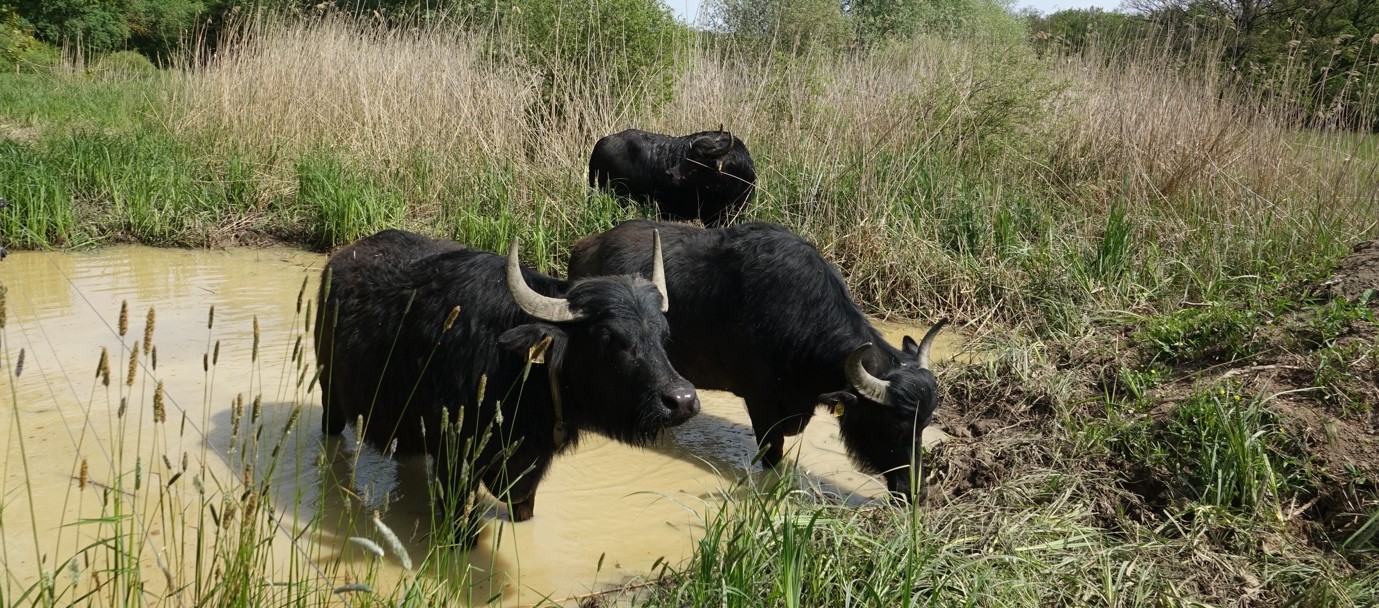
Small waterbodies such as ponds contribute very strongly to the biodiversity of landscapes, as they can accommodate very different communities depending on their age, size and condition. Ponds are normally subject to a fairly rapid succession of their vegetation, i.e. they change their state from open to heavily vegetated water areas within a few years, especially if there is a significant eutrophication of the landscape.
The dragonfly communities of ponds change with succession. Some species prefer open ponds, others prefer those with denser, species-rich vegetation and few are found in heavily vegetated waters. It has long been known that it is advantageous to have as many succession stages as possible next to each other in a pond area in order to achieve a high species richness of dragonflies and other organisms (Wildermuth & Schiess 1983. Odonatologica, 12, 345–366). However, the necessary management measures (e.g. regular evictions) are laborious and costly.
We have been investigating for several years whether grazing by large herbivores has similar positive effects on the dragonfly communities of a pond landscape. The landscape was grazed by water buffalo in 2023 and 2024, and by Scottish Highland cattle in 2025 and 2026. In addition, further ponds were newly created. We record the dragonfly larvae at all ponds in order to be able to determine the composition of the autochthonous community over time. We also have a database available that describes the change in dragonfly fauna (based mainly on data on imagines) back to the 1990s, providing data on background chnages,e.g. due to climate change. First results after four years of observation imply that the buffalo in low density (approx. 1 LSU/ha) generate quite a few succession stages next to each other due to their intensive use of the ponds (eating the aquatic plants, wallowing). The highland cattle seem to be less effective. The investigations are to be continued, again with water buffalo from 2027.