

Technische Universität Braunschweig
  • Study & Teaching
    • Beginning your Studies
      • Prospective Students
      • Degree Programmes
      • Application
      • Why TU Braunschweig?
    • During your Studies
      • Fresher's Hub
      • Term Dates
      • Courses and Qualifications
      • Practical information
      • Beratungsnavi
      • Financing and Costs
      • Special Circumstances
      • Health & Wellbeing
      • Campus life
    • At the End of your Studies
      • Career Service
      • Alumni
      • Discontinuation and Pre-Certification
      • After graduation
    • Strategies and Quality Management
      • TU Teaching Award
    • For Teaching Staff
      • Strategy, Offers and Information
      • Learning Management System Stud.IP
    • Contact
      • Study Service Centre
      • Academic Advice Service
      • Student Office
      • Department 16 - Academic and Student Affairs
      • Career Service
  • Research
    • Research Profile
      • Core Research Areas
      • Clusters of Excellence at TU Braunschweig
      • Research Projects
      • Research Centres
      • Professors‘ Research Profiles
    • Early Career Researchers
      • Support in the early stages of an academic career
      • PhD-Students
      • Postdocs
      • Junior research group leaders
      • Junior Professorship and Tenure-Track
      • Habilitation
      • Service Offers for Scientists
    • Research Data & Transparency
      • Transparency in Research
      • Research Data
      • Open Access Strategy
    • Research Funding
      • Research Funding Network
      • Research funding
    • Contact
      • Research Services
      • Academy for Graduates
  • Transfer
    • Transfer profile
      • Transfer strategy "TIES® with Impact"
      • Technology Transfer
      • Knowledge Transfer
      • Relationship Management
    • Innovation
      • Startups
      • Patents
    • Offers for schools and pupils
    • For enterprises
      • Friends & Supporters
    • For Alumni*ae
    • For everyone
  • International
    • International Students
      • Why Braunschweig?
      • Degree seeking students
      • Exchange Studies
      • TU Braunschweig Summer School
      • Students from German Schools Abroad
      • Refugees
      • International Student Support
      • International Career Service
    • Going Abroad
      • Studying abroad
      • Internships abroad
      • Teaching and research abroad
      • Working abroad
    • International Researchers
      • Welcome Support for International Researchers
      • Service for Host Institutes
    • Language and intercultural competence training
      • Learning German
      • Learning Foreign Languages
      • Intercultural Communication
    • International Profile
      • Internationalisation
      • International Cooperations
      • Strategic partnerships
      • International networks
    • International House
      • About us
      • Contact & Office Hours
      • News and Events
      • Newsletter, Podcast & Videos
      • Job Advertisements
  • TU Braunschweig
    • Our Profile
      • Aims & Values
      • Regulations and Guidelines
      • The University Development Initiative 2030
      • Ecoversity – the TU Braunschweig as a university ecosystem
      • Equal Opportunity
      • Diversity
      • Sustainability
      • Facts & Figures
      • Our History
    • Presidency & Organisation
      • Executive Board
      • Designated Offices
      • Administration
      • Facilities
      • Committees
      • Student body
    • Career
      • Working at TU Braunschweig
      • Vacancies
      • Information and Offers for New Employees
    • Faculties
      • Carl-Friedrich-Gauß-Fakultät
      • Faculty of Life Sciences
      • Faculty of Architecture, Civil Engineering and Environmental Sciences
      • Faculty of Mechanical Engineering
      • Faculty of Electrical Engineering, Information Technology, Physics
      • Faculty of Humanities and Education
      • Institutes from A to Z
    • Events
  • Search
  • Quicklinks
    • People Search
    • Webmail
    • cloud.TU Braunschweig
    • Messenger
    • Cafeteria
    • TUconnect (student platform)
    • Emergency
    • Stud.IP
    • Library Catalogue
    • Research Information System
    • Information Portal (employees)
    • Link Collection
    • DE
    • EN
    • Instagram
    • YouTube
    • LinkedIn
    • Mastodon
    • Bluesky
Menu
  • TU Braunschweig
  • Faculties
  • Faculty of Architecture, Civil Engineering and Environmental Sciences
  • Institutes
  • Institute of Geoecology
  • Working Groups
  • Landscape Ecology and Environmental Systems Analysis
  • Research
  • Projects
Logo Institut für Geoökologie der TU Braunschweig
Jena Experiment
  • Projects
    • LegacyNet
    • CitySoundscapes
    • AIforIBM
    • Jena Experiment
    • agri:change
    • Changing Interactions
    • Future Urban Coastlines
    • Prokaryotes
    • TideelbeKlima
    • Urban Streams

Jena Experiment

Projekt Jena Experiment

Jena Experiment – Subproject Consumers and Functions (SP10)

Why diversity?

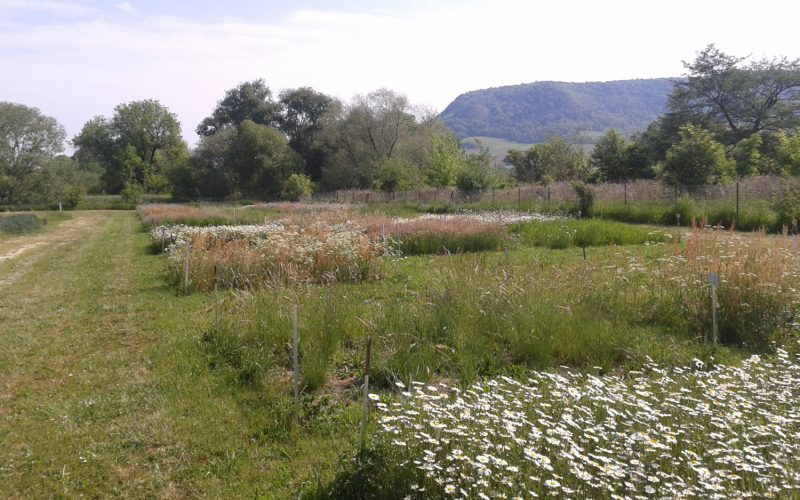
Meadows can consist of a few or of very many plant species. Does that make a difference to how an ecosystem functions? This question is at the heart of the Jena Experiment, one of the largest and longest-running biodiversity experiments in the world. Since 2002, meadows deliberately sown with 1 to 60 plant species have been growing on around 80 experimental plots in the floodplain of the river Saale near Jena. Because the plots differ only in their number of species, we can measure directly what diversity does. The result after more than twenty years: species-rich meadows produce more biomass, store more carbon and are home to more animals.

Our subproject: insects and what they do

Thousands of invertebrates live in a meadow. Some feed on plants, such as grasshoppers, leafhoppers and aphids. Others feed on these plant eaters, such as spiders and ground beetles. Feeding on plants (herbivory) and preying on other animals (predation) are key processes in an ecosystem: they determine how much plant material remains and whether individual species multiply en masse.

Our previous work shows that more plant species also mean more animal species and more herbivory and predation. It also shows, however, that insect communities fluctuate strongly from year to year and within a year. In the current subproject we therefore ask:

  • What causes these fluctuations?

  • Does plant diversity act as a buffer, so that insect communities and their functions remain more stable in species-rich meadows, especially in dry years?

In view of climate change, this is of practical importance: if diversity stabilises, species-rich meadows are better protected against extreme years.

How we work

We combine two approaches. In the field, we record insects and spiders and measure herbivory and predation on the experimental plots. Together with data from earlier years, this yields time series spanning more than 15 years, which we analyse statistically.

In the greenhouse, we test the mechanisms under controlled conditions. In the HerbiCoMic experiment, a trial with around 900 pots, we study the interplay of drought stress, plant diversity and herbivores. We expose small plant communities with different numbers of species in their pots to above- and below-ground plant eaters (caterpillars and beetle grubs) and to drought, and measure how much of the plants is eaten and how they grow. We also study the survival and growth of the herbivores.

Key facts

Lead: Sebastian T. Meyer together with Anne Ebeling (University of Jena) · Funding: DFG Research Unit The Jena Experiment (FOR 5000) · Duration: 2024–2028 · More: Subproject page


Photo credits on this page

For All Visitors

Vacancies of TU Braunschweig
Career Service' Job Exchange 
Merchandising

For Students

Term Dates
Courses
Degree Programmes
Information for Freshman
TUCard

Internal Tools

Glossary (GER-EN)
Change your Personal Data

Contact

Technische Universität Braunschweig
Universitätsplatz 2
38106 Braunschweig

P. O. Box: 38092 Braunschweig
GERMANY

Phone: +49 (0) 531 391-0

Getting here

© Technische Universität Braunschweig
Legal Notice Privacy Accessibility

TU Braunschweig uses the software Matomo for anonymised web analysis. The data serve to optimise the web offer.
You can find more information in our data protection declaration.