

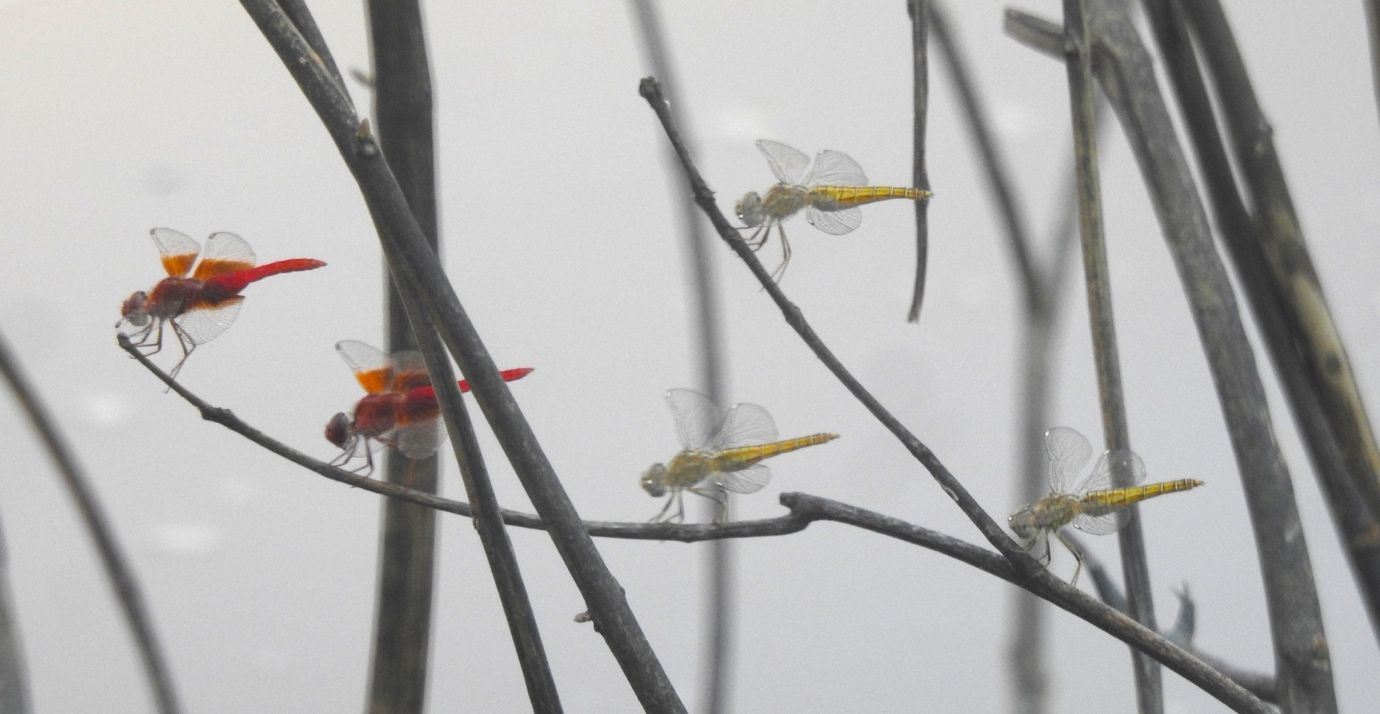
Since 2001, our research has focused on the biodiversity of dragonflies in Sub-Saharan Africa. We contribute to analyses of species diversity, habitat associations, and current threats (IUCN Red List) at the continental level and in select countries. Our work encompasses the compilation of species checklists, comprehensive overviews of species diversity, and taxonomic research. Furthermore, we have investigated the life cycles, species interactions, and behaviours of African dragonflies, particularly within the Namibian desert dragonfly assemblages. Moreover, we are interested in developing dragonfly-based indicator systems.
Patterns of spatial distribution and habitat suitability of Odonata in Nigeria
Nigeria's heterogeneous habitats support a rich diversity of dragonflies many of which have been overlooked over the decades. Some of them are remarkably connected to specific environments and can be used to tell a story of the historical dynamics of forest and community. Pentaphlebia gamblesi for example was described from Obudu Plateau in 1977 by M. J. Parr and has not been re-recorded from that region nor anywhere else on earth. Based on the variability of sensitivity and association of Nigerian dragonflies with their habitat, an index (known as the Dragonfly Biotic Index) can be harnessed to measure habitat quality. Work is on-going to answer three key questions viz: What dragonfly species are there in Nigeria? Where are they? Why are they there? With the collaboration of other colleagues, two new species of dragonflies are being described from Nigeria which highlights the importance of developing a strategic conservation intervention to protect the habitats of dragonflies in Nigeria.
Funding: DAAD grant to Ojonugwa Ekpah
Conservation and management of freshwater of Uganda’s ecosystems: Establishing Odonata-based biotic indices for assessment and monitoring of the ecological Integrity
Freshwater ecosystems in Uganda are under increasing pressure from human activities and climate-induced stressors, yet tools for their ecological assessment are limited. This project aims to develop Odonata-based biotic indices for evaluating and monitoring the ecological integrity of Uganda’s freshwaters. By linking Odonata assemblages to water quality, habitat structure and anthropogenic disturbances, we seek to establish a reliable, low-cost biomonitoring tool to support conservation and sustainable management of freshwater resources in Uganda.
Funding: DAAD grant to Vincent Levi Odongo
Biodiversity of Namibia’s dragonflies
Our research in Namibia encompassed a broad range of topics, including taxonomy, faunistic overviews, behavior, and ecology, with a particular emphasis on the life cycles of dragonflies. One of our primary objectives was to develop identification keys as a means of capacity building, particularly for future generations of Namibian researchers. As a result, we published a handbook of Namibian dragonflies, which included a key to the adults (Suhling & Martens 2007) and a key to the odonate larvae (Suhling, Müller & Martens 2014).
Our interest in Namibian dragonflies was initially sparked by the German Ministry of Science (BMBF) research project Biodiversity Transect Analysis in Africa (BIOTA) from 2001 to 2004. Additional support was provided by the International Union for Conservation of Nature (IUCN) in the context of the “Assessment of Odonata of southern Africa” and by the JRS Biodiversity Foundation project “A practical tool for evaluating freshwater health and biodiversity across Africa”.
Funding: DAAD grants · Duration 2025-2028 · Project management: Prof. Dr. Frank Suhling · Research Associates: Ojonugwa Ekpah, Vincent Odongo
Publications
Ekpah, O., & Suhling, F. (2025). Occurrence and distribution of Odonata (Insect: dragonflies and damselflies) in Nigeria. International Journal of Odonatology, 28, 146–158. doi.org/10.48156/1388.2025.1917346
Müller, O., Kohl, S., Suhling, F., Wildermuth, H., & Abbott, J. (2021). Description of last instar larvae of Ceratogomphus triceraticus Balinsky, 1963 and C. pictus Hagen in Selys, 1854 (Odonata: Gomphidae). International Journal of Odonatology, 24, 247–260. doi.org/10.23797/2159-6719_24_19
Khelifa, R., Deacon, C., Mahdjoub, H., Suhling, F., Simaika, J. P., & Samways, M. J. (2021). Dragonfly Conservation in the Increasingly Stressed African Mediterranean-Type Ecosystems. Frontiers in Environmental Science, 9. doi.org/10.3389/fenvs.2021.660163
Vorster, C., Samways, M. J., Simaika, J. P., Kipping, J., Clausnitzer, V., Suhling, F., & Dijkstra, K. D. B. (2020). Development of a new continental-scale index for freshwater assessment based on dragonfly assemblages. Ecological Indicators, 109. doi.org/10.1016/j.ecolind.2019.105819
Suhling, F., Martens, A., & Suhling, I. (2017). Long-distance dispersal in Odonata: Examples from arid Namibia. Austral Ecology, 42(5), 544–552. doi.org/10.1111/aec.12472
Suhling, F., & Martens, A. (2014). Distribution maps and checklist of Namibia Odonata Libellula Supplement, 13, 107–175.
Suhling, F., Müller, O., & Martens, A. (2014). The dragonfly larvae of Namibia. Libellula Supplement, 13, 5–106.
Simaika, J. P., Samways, M. J., Kipping, J., Suhling, F., Dijkstra, K.-D. B., Clausnitzer, V., Boudot, J.-P., & Domisch, S. (2013). Continental-scale conservation prioritization of African dragonflies. Biological Conservation, 157, 245–254. doi.org/10.1016/j.biocon.2012.08.039
Clausnitzer, V., Dijkstra, K.-D. B., Koch, R., Boudot, J.-P., Darwall, W. R. T., Kipping, J., Samraoui, B., Samways, M. J., Simaika, J. P., & Suhling, F. (2012). Focus on African freshwaters: hotspots of dragonfly diversity and conservation concern. Frontiers in Ecology and the Environment, 10(3), 129–134. doi.org/10.1890/110247
Kipping J., A. Martens & F. Suhling (2012). Africa's smallest damselfly – a new Agriocnemis from Namibia (Odonata: Coenagrionidae). Organisms Diversity & Evolution 12: 301-306
Martens A., A. Günther & F. Suhling (2012). Diversity in mate-guarding types within the genus Anax (Odonata: Aeshnidae). Libellula Supplement 12: 113-122
Braune E., A. Martens, O. Richter, D. Söndgerath & F. Suhling (2010). A spatially explicit model for interacting populations of dragonflies in arid Namibia. In: Schmiedel U. & N. Jürgens (eds) Biodiversity in southern Africa 2: Patterns and processes at regional scale, Klaus Hess Publishers, Göttingen & Windhoek
Martens A., O. Richter & F. Suhling (2010). The relevance of perennial springs for regional biodiversity and conservation. In: Schmiedel U. & N. Jürgens (eds) Biodiversity in southern Africa 2: Patterns and processes at regional scale, Klaus Hess Publishers, Göttingen & Windhoek
Suhling F. & E. Marais (2010). Crenigomphus kavangoensis sp. nov. from the Okavango River, Namibia (Odonata: Gomphidae) International Journal of Odonatology 13: 267-276
Suhling F., M.J. Samways, J.P. Simaika, Richter, E. Marais, A. Martens & J. Kipping (2010). Dragonfly diversity from the Cape to the Kavango In: Schmiedel U. & N. Jürgens (eds) Biodiversity in southern Africa 2: Patterns and processes at regional scale, Klaus Hess Publishers, Göttingen & Windhoek
Suhling F., A. Martens & E. Marais (2009). How to enter a desert – patterns of Odonata colonisation of arid Namibia. International Journal of Odonatology 12: 287-308
Suhling F., M.J. Samways, J.P. Simaika & J. Kipping (2009) .The status and distribution of dragonflies (Odonata). The status and distribution of freshwater biodiversity in southern Africa. IUCN Cambridge, UK and Gland, Switzerland
Suhling F. & A. Martens (2007). Dragonflies and damselflies of Namibia. Gamsberg Macmillan, Windhoek
Dijkstra K., F. Suhling & O. Müller (2006). Review of the genus Zygonoides, with description of the larvae and notes on ‘zygonychine' Libellulidae (Odonata). Tijdschrift voor Entomologie 149: 275
Koch K. (2006). Effects of male harassment on females’ oviposition behaviour in Libellulidae (Odonata) International Journal of Odonatology 9: 71-80
Suhling F., G. Sahlén, A. Martens, E. Marais & C. Schütte (2006). Dragonfly assemblages in arid tropical environments: a case study from western Namibia. Biodiversity and Conservation 15: 311-332
Koch K. & F. Suhling (2005) Do behavioural and life-history traits vary with mate-guarding intensity in libellulid odonates? Canadian Journal of Zoology 83: 1631-1637
Müller O., V. Clausnitzer, K. Grabow, G. Vick & F. Suhling (2005). Description of the final stadium larvae of African Gomphidia (Odonata: Gomphidae). International Journal of Odonatology 8: 233-241
Schenk K. & D. Söndgerath (2005). Influence of egg size differences within egg clutches on larval parameters in nine libellulid species (Odonata). Ecological Entomology 30: 456-463
Suhling F., G. Sahlén, J. Kasperski & D. Gaedecke (2005). Behavioural and life history traits in temporary and perennial waters: comparisons among three pairs of sibling dragonfly species. Oikos 108: 609-617
Braune E. (2004). Populationsdynamik in sich verändernden Landschaften: Ein räumlich explizites Modell für Libellen in Namibia. In: Dormann C., A. Lausch, T. Blaschke, D. Söndgerath & B. Schröder (eds) Habitatmodelle. Methodik, Anwendung, Nutzen, Umweltforschungszentrum Leipzig-Halle, Leipzig
Johansson F. & F. Suhling (2004). Behaviour and growth of dragonfly larvae along a permanent to temporary water habitat gradient. Ecological Entomology 29: 196-202
Schenk K., F. Suhling & A. Martens (2004). Relation between egg distribution, mate guarding intensity, and offspring characteristics in dragonflies (Odonata). Animal Behaviour 68: 599–606
Suhling F., A. Martens & E. Marais (2004). Critical species of Odonata in southwestern Africa. International Journal of Odonatology 7: 263-277
Suhling F., C. Schütte & O. Müller (2004). Nesciothemis farinosa: description of the final stadium larva (Odonata: Libellulidae). International Journal of Odonatology 7: 73-78
Suhling F., K. Schenk, T. Padeffke & A. Martens (2004). A field study of larval development in a dragonfly assemblage in African desert ponds (Odonata). Hydrobiologia 528: 75-85
Martens A. (2003). Reproductive behaviour of African Odonata - a review. Cimbebasia 18: 225-241
Martens A., R. Jödicke & F. Suhling (2003). An annotated checklist of the Odonata of Namibia. Cimbebasia 18: 139-160
Martens A. & F. Suhling (2003). The barbed inflorescence of the grass Setaria verticilliata as a lethal trap for dragonflies (Odonata). Cimbebasia 18: 243-246
Padeffke T. & F. Suhling (2003). Temporal priority and intraguild predation in temporary waters: an experimental study using Namibian desert dragonflies. Ecological Entomology 28: 340-347
Suhling F., R. Jödicke & W. Schneider (2003). Odonata of African arid regions - are there desert species? Cimbebasia 18: 207-224