

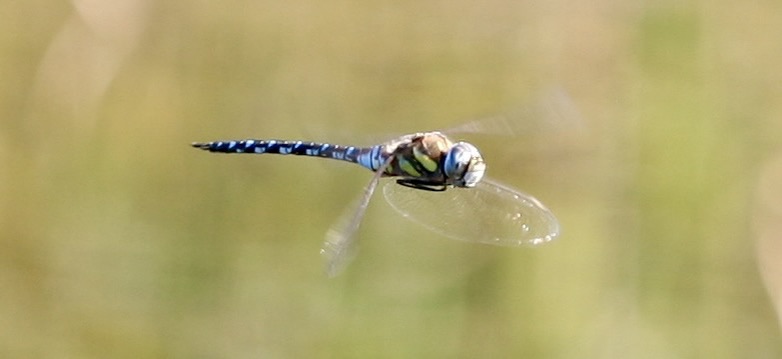
Dragonfly migration in Northern Europe
Insects are common and ecologically significant animal migrants. However, our understanding of the patterns and processes underlying insect migration is limited. Several species of dragonflies (Odonata) are known for their long-distance migrations and significant ecological impacts through biomass and nutrient transfer, pest control and species interactions (Hedlund et al. 2026, Biol. Rev.). Nevertheless, even the migration process in Odonata remains poorly understood, and many of the patterns and processes governing the long-distance movements of dragonflies cannot be satisfactorily explained.
In this project, we integrate various methodological approaches that provide data on movement patterns and potential processes associated with the large-scale movement of European dragonfly species. These methods include stable isotope analyses (hydrogen isotopes), molecular analyses, and a number of experimental and morphological analyses. We are making use of the fact that a considerable number of dragonflies are caught annually in Heligoland traps, which were originally set up to capture migratory birds. Initial isotope analyses have already shown that many of the captured dragonflies must have come from much further north (Oelmann et al. 2023, Mov. Ecol.). Some of the captured dragonfly species are considered facultative migrants, whose (long-distance) movements often occur irregularly (i.e. in contrast to obligate migrants, which migrate regularly). We compared these species with closely related species that are not known to exhibit this behaviour.
This project is a collaboration with the University of Tübingen.
Key facts
Funding: DFG, project number 584886230 · Duration: 2026–2029 · Project management: Prof. Dr Frank Suhling · Joint research project with Prof. Yvonne Oelmann & Dr Henri Thomassen, University of Tübingen
Previous publications by the research group on this topic
Suhling, F., Martens, A., & Suhling, I. (2017). Long-distance dispersal in Odonata: Examples from arid Namibia. Austral Ecology, 42(5), 544–552. doi.org/10.1111/aec.12472
Troast, D., Suhling, F., Jinguji, H., Sahlen, G., & Ware, J. (2016). A global population genetic study of Pantala flavescens. PLoS One, 11(3), e0148949. https://doi.org/10.1371/journal.pone.0148949