

What does a healthy city sound like?
Cities are loud, but not every sound is noise. Many people find birdsong, rustling leaves or running water pleasant and restorative. Yet such sounds hardly feature in urban planning so far. The CitySoundscapes project investigates how urban structure, green spaces and biodiversity shape the soundscape of a city, and how these sounds relate to people's health. The aim is to design green spaces that benefit both biodiversity and wellbeing.
The research takes place in Munich, in three neighbourhoods with very different built structures: Au, Harlaching and Neuperlach. The project is coordinated by Monika Egerer (Technical University of Munich) and brings together ecology, acoustics, health sciences, urban planning and art. Several chairs of the Technical University of Munich are involved, together with LMU Munich and TU Berlin. They are joined by the City of Munich as practice partner, BUND Naturschutz and Green City e. V. Residents take part through soundwalks, public listening salons and their own sound recordings.
Our subproject: what does a bird need in the city?
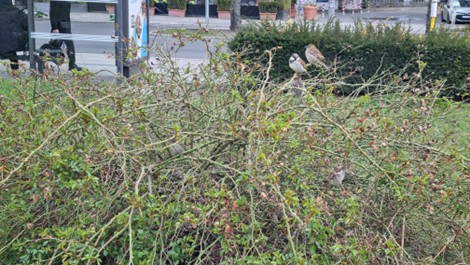
Some birds cope well in the city, while others are almost entirely absent. But what makes a green space a suitable habitat? Is it enough for it to be green, or does it matter how dense, how tall and how varied the vegetation is? And what role does the surrounding area play, that is, how heavily built-up and sealed a neighbourhood is?
To answer these questions, we take measurements at 25 points in each of the three neighbourhoods, 75 in total. The points are chosen to cover two kinds of difference: how much vegetation there is overall (how green?) and how it is structured (which kind of green?). At each point we combine two modern methods. Using laser scanners (LiDAR), we measure the vegetation, from lawns and shrubs up to the tree canopy. At the same time, audio recorders capture the sounds. From these recordings, an artificial intelligence, the program BirdNET, filters out the bird calls and identifies the species. This allows us to record which birds occur where, at many sites simultaneously and over long periods, without anyone having to be present.
We analyse both datasets together from an urban ecology perspective: which structures in green spaces and which features of the surrounding area are associated with more bird species? The results feed into the other parts of the project, for example into the question of which sounds people find restorative, and into recommendations for the design of urban green spaces.
Key facts
Subproject lead: Sebastian T. Meyer together with Peter Annighöfer (Technical University of Munich) · Doctoral researcher: Rachel Schiebel (Technical University of Munich) · Project coordination: Monika Egerer (Technical University of Munich) · Funding: BMFTR – Research Initiative for the Conservation of Biodiversity (FEdA) · Duration: 2024–2027 · More: CitySoundscapes project page