
E-Mail: f.vauti[at]tu-braunschweig.de
Telefon: +49 (0) 531 391 5722
Anschrift:
Technische Universität Braunschweig
Biozentrum
Institut für Zell- und Neuroviologie (IZN)
Zelluläre und Molekulare Neurobiologie
Spielmannstr. 7
38106 Braunschweig
2023: Habilitation and venia legendi for Cell- and Molecular Biology.
2015: Research Assistant at the Department of Cell and Molecular Neurobiology, Institute of Zoology, at the University of Braunschweig (headed by Prof. Dr. Reinhard Köster).
1999 - 2015: Research Assistant at the Institute of Biochemistry and Biotechnology in the Department of Cell Biology at the University of Braunschweig (headed by Prof. Dr. Hans-Henning Arnold).
1995 - 1999: Postdoctoral researcher at the Institute of Mammalian Genetics at the GSF Research Center Neuherberg in Munich (headed by Prof. Dr. Rudi Balling) in the Developmental Genetics Group (led by Prof. Dr. Wolfgang Wurst).
1990 - 1994: Postdoctoral researcher at the Institute for Cardiovascular Prevention (IPEK) at LMU Munich (headed by Prof. Dr. Peter C. Weber) in a research group (led by Prof. Dr. Wolfgang Siess).
1988 - 1989: Postdoctoral fellow, funded by the Konrad Adenauer Foundation (KAS) and the Max Planck Society (MPG), at the Max Planck Institute of Biochemistry in Martinsried (headed by Prof. Dr. Günther Gerisch) in a research group (led by Prof. Dr. Wolfgang Nellen).
1987 - 1988: Postdoctoral fellow under the Konrad Adenauer Foundation (KAS) program for the promotion of early-career researchers. Advanced studies in microbiology and molecular biology at LMU Munich.
1985 - 1988: Lecturer in Medical Physiology at the Karl-Franzens-University of Graz. Teaching and project-based research at the Institute of Physiology.
1985: Promotion to Doctor of Philosophy (PhD).
1982 - 1985: Doctoral thesis at the Institute of Physiology (headed by Prof. Dr Thomas Kenner) in the research group (led by Prof. Dr Maximilian Moser), Faculty of Medicine, Karl-Franzens-University of Graz, Austria.
1979 - 1985: Study of biology, specialising in zoology, with biochemistry and philosophy at the Karl-Franzens-University of Graz, Austria.
Understanding and treating human diseases is a central aim of biomedical research. Genome-wide association studies have identified mechanisms and signalling pathways that have provided many unexpected insights into the biological basis of complex diseases. Investigating gene function in model organisms and striving to understand this across species has always been a key driving force for me. My research interests focus on biomedical questions and on the molecular and cellular biological causes of pathophysiological processes in vertebrates.
The sequencing of the mouse genome in 2002 and the zebrafish genome in 2013 represented milestones for comparative genetic studies of the human genome using common vertebrate models. The existing knowledge of both model organisms has received an enormous boost for new, groundbreaking biomedical insights through the continuous development of genetic tools. Comparative genomics is one of the most powerful approaches for unravelling the secrets of the human genome. This is particularly true for traits that are subtle and difficult to detect in the human genome alone. Functional studies are of great importance for understanding the mechanisms by which a causal monogenic origin leads to variations in disease phenotypes. Cell or animal models must be developed to establish a link between the organism’s genotype and phenotype.
Analysis of sequence conservation between genomes has provided insights into nucleotide substitutions and variations caused by insertions and deletions over the course of evolution. Whilst mouse models have been used in biological research for over a century, the zebrafish has become an increasingly popular animal model in recent years.
Our current research focuses on spinocerebellar ataxias (SCAs), a group of inherited neurodegenerative disorders in humans that primarily affect the cerebellum and spinal cord, leading to progressive impairments in balance, coordination, speech and eye movements.
To date, more than 40 genetic types of SCA have been identified in humans (SCA1 to SCA44). They are usually inherited in an autosomal dominant pattern, which means that even a single mutated copy of the gene can cause the disease. Some SCAs are caused by mutations in the form of repeat expansions in their coding genes, particularly CAG expansions in common types such as SCA1, SCA2, SCA3 and SCA6. All SCAs are classified as rare diseases worldwide. For SCA2, there are hotspot regions, for example in Cuba.
We have focused our research on investigating the three different genes – Ataxin 1, Ataxin 2 and Ataxin 3 – in animal models that cause SCA1, SCA2 and SCA3. Whilst earlier collaborative work was carried out on an Ataxin-3 mouse model (Hübener et al., 2011), our most recent work focuses on genomic analysis and the spatiotemporal expression of Ataxin 1 and Ataxin 2 in zebrafish (Vauti et al., 2021, Vauti et al., 2025).
Our research is currently focused on Ataxin 2, a multifunctional RNA-binding protein that regulates mRNA stability, translation, stress granules, metabolic signalling and neuronal function. Dysfunction of Ataxin 2 contributes to SCA2, as well as to amyotrophic lateral sclerosis (ALS) and metabolic disorders. We plan to generate genetically modified models for Ataxin 2 and its paralog Atxn2l in order to replicate and investigate the function of the protein and the human disease SCA2 in the zebrafish model.
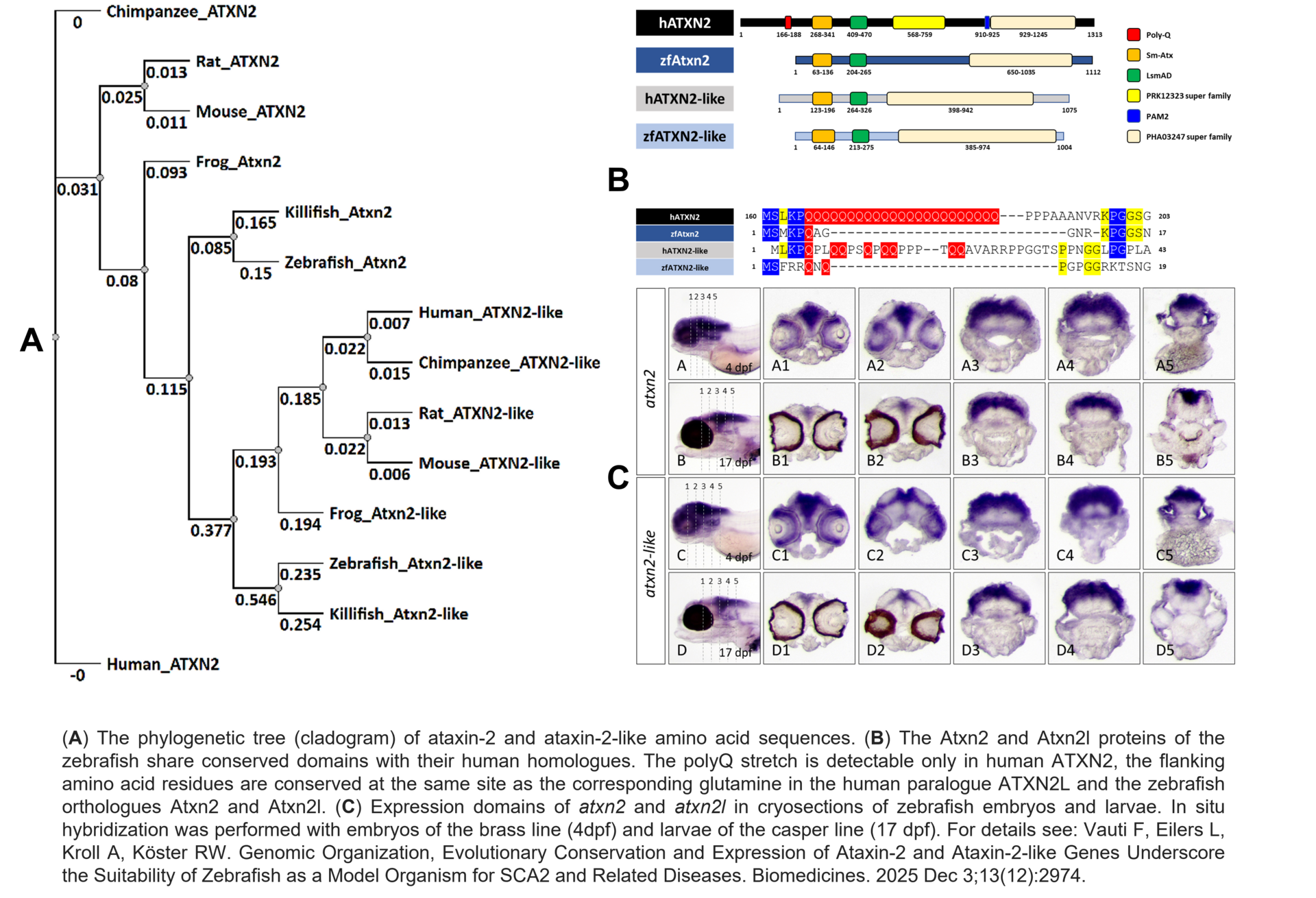
Vauti F, Eilers L, Kroll A, Köster RW. Genomic Organization, Evolutionary Conservation and Expression of Ataxin-2 and Ataxin-2-like Genes Underscore the Suitability of Zebrafish as a Model Organism for SCA2 and Related Diseases. Biomedicines. 2025 Dec 3;13(12):2974. doi: 10.3390/biomedicines13122974. PMID: 41462986; PMCID: PMC12730607.
Vauti F, Vögele V, Deppe I, Hahnenstein ST, Köster RW. Structural Analysis and Spatiotemporal Expression of Atxn1 Genes in Zebrafish Embryos and Larvae. Int J Mol Sci. 2021 Oct 21;22(21):11348. doi: 10.3390/ijms222111348. PMID: 34768779; PMCID: PMC8583371.
Hübener J, Vauti F, Funke C, Wolburg H, Ye Y, Schmidt T, Wolburg-Buchholz K, Schmitt I, Gardyan A, Driessen S, Arnold HH, Nguyen HP, Riess O. N-terminal ataxin-3 causes neurological symptoms with inclusions, endoplasmic reticulum stress and ribosomal dislocation. Brain. 2011 Jul;134(Pt 7):1925-42. doi: 10.1093/brain/awr118. Epub 2011 Jun 7. PMID: 21653538.
Lecture:
Bio-ZN31 and MZ06: Modelling of human diseases in vertebrates (Master)
Seminars:
Bt-BS02 and Bio-Nat07: Berufsvorbereitung und Informationskompetenz (Bachelor)
Bt-MS01: Berufsvorbereitungsseminar (Master)
Bio-NAT06: Wissenschaftsethik (Bachelor)
Braunschweig Biological Lectures (Organizer)
Practical courses:
Bio-ZB02: Cell signalling (6 weeks) (Bachelor)
Gene expression analysis (lab course)
Biosafety officer
Advisory scientist for animal protocols
Advisory member of the Biology Studies Committee
Advisory member of the Biotechnology Studies Committee