
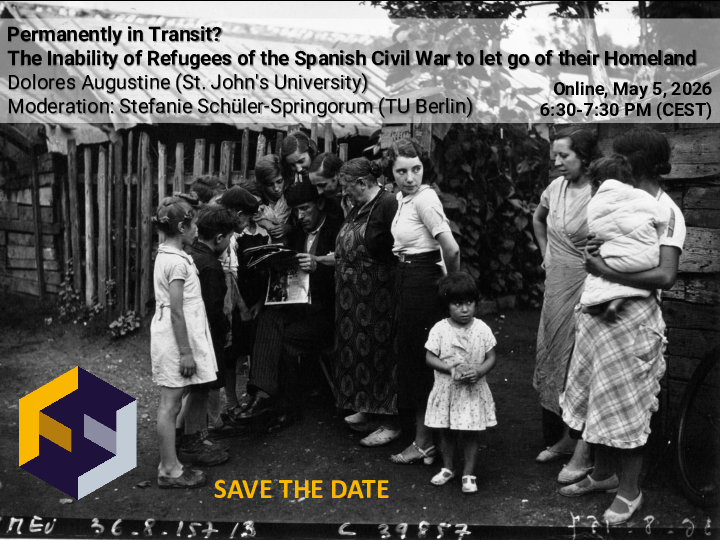
Making a new home in a foreign country is difficult for those who have been forced to emigrate. The refugees of the Spanish Civil War, which ended in 1939, proved particularly resistant to accepting their exile as long-term, or possibly permanent, in nature. Many Spaniards lived for years in a state of liminality, to use Arnold van Gennep’s term. Keeping a proverbial packed suitcase next to the front door, they long remained emotionally in transit, as examples from France and Mexico show. The emotional geography of exile in France was molded by various factors: the suddenness with which they had to flee Spain; the geographical proximity of Spain; the desire to cross back over the Pyrenees into Spain to sow an uprising against General Francisco Franco’s regime; and the emergence of Toulouse as a center of Spanish life. Poor and under-educated exiles clung with tenacity to their insular community in France, while communists and anarchists infiltrated their homeland clandestinely. However, the better-off Spanish refugees who escaped during the Second World War to Mexico also remained in a state of limbo for a long time, awaiting Franco’s death and the possibility of return to Spain. A post-colonial studies framework can help explain their attempts to reconstruct Republican Spain in Mexico.
May 5, 2026 12:30-1:30 pm Eastern Daylight Time / 18:30-19:30 Central European Summer Time
In Global Transit talk by Dolores Augustine (St. John’s University)
Moderated by Stefanie Schüler-Springorum (Technische Universität Berlin)
Introduced by Simone Lässig (Technische Universität Braunschweig)
Online, please register here.
Organized by “In Global Transit: International Standing Working Group to Explore Spatial and Temporal Dimensions in Global Migration”
Website: transit.hypotheses.org
Contact: Swen Steinberg (Swen.Steinberg@queensu.ca)
Photo: Agence Meurisse, Les réfugiés espagnols
dans la région parisienne, 1936, Public Domain
https://catalogue.bnf.fr/ark:/12148/cb415964048