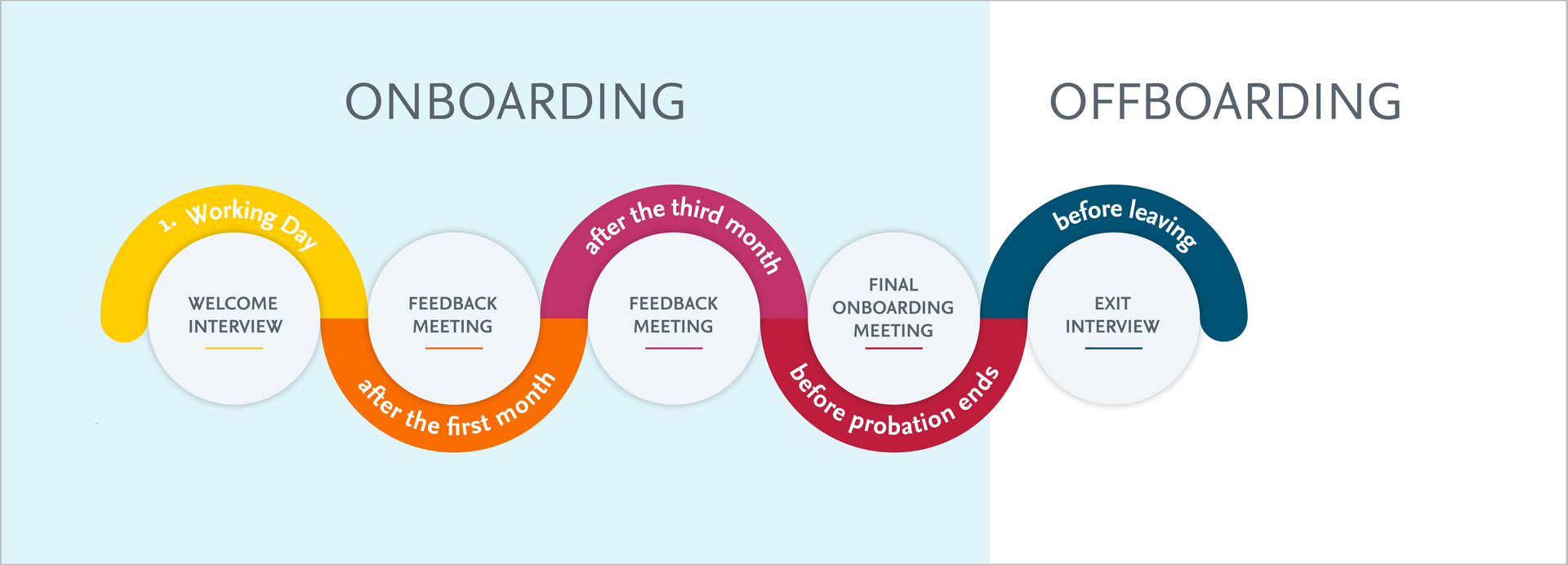
Regular meetings with new employees are a key element of successful onboarding.
In addition to situational feedback and regular informal exchange, it is advisable to integrate scheduled meetings into the onboarding process.
It is equally important to offer an exit interview to departing employees as part of the offboarding process.
Information and discussion guidelines for the various types of meetings within the onboarding and offboarding processes can be found on this website.
If you have any questions or feel that meeting formats are missing within the onboarding and offboarding process?
Please feel free to contact aus
More information and supporting materials on the topic of onboarding at TU Braunschweig can be found on our Onboarding Website
A welcome interview on the first working day is a central element of successful onboarding. It serves to personally welcome new employees and to give them a positive start at our university. During this meeting, expectations, tasks and goals can be discussed in order to create clarity about the role and responsibilities and to provide the new employee with orientation. Getting to know each other personally helps to build trust and lays the foundation for good collaboration. Overall, the welcome meeting helps to promote motivation, commitment and integration of the new employee.
Currently, the following documents are available only in German:

A structured feedback meeting as part of the onboarding process helps new employees to settle into their new role in terms of professional, social and cultural integration. It provides space for open dialogue about initial experiences, successes and potential challenges, enabling support needs to be identified at an early stage. Through mutual exchange, expectations can be aligned, misunderstandings clarified and constructive improvements to the onboarding process initiated. At the same time, the meeting signals appreciation and promotes motivation, satisfaction and commitment to TU Braunschweig.
Currently, the following documents are available only in German:

The final onboarding meeting at the end of the probation period is a key milestone in the integration of new employees. It provides an opportunity to systematically reflect on the entire onboarding phase, acknowledge results and progress, and identify development potential. At the same time, expectations for future collaboration are clarified and, where necessary, binding agreements are made. For the new colleague, the meeting conveys appreciation and transparency regarding future development priorities. For the manager, it is an opportunity to strengthen motivation and commitment and to formally conclude the onboarding process.
Currently, the following documents are available only in German:
Handout Final Onboarding Meeting
An exit interview is an essential element of a professional offboarding process. It provides an opportunity to conclude the collaboration constructively, gather valuable feedback for the organisation and maintain a positive relationship beyond the employment relationship. For the university, it is a chance to better understand the reasons for staff turnover and to identify potential improvements in the working environment. For employees, it offers a space to share thoughts and experiences, receive appreciation for their contribution and shape the transition in a respectful manner.
Currently, the following documents are available only in German: