
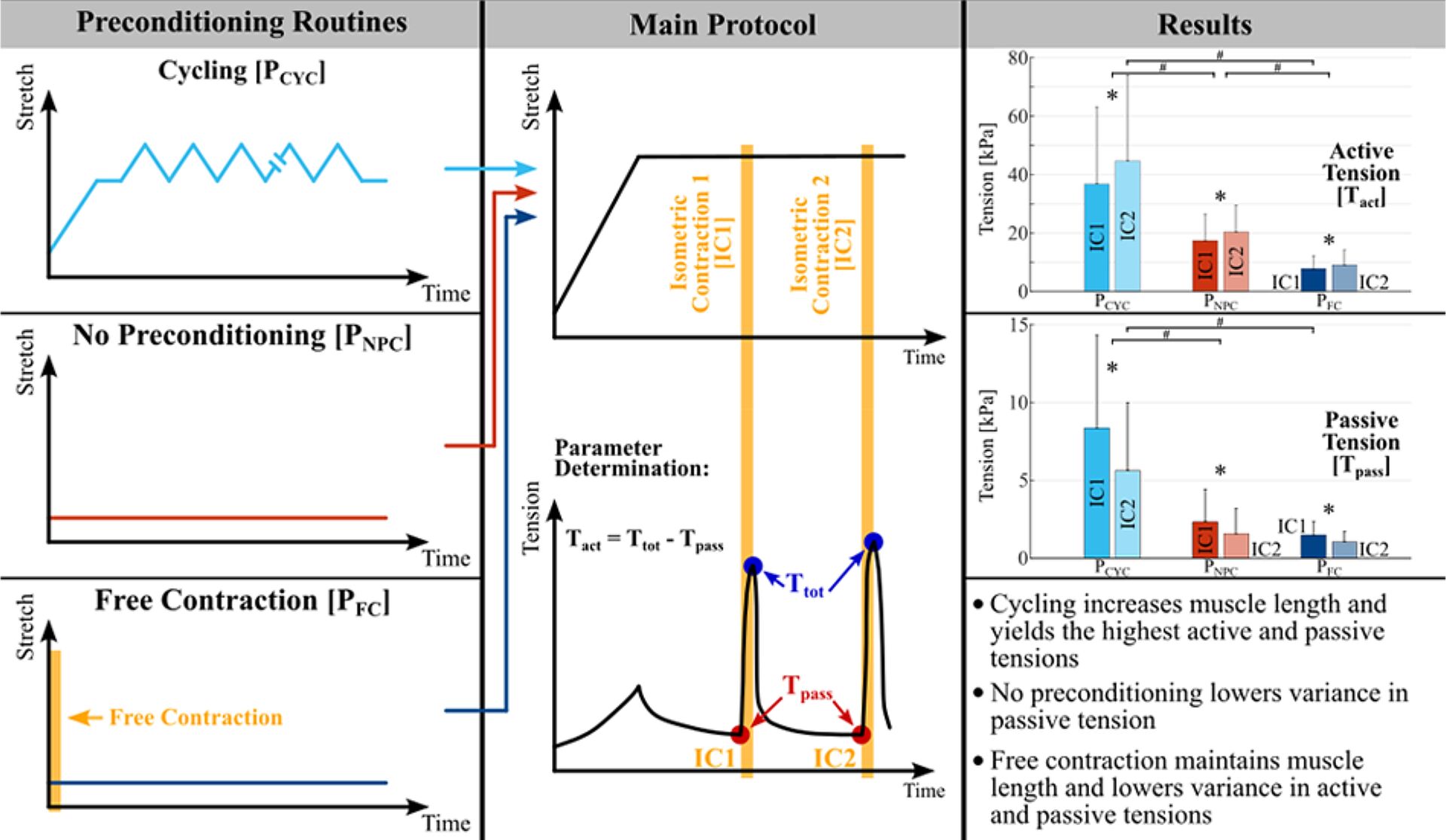
Smooth muscle (SM) exhibits rapid mechanical adaptation in response to various stimuli, posing challenges for reproducible experimental results and consistent material parameter determination in biomechanical modeling. Preconditioning involving repeated loading and unloading cycles is commonly used to stabilize mechanical responses before testing. However, their influence on tissue properties and data variability remains underexplored. This study compares the effects of three preconditioning routines—passive cycling, no preconditioning, and free contraction—on the active and passive force responses of porcine urinary bladder (UB) SM tissue. Three tissue strips from 12 UBs were randomly assigned to one of the routines and underwent an identical protocol involving a passive stretch ramp and two isometric contractions (IC1, IC2) to evaluate active and passive force development. After passive cycling, the tissue generated the highest active (IC2: 44.7 ± 29.4 kPa) and passive tensions (IC2: 5.6 ± 4.3 kPa), though it also showed the highest variance in active tension. No preconditioning resulted in the lowest variance in active tension, with a coefficient of variation (CV) of 45%, and free contraction showed the lowest variance in passive tension, CV=57%. These findings imply that the decision for a certain preconditioning protocol influences the observed mechanical properties. In this context, free contraction appears promising for minimizing passive force variability and preventing creep-induced lengthening. This couldoffer a more reliable foundation for subsequent experiments analyzing mechanical parameters. This study underscores the importance of customized preconditioning strategies to enhance consistency and comparability in SM research and organ modeling.
S. Kiem, S. Papenkort, M. Borsdorf, M. Böl, T. Siebert
Shaping smooth muscle forces: the role of preconditioning in urinary smooth muscle
Journal of Applied Physiology, 140, 971–982, (2026) [Link]