

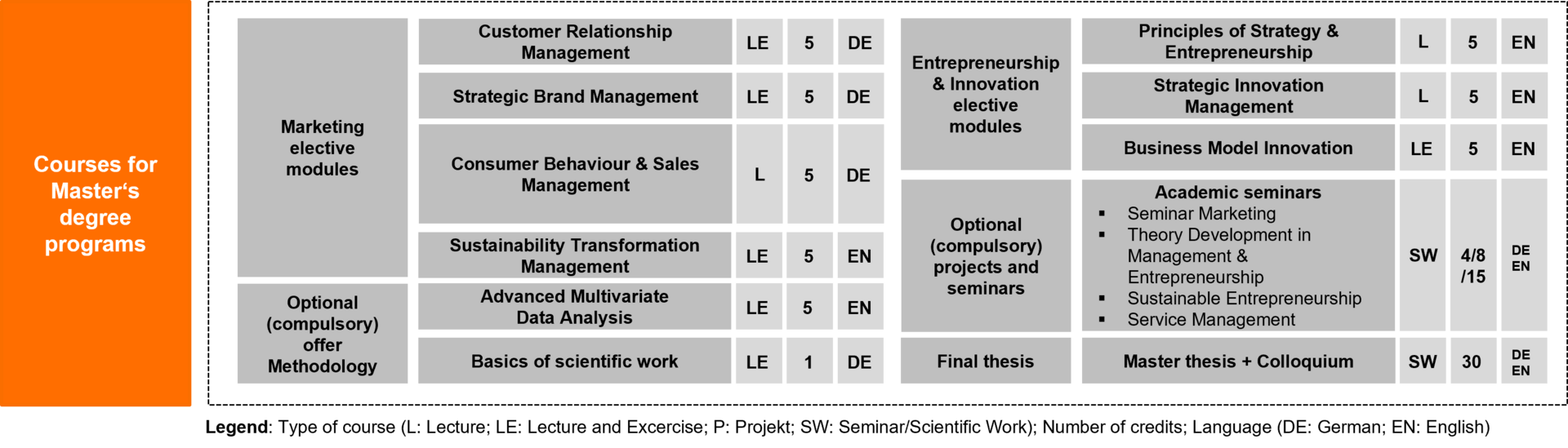
Students have an understanding of issues that arise in the context of recording, designing and evaluating customer relationships. Based on the concepts and methods they have learned, students will be able to independently identify, conceptually structure and analyse customer relationship management issues in various industry contexts. After successfully completing the course, they will also have the methodological knowledge required to analyse customer and company data qualitatively and quantitatively in order to answer customer relationship management questions.
Stud.IP
| Lecturer | Prof. Dr. David Woisetschläger |
|---|---|
| Schedule | Summer term |
| Language | German |
| Scope | 4 SWS / 5 Credits |
| Examination | Exam 120 minutes (Lecture- and Exercise) |
| Course number | 2220039 |
| Courses | Lecture Customer Relationship Management & Exercise Customer Analytics |
After successful participation, students have a basic understanding of brands and know which aspects play a role in branding. In addition, they will understand and be able to critically discuss how brands are developed and positioned and which instruments are suitable for this. They can argue on the basis of theory why certain brand-related measures can be expected to have an effect and have methodological knowledge in order to measure the brand and quantify influencing factors. After successfully completing the course, students will also be able to formulate precise problems and research questions based on a complex practical issue in the field of brand management and develop a solution to the problem using the content and methods learnt in the Strategic Brand Management lecture.
| Lecturer | Prof. Dr. David Woisetschläger |
|---|---|
| Schedule | Winter term |
| Language | German |
| Scope | 4 SWS / 5 Credits |
| Examination | Exam 60 minutes + Portfolio |
| Course number | 2201046 |
| Courses | Lecture Strategic Brand Management & Exercise Brand Strategy Bootcamp |
Last enrolment in Orientation A in the summer semester of 2026:
The old Orientation A as a combined examination (120 minutes) consisting of the lectures "Strategic Brand Management" and "Business Model Innovation" can be taken for the last time in the summer semester 2026. From the winter semester 2026/2027 onwards, it will only be possible to enrol in the modules according to the new enrolment logic.
| Lecturer | Prof. Dr. Christof Backhaus |
|---|---|
| Schedule | Winter term |
| Language | German |
| Scope | 2,5 CPs (Combination with Sustainability Transformation Management: 5CPs) |
| Examination | Exam |
| Course number | 2221000006 |
| Courses | Lecture Consumer behaviour |
Module completion (depending on examination regulations):
OR
Please register for the Master's orientation via your examination office!
| Lecturer | Prof. Dr. Christof Backhaus |
|---|---|
| Schedule | Summer term |
| Language | German |
| Scope | 2,5 CPs (Combination with der Übung Sustainability Transformation Management: 5CPs) |
| Examination | Exam |
| Course number | 2221000002 |
| Courses | Lecture Sales Management |
Module completion:
AND
Registration for the Master's specialisation takes place via your examination office!
Registration for the exercise course takes place in the corresponding StudIP course! Please note the corresponding announcements on our website
| Lecturer | Prof. Dr. Christof Backhaus |
|---|---|
| Schedule | Winter term |
| Language | English |
| Scope | 2,5 CPs (Combination with Konsumentenverhalten: 5CPs) |
| Examination | |
| Course number | 2221000001 |
| Courses | Lecture Sustainability Transformation Management, Exercise Sustainability Transformation Management |
Module completion (depending on examination regulations):
OR
Please register for the Master's orientation via your examination office!
In our research-led Principles of Strategy & Entrepreneurship course, we will explore key issues in strategic management and look at the process of creating new businesses. The course covers seven main areas:
| Lecturer | Prof. Dr. Bastian Kindermann |
|---|---|
| Schedule | Winter term |
| Language | English |
| Scope | |
| Examination | |
| Course number | 2225000004 |
| Courses | Lecture Principles of Strategy & Entrepreneurship |
The "Strategic Innovation Management" course offers participants a holistic orientation for the process of innovation management. The course content includes topics such as strategy development, the creation of innovation-orientated corporate cultures and leadership as well as expansion into global markets. In addition, specific innovation strategies related to open innovation and (digital) platforms are covered. After completing this course, participants should be able to understand and apply key concepts of strategy and innovation management. These skills will prepare participants not only for future research-related work (e.g. master's theses, doctorates), but also for career opportunities in innovation departments, start-ups and management consulting.
After successful participation, students have a basic understanding of business model innovation and know which factors play a role in the development of business model innovations. In addition, they will understand and be able to critically discuss how innovations are developed and which methods are suitable for this. They can argue on the basis of theory why certain corporate measures can be expected to have an effect on the success of innovation and have methodological knowledge to develop, evaluate and critically reflect on business model innovations themselves. After successfully completing the course, students will also be able to formulate precise problems and research questions based on a complex practical issue in the field of innovation management and develop solutions to problems using the content and methods learnt in the Business Model Innovation lecture and other methods taught in the tutorial.
| Lecturer | Prof. Dr. David Woisetschläger |
|---|---|
| Schedule | Winter term |
| Language | English |
| Scope | 4 SWS / 5 Credits |
| Examination | Exam 60 Minuten + Portfolio |
| Course number | 2201051 |
| Courses | Lecture Business Model Innovation, Exercise Business Model Innovation |
Last enrolment in Orientation A in the summer semester of 2026:
The old Orientation A as a combined examination (120 minutes) consisting of the lectures "Strategic Brand Management" and "Business Model Innovation" can be taken for the last time in the summer semester 2026. From the winter semester 2026/2027 onwards, it will only be possible to enrol in the modules according to the new enrolment logic.
After completing this course, students will have advanced knowledge of multivariate data analysis methods in economics. They will be able to carry out and interpret multivariate data analyses using the open source software R.
Stud.IP
| Lecturer | Bastian Land |
|---|---|
| Schedule | Winter term |
| Language | English |
| Scope | 4 SWS / 5 Credits |
| Examination | Exam 60 minutes + Portfolio |
| Course number | 2201003 |
| Courses | Lecture + Exercise |
Academic work is one of the core competences of the degree programme and is a necessary prerequisite for obtaining a Bachelor's or Master's degree. In both theoretical and highly interactive units, the seminar covers the basics of academic work, such as structuring a paper or literature review. In addition, you will learn about "storytelling" for your thesis in order to create and maintain the central theme of your work. In the interactive units, you will also have the opportunity to refer to individual questions and your own examples.
Stud.IP
| Lecturer | Phil Petri |
|---|---|
| Schedule | Every term |
| Language | German |
| Scope | 2 SWS / 1 Credit |
| Examination | Presentation |
| Course number | 2220068 |
| Courses |
"Theory is the currency of our scholarly realm" (Corley & Gioia, 2011, p. 12). Despite the continuous increase in increasingly sophisticated methodological tools in recent years, this statement has lost none of its validity. In this master's seminar, we will examine the use of theories in management and entrepreneurship research. In particular, the course will cover four main areas: 1) Structure, types and incidence of theories; 2) Theoretical problems and contributions; 3) Anatomy of theoretical arguments; and 4) Creativity and theorising. Taken together, these four areas provide students not only with a comprehensive understanding of what theory is (and is not), but also with practical guidance on how to use theories effectively in their Masters theses and potential PhDs.
| Lecturer | Prof. Dr. Bastian Kindermann |
|---|---|
| Schedule | Every term |
In the practice-orientated master's seminar "Sustainable Entrepreneurship", participants explore how entrepreneurial activity can succeed in harmony with ecological and social goals. Using the triple bottom line (people, planet, profit), success factors of sustainable start-ups are analysed and the particular challenges they face are highlighted. Together with partners within TU Braunschweig, participants develop their first entrepreneurial project ideas that go beyond pure profit maximisation. The course is aimed at anyone who wants to found a start-up or work in a sustainable innovation environment and is looking for impact rather than just growth.
Stud.IP
| Lecturer | Prof. Dr. Bastian Kindermann |
|---|---|
| Schedule | Winter term |
Automated driving is one of the key future technologies in the field of mobility and transportation systems. Automated and connected driving opens up a wide range of applications, from driverless shuttle services in urban areas to smart logistics solutions and data-driven mobility services for specific target groups such as seniors or commuters. Despite these possibilities, current studies show that even individual acceptance of assisted driving functions is significantly influenced—both positively and negatively—by factors such as subjective norms, trust in the technology, or enjoyment of the technology. Against this backdrop, a systematic investigation of usage and acceptance patterns of automated driving functions is warranted to gain a deeper understanding of the associated opportunities and challenges in the practical application of this technology.
During the seminar, participants will examine the usage and adoption behavior of driver assistance functions and automated driving functions using quantitative and qualitative research methods. The goal is to systematically analyze determinants of willingness to use and actual use of automated driving functions and to empirically identify differences between user segments based on influencing factors (e.g., risk affinity, mobility profiles, urbanity, and need for control). The focus is on the tension between the perceived benefits of automated systems, the actual use of automated driving functions, and psychological factors such as loss of control or individual risk perception. The results serve as a basis for deriving differentiated usage and communication approaches as well as for a reflective assessment of technological and societal implications
Depending on the specific research questions, participants will flexibly choose between qualitative and quantitative study designs: In the process, participants will learn to formulate precise research questions, select appropriate data collection methods (e.g., expert interviews, surveys, secondary data analyses), and systematically evaluate data. Subsequently, the findings are to be discussed in an academic context and robust conclusions developed.
| Lecturer | Prof. Dr. David Woisetschläger |
|---|---|
| Schedule | Every term |
| Language | German |
| Scope | 4 Credits |
| Examination | Written elaboration + presentation |
| Course number | 2220045 |
Please register for the event on Stud.IP to receive information and updates about the seminar. Further details (including the schedule and topic assignments) will be provided at the kickoff. Binding registration for the course credit must be completed via the TU-Connect portal during the kickoff event. Attendance at the kickoff and the final presentation is mandatory for participation in the seminar.
Artificial Intelligence (AI) is transforming marketing across the entire marketing value chain—from market and consumer insights to creation and communication, as well as sales and performance management. Generative AI and autonomous AI agents are increasingly shaping creative processes through collaboration between humans and AI agents, while purchase decisions are shifting from traditional digital touchpoints to AI-based shopping agents.
The aim of this seminar is to analyze current research from leading international marketing journals and to develop theoretically grounded, empirically testable research questions based on this literature.
The seminar examines how Artificial Intelligence is changing marketing along the entire value chain. One key focus is the use of generative AI in marketing communication and creation. Potential research topics include the interaction between humans and AI in creative processes, the effects of AI support on creative quality and diversity, and the perception and impact of AI-generated content among consumers, including issues of authenticity, creativity, and transparency regarding the use of AI.
A second focus addresses AI in sales and commerce. This includes analyzing how shopping agents change product search and purchase decisions, how trust, decision quality, and brand perception evolve, and what consequences arise for marketing management—such as implications for visibility, performance measurement, and budget allocation in agent-mediated purchasing processes.
The seminar is intended for students interested in innovative developments in marketing who seek both theoretical and practice-oriented insights into the use of AI.
| Lecturer | Prof. Dr. David Woisetschläger |
| Schedule | Every term |
| Language | German |
| Scope | 4 Credits |
| Examination | Written elaboration + presentation |
| Course number | 2220045 |
Please register for the event on Stud.IP to receive information and updates about the seminar. Further details (including the schedule and topic assignments) will be provided at the kickoff. Binding registration for the course credit must be completed via the TU-Connect portal during the kickoff event. Attendance at the kickoff and the final presentation is mandatory for participation in the seminar.
Vacancies of TU Braunschweig
Career Service' Job Exchange
Merchandising
Term Dates
Courses
Degree Programmes
Information for Freshman
TUCard
Technische Universität Braunschweig
Universitätsplatz 2
38106 Braunschweig
P. O. Box: 38092 Braunschweig
GERMANY
Phone: +49 (0) 531 391-0