
The Sustainable Development Goals (SDGs) are 17 goals set by the United Nations in 2015. Their aim is to make social, environmental, and economic development more sustainable by 2030. The goals cover topics such as reducing poverty, improving education, protecting the climate, and strengthening global cooperation.
The SDGs combine important strengths and challenges. They provide a globally recognized framework that links social, environmental, and economic dimensions and thereby offers orientation for different aspects of sustainable development. Their clear structure gives guidance, facilitates communication, educational activities, and the monitoring of progress. At the same time, this framework is also subject to criticism. Some goals are formulated in a very broad or highly ambitious manner, and potential conflicts (for example between economic growth and environmental protection) are not fully addressed. In addition, the goals are not legally binding for states, which can hinder their effective implementation.
It is this combination of guidance and challenges that highlights the importance of a thoughtful engagement with the SDGs in higher education. For teaching, the global goals provide a structured introduction into different topics of sustainable development and create space for critical discussions on goal conflicts, priorities, and implementation strategies. Educators can use SDGs to illustrate interdisciplinary connections, foster critical thinking, and enable students to analyze real-world problems. Project-based and action-oriented approaches further make the goals tangible, motivating students to develop their own contributions toward a sustainable future.
When sustainable development is fully integrated into teaching, research, and campus life, a university not only helps achieve the global sustainability goals but also equips its students and researchers to tackle complex societal challenges in a responsible and creative way.
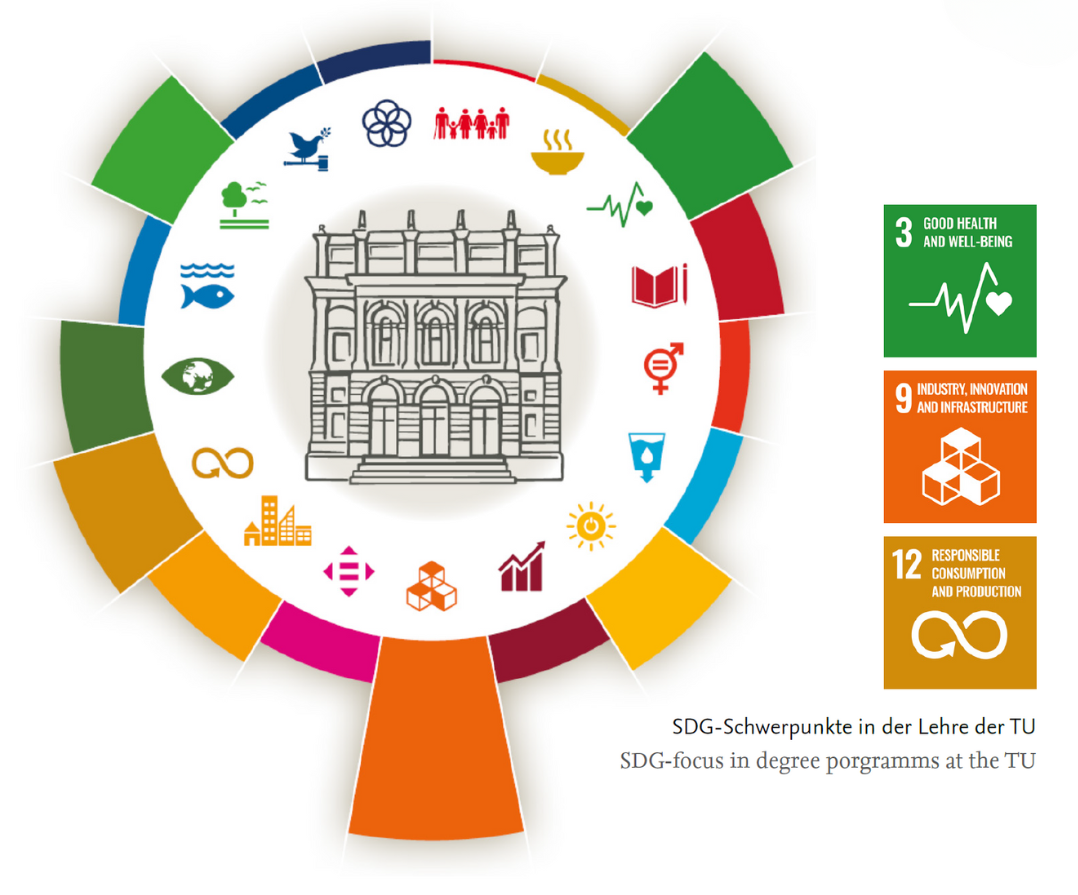
In 2024, the TU Braunschweig started a systematic evaluation to examine the extent to which its study programs address topics related to sustainable development — particularly the Sustainable Development Goals (SDGs). To this end, the module descriptions of all degree programs were carefully analyzed to identify their connections to the global goals.1 The results show that teaching at TU Braunschweig not only makes a fundamental contribution to SDG 4 - Quality Education, but provides key impulses for a sustainable future, for example in the areas of innovative technologies, future-oriented business models, health and well-being, and resource-efficient production methods. The university’s focus on engineering and technology contributes notably to SDG 9 - Industry, Innovation and Infrastructure.