

Wear, erosion, and other damage can alter the geometry of a turbofan engine's components. These geometric variations affect the engine's performance and efficiency, resulting in significant costs for operators. Particularly in the case of modern engine designs such as the CFM LEAP and the 3D-optimized geometries used in it, there is currently little experience with the effects of geometric variations on the respective components and their sensitivities.
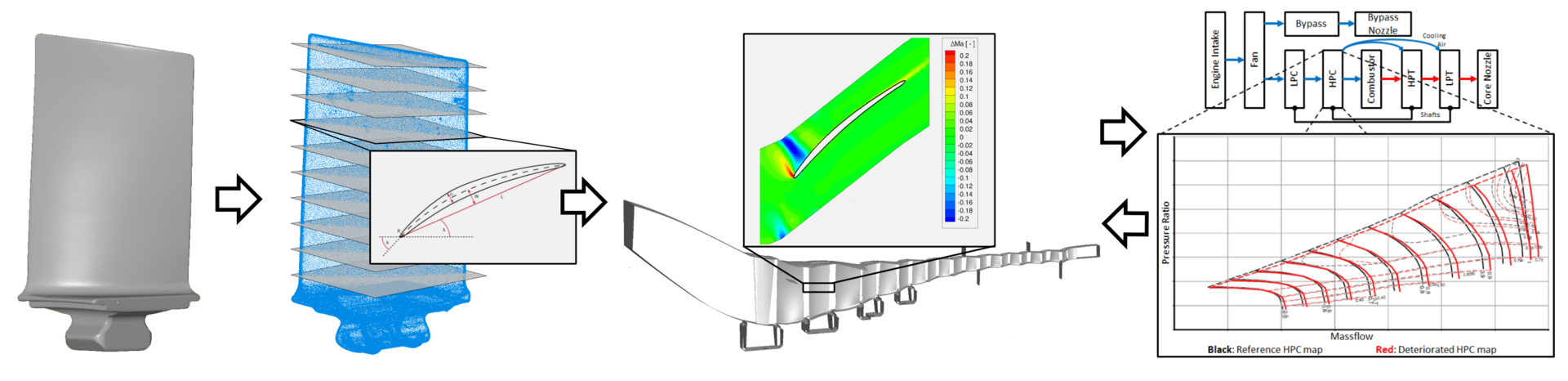
As part of SFB 871, a process architecture was developed that enables the analysis and evaluation of geometric variations in high-pressure compressor and turbine blades of a classic turbofan engine. The aim of the Intelligent Life Cycle Support (iLCS) project is to transfer this process to the latest generation of engines and fully automate it in collaboration with project partners Lufthansa Technik and the Institute of Turbomachinery and Fluid Dynamics at Leibniz University Hannover.
The desired process begins with the creation of a digital twin of the components to be examined by 3D scanning the parts and then performing a geometric analysis. On this basis, flow simulations and performance calculations are carried out to map the influences of the respective variances. The results obtained can then be used to create a meta-model. This model can be used to quickly determine the influences of individual blades on engine performance and thus also be integrated into the MRO process. This allows consumption and costs to be optimized through targeted maintenance.