„Architecture should offer an incentive to users to influence their surroundings, to take possession of them [...] it must be a framework that invites people to fill it with their own intentions.”
Herman Hertzberger (in: Lessons for Students in Architecture)
Herman Hertzberger is one of the most renowned architects of 20th-century Netherlands. He is regarded as the leading exponent of Dutch Structuralism. This movement, which emerged around 1960, saw itself as a counter-model to functionalist architecture. The structuralists took human behaviour as their starting point. Consequently, they believed that buildings must satisfy both the individual and social needs of their users, and that architecture must be ‘inviting’. Buildings are thus understood not as self-contained objects, but as open systems – as a spatial framework that facilitates growth, change and adaptation.
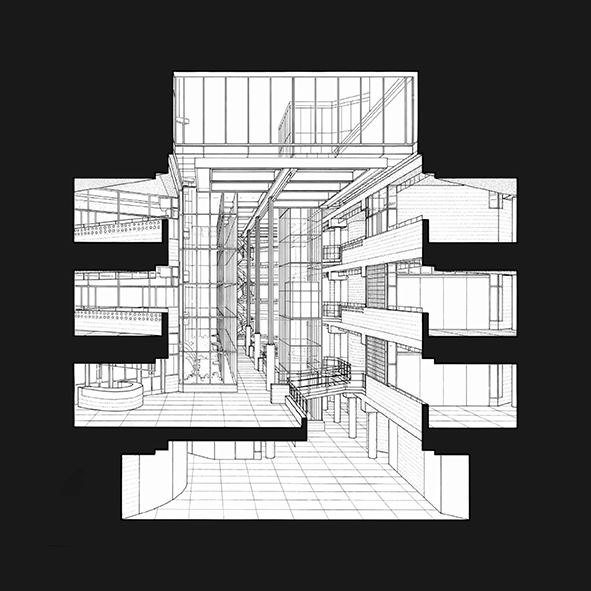
In this spirit, Hertzberger designed office buildings, schools and housing estates from 1960 onwards. The Ministry of Social Affairs and Employment in The Hague (Ministerie van Sociale Zaken en Werkgelegenheid – SoZaWe), planned and built between 1979 and 1990, is a striking example of the characteristics of structuralism. The large-scale building, organised as an additive structure of columns, beams and clusters, possesses such an explicit systematic nature that its original character remains constantly recognisable. This inherent structural logic makes it possible, even after the original occupant has moved out, to continue to conceive of the building as a multi-layered, urban entity capable of responding flexibly to new requirements.
As with many Structuralist buildings, the building’s qualities lie in striking a balance between the individual and the community, and these qualities become apparent when experiencing the interior. However, the relationship with the public realm has been largely ignored. The building reveals itself as a hermetic interior world, isolated from the surrounding urban space. The main entrance is barely identifiable; there is no clear address and no welcoming gesture. However, the size of the building, which occupies an entire city block, calls for uses that are open to the public. The Bachelor’s thesis addresses this issue. It focuses on the main entrance of the building complex—which has been temporarily vacant and is now threatened with demolition—as a critical interface between the city and the internal structure.
The basis is formed by three different urban design concepts for the transformation of the complex, developed by the Dutch architectural firms Architectuurstudio HH, De Zwarte Hond and FABRICations. These scenarios explore how new public passages can be created and connections to the urban environment strengthened. When developing the Bachelor’s thesis, one of these strategies is to be selected as a starting point. It is important to critically examine the chosen approach. It may be modified or supplemented with one's own well-reasoned proposals. Common to all concepts is that the lower levels are to be reserved for communal and commercial uses, whilst the upper floors are to be used for residential purposes. In doing so, they aim to continue the current temporary use by traders, service-providers, shops or start-ups, as well as residential use in the former office floors.
The aim of the Bachelor’s thesis is to design, in line with these concepts, a community centre for future residents opposite Laan van NOI railway station, creating a striking and inviting entrance to the former ministry building. It is intended to spatially complement the existing structure as an extension and to function as a lively meeting place, offering in particular event, workshop and rehearsal spaces, as well as a small sports hall. Particular importance is attached here to the programming and designing of the ground floor area, which forms the threshold between public space and internal use. In other words, the task is not to formulate a concept for the entire complex, but rather to create a distinct identity by making a selective intervention in the structure at a key point.
The key objectives of the design are to enhance the building complex with public spaces that encourage interaction, to create a facade that meets current climate requirements and engages effectively with the urban environment, and to develop a structural framework that not only respects the existing building but also establishes a symbiotic relationship with it.
Examiners:
Prof. Job Floris
Prof. Dr. Norman Hack
Tutors:
Bernd Ax
Susanna Bier
Edwald Dederer
Type of assignment:
Individual work
Language:
Introduction and weekly tutorials are conducted in German. Keynote lecture and critiques are given in English. Presentations may be held in English or German.
Participants:
Max. 18
Introduction, issuing of the task and keynote lecture:
Wed 29 April 2026, 12:30
Field trip to Den Haag:
Sat 9 May to Mon 11 May 2026
Tutorials:
Tuesdays
Interim critiques:
Tue 19 May 2026
Thu 25 June 2026
Tue 14 July 2026
Submission (digitally):
Wed 12 August 2026
Presentation:
Calendar week 37