
Technische Universität Braunschweig
  • Study & Teaching
    • Beginning your Studies
      • Prospective Students
      • Degree Programmes
      • Application
      • Why TU Braunschweig?
    • During your Studies
      • Fresher's Hub
      • Term Dates
      • Courses and Qualifications
      • Practical information
      • Beratungsnavi
      • Financing and Costs
      • Special Circumstances
      • Health & Wellbeing
      • Campus life
    • At the End of your Studies
      • Career Service
      • Alumni
      • Discontinuation and Pre-Certification
      • After graduation
    • Strategies and Quality Management
      • TU Teaching Award
    • For Teaching Staff
      • Strategy, Offers and Information
      • Learning Management System Stud.IP
    • Contact
      • Study Service Centre
      • Academic Advice Service
      • Student Office
      • Department 16 - Academic and Student Affairs
      • Career Service
  • Research
    • Research Profile
      • Core Research Areas
      • Clusters of Excellence at TU Braunschweig
      • Research Projects
      • Research Centres
      • Professors‘ Research Profiles
    • Early Career Researchers
      • Support in the early stages of an academic career
      • PhD-Students
      • Postdocs
      • Junior research group leaders
      • Junior Professorship and Tenure-Track
      • Habilitation
      • Service Offers for Scientists
    • Research Data & Transparency
      • Transparency in Research
      • Research Data
      • Open Access Strategy
    • Research Funding
      • Research Funding Network
      • Research funding
    • Contact
      • Research Services
      • Academy for Graduates
  • Transfer
    • Transfer profile
      • Transfer strategy "TIES® with Impact"
      • Technology Transfer
      • Knowledge Transfer
      • Relationship Management
    • Innovation
      • Startups
      • Patents
    • Offers for schools and pupils
    • For enterprises
      • Friends & Supporters
    • For Alumni*ae
    • For everyone
  • International
    • International Students
      • Why Braunschweig?
      • Degree seeking students
      • Exchange Studies
      • TU Braunschweig Summer School
      • Students from German Schools Abroad
      • Refugees
      • International Student Support
      • International Career Service
    • Going Abroad
      • Studying abroad
      • Internships abroad
      • Teaching and research abroad
      • Working abroad
    • International Researchers
      • Welcome Support for International Researchers
      • Service for Host Institutes
    • Language and intercultural competence training
      • Learning German
      • Learning Foreign Languages
      • Intercultural Communication
    • International Profile
      • Internationalisation
      • International Cooperations
      • Strategic partnerships
      • International networks
    • International House
      • About us
      • Contact & Office Hours
      • News and Events
      • Newsletter, Podcast & Videos
      • Job Advertisements
  • TU Braunschweig
    • Our Profile
      • Aims & Values
      • Regulations and Guidelines
      • The University Development Initiative 2030
      • Ecoversity – the TU Braunschweig as a university ecosystem
      • Equal Opportunity
      • Diversity
      • Sustainability
      • Facts & Figures
      • Our History
    • Presidency & Organisation
      • Executive Board
      • Designated Offices
      • Administration
      • Facilities
      • Committees
      • Student body
    • Career
      • Working at TU Braunschweig
      • Vacancies
      • Information and Offers for New Employees
    • Faculties
      • Carl-Friedrich-Gauß-Fakultät
      • Faculty of Life Sciences
      • Faculty of Architecture, Civil Engineering and Environmental Sciences
      • Faculty of Mechanical Engineering
      • Faculty of Electrical Engineering, Information Technology, Physics
      • Faculty of Humanities and Education
      • Institutes from A to Z
    • Events
  • Search
  • Quicklinks
    • People Search
    • Webmail
    • cloud.TU Braunschweig
    • Messenger
    • Cafeteria
    • TUconnect (student platform)
    • Emergency
    • Stud.IP
    • Library Catalogue
    • Research Information System
    • Information Portal (employees)
    • Link Collection
    • DE
    • EN
    • Instagram
    • YouTube
    • LinkedIn
    • Mastodon
    • Bluesky
Menu
  • TU Braunschweig
  • Faculties
  • Faculty of Mechanical Engineering
  • Institutes
  • Institute of biochemical engineering
  • Research
  • Production of natural products
Logo Institut für Bioverfahrenstechnik der TU Braunschweig
Rheomorphological Interactions in Filamentous Microorganisms: From High-Throughput Screening to Scale-Up
  • Production of natural products
    • Production of Bacterial Cellulose in a Membrane-Based Bioreactor
    • Rheomorphological Interactions in Filamentous Microorganisms: From High-Throughput Screening to Scale-Up

Rheomorphological Interactions in Filamentous Microorganisms: From High-Throughput Screening to Scale-Up

Filamentous microorganisms are known for their broad spectrum of primary and secondary metabolites. For example, the genus Actinomycetes accounts for over 45% of all known bioactive substances used in the food, pharmaceutical, and agricultural industries[1], such as novel antibiotics or potential chemotherapeutic agents. Despite this potential, the widespread use of filamentous microorganisms is often hindered by inefficient production processes. Filamentous microorganisms grow in a complex mycelial network, and the resulting morphology is not only directly linked to the metabolism responsible for product formation but also causes an increase in the viscosity of the culture broth. The resulting effects of shear-thinning rheology impose limitations on mixing and mass transfer processes, which in turn can lead to growth limitations and metabolic changes. This creates a network of complex interdependencies between rheology and morphology, which complicate effective process development and scaling.
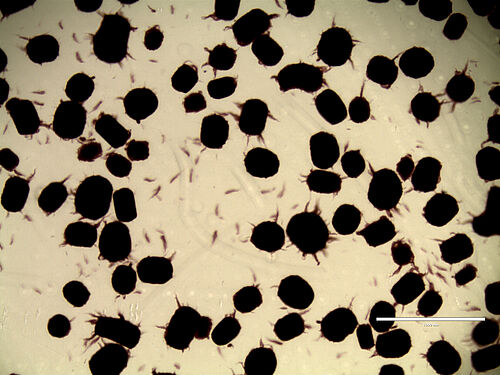
 

S. coelicolor Pellets (10x Vergrößerung)
S. coelicolor Pellets

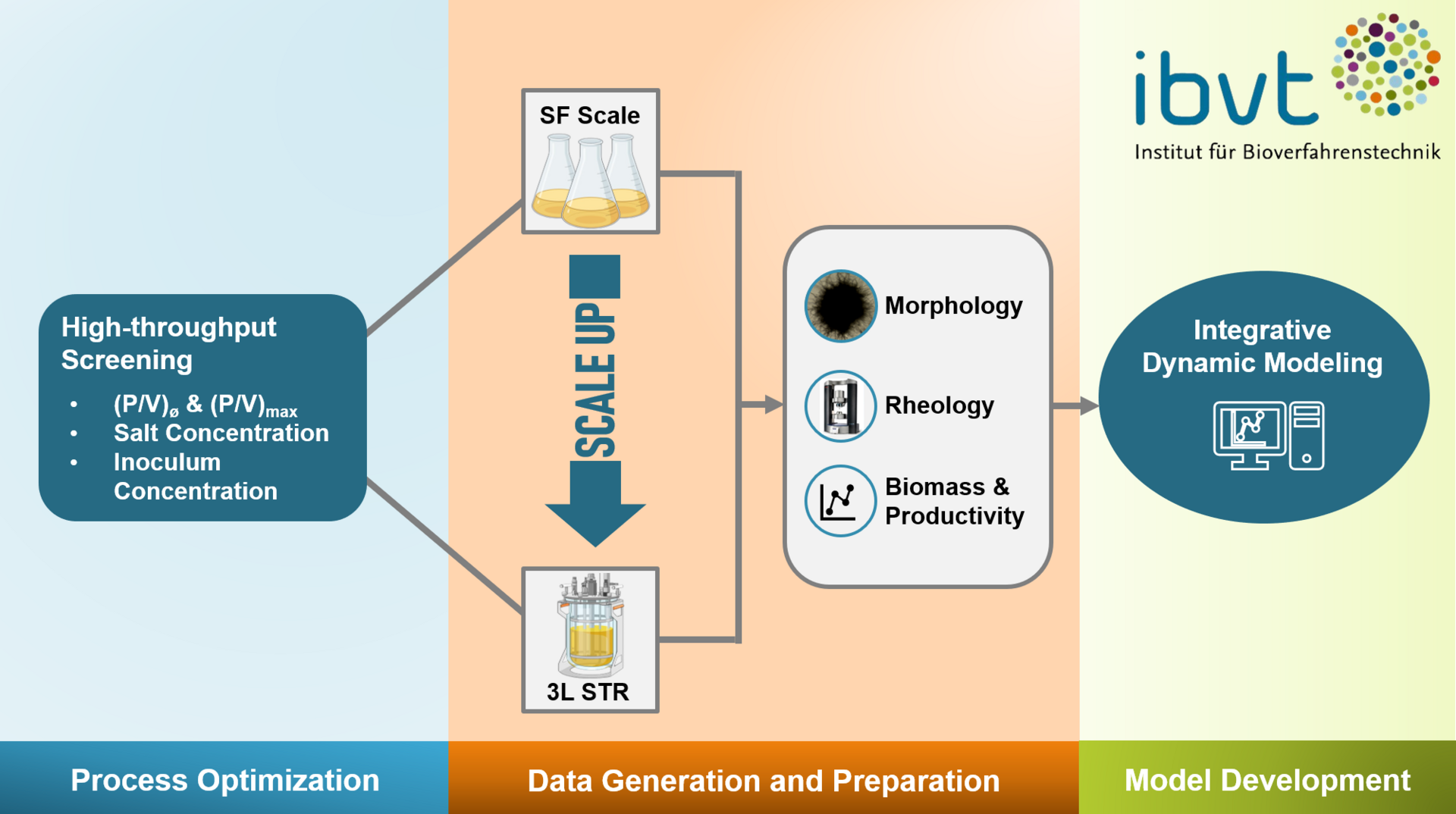
In this project, these interactions will be investigated by varying morphology-controlling parameters (e.g., osmolarity, spore concentration in the inoculum, power input…) in order to develop a comprehensive hybrid model and thereby overcome challenges in process development. Streptomyces coelicolor A(3)2 (S. coelicolor) serves as a model organism for filamentous bacteria and produces two pharmaceutically relevant secondary metabolites: the blue pigment actinorhodin and the red-fluorescent pigment undecylprodigiosin. While actinorhodin exhibits antibiotic activity, undecylprodigiosin offers potential for use as a chemotherapeutic agent or for the treatment of malaria and fungal infections. Following process establishment and optimization in a shake flask, the process will be scaled up to a bioreactor using rheology-based scale-up criteria. Based on the generated data, an integrative hybrid model will then be developed to predict key process parameters and thus ensure effective process development and control.

[1] Correia J, Borges A, Simões M, Simões LC, “Beyond Penicillin: The Potential of Filamentous Fungi for Drug Discovery in the Age of Antibiotic Resistance.” *Antibiotics* 12, 2023, DOI: 10.3390/antibiotics12081250.
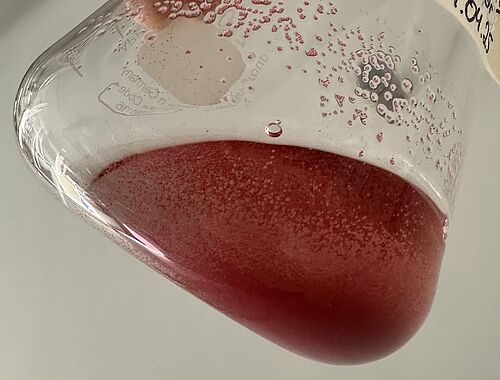
Schüttelkolben S. coelicolor
Pigment Production in a Shaking Flask
Graphical Abstract RheoMorph-Projekt


Project Manager: Leonie Schumann


Thesis Opportunities: Theses

Photo credits on this page

For All Visitors

Vacancies of TU Braunschweig
Career Service' Job Exchange 
Merchandising

For Students

Term Dates
Courses
Degree Programmes
Information for Freshman
TUCard

Internal Tools

Glossary (GER-EN)
Change your Personal Data

Contact

Technische Universität Braunschweig
Universitätsplatz 2
38106 Braunschweig

P. O. Box: 38092 Braunschweig
GERMANY

Phone: +49 (0) 531 391-0

Getting here

© Technische Universität Braunschweig
Legal Notice Privacy Accessibility

TU Braunschweig uses the software Matomo for anonymised web analysis. The data serve to optimise the web offer.
You can find more information in our data protection declaration.