

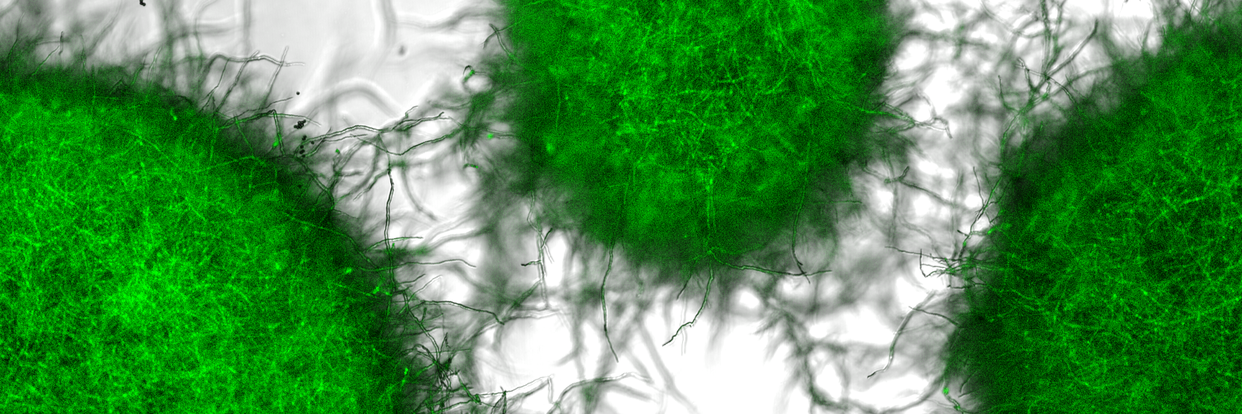
Natural substances are compounds synthesized by whole cells or enzymes. The wide range of products extends, for example, from dietary supplements (amino acids, vitamins) and enzymes for the food and detergent industries to active pharmaceutical ingredients. To make existing processes more efficient and to open up new areas of application, it is necessary to analyze the production strains and optimize the cultivation conditions as well as the parameters that influence morphology. A key area of research at ibvt is the cultivation and characterization of filamentous microorganisms. The research focuses on the quantitative investigation of filamentous structures and their bioagglomerate stability and variability under various cultivation conditions (including hydromechanical stress, mass transfer, rheology, and productivity). In current research, expertise gained from eukaryotic systems (fungi) is also being applied to filamentous prokaryotic systems (actinomycetes) that produce new antibiotics. In addition, the ibvt is developing a broad repertoire of methods for morphology engineering to steer cellular morphology toward higher productivity. To study the morphology of filamentous microorganisms, the following techniques were introduced: oxygen microelectrode technique, confocal laser scanning microscopy, focused beam reflection microscopy, laser diffractometry, image analysis, cryomicrotomy, and pellet sedimentation. To quantify the structure of pellets, nondimensional morphological metrics were developed.