On this page you will find everything you need to know about the Bachelor's degree programme in Computer Science.
This Bachelor's degree programme covers all areas of computer science. All students must take compulsory and compulsory elective courses in computer science, mathematics and a minor subject. Every student must complete at least one work placement. In addition, a final thesis lasting three months must be completed.
In order to complete the Bachelor's degree programme in Computer Science, you must earn a total of 180 credit points (CP).
The credit points are distributed across the various areas of the Bachelor's degree programme in Computer Science as follows:
In the first semesters, students learn the basic principles and methods of computer science and mathematics. They provide an indispensable basis for finding reliable and optimal solutions to the various application problems later on and are therefore compulsory for all students.
| Title of Module | Credits | Semester | Professor |
|---|---|---|---|
| Algorithmen & Datenstrukturen | 8 LP | WS | Prof. Sándor Fekete |
| Programmieren 1 | 6 LP | WS & SS | Prof. Martin Johns |
| Programmieren 2 | 6 LP | SS | Prof. Martin Johns |
| Propädeutikum | 6 LP | WS & SS | various professors |
| Technische Informatik | 5 LP | SS | Prof. Rolf Ernst |
| Theoretische Informatik 1 | 5 LP | WS | Prof. Roland Meyer |
| Theoretische Informatik 2 | 5 LP | SS | Prof. Roland Meyer |
| Einführung in die Logik | 5 LP | SS | Prof. Roland Meyer |
| Title of Module | Credits | Semester | Professor |
| Analysis für Informatiker | 10 LP | Winter | Prof. Thomas Sonar |
| Lineare Algebra für Informatiker | 10 LP | Sommer | Prof. Thomas Sonar |
| Diskrete Mathematik für Informatiker | 5 LP | Sommer | Prof. Bettina Eick |
| Title of Module | Credits | Semester | Professor |
| Betriebssysteme | 5 LP | Sommer | Prof. Rüdiger Kapitza |
| Computernetze 1 | 5 LP | Sommer | Prof. Lars Wolf |
| Einführung in die IT-Sicherheit | 5 LP | Winter | Prof. Konrad Rieck |
| Relationale Datenbanksysteme 1 | 5 LP | Sommer | Prof. Wolf-Tilo Balke |
| Software Engineering 1 | 5 LP | Winter | Prof. Ina Schaefer |
| Softwareentwicklungspraktikum* (SEP) | 7 LP | Sommer | Prof. Ina Schaefer |
In the compulspry-elective area "Computer Science", 30 credit points must be achieved through the courses from chart A, in addition to one seminar and one team project (section B).
| Title of Module | Credits | Semester | |
| Algorithmen und Datenstrukturen2 | 5 | SS | |
| Algorithmik-Praktikum | 5 | WS & SS | |
| Bild- und Signalerzeugung in der Biomedizin | 5 | SS | |
| Computergraphik - Grundlagen | 5 | WS | |
| Computergraphik - Grundlagenpraktikum | 5 | WS & SS | |
| Cloud Computing | 5 | SS | |
| Einführung in Algorithm Engineering | 5 | WS | |
| Einführung in die Medizinische Informatik | 5 | WS | |
| Elektronische Grundlagen der Technischen Informatik | 5 | SS | |
| Grundlagen der Digitalen Schaltungstechnik | 5 | WS | |
| Grundlagen Maschinelles Lernen | 5 | SS | |
| Hardware-Praktikum | 5 | SS | |
| Hardware-Software-Systeme | 5 | WS | |
| Medizinische Informationssysteme A | 5 | SS | |
| Netzwerkalgorithmen | 5 | SS | |
| Praktikum Cloud Computing | 5 | WS | |
| Praktikum Einführung in die Technische Informatik | 4 | WS & SS | |
| Praktikum Enterprise Applications | 5 | WS | |
| Praktische Aspekte der Informatik | 6 | WS & SS | |
| Raumfahrtelektronik 1 | 5 | SS | |
| Rechnerstrukturen 1 | 6 | SS | |
| Repräsentation und Analyse medizinischer Daten | 5 | WS | |
| Verteilte Systeme | 5 | SS |
A module that is not listed in the appendices or in a list of additional possible modules approved by the Computer Science Examination Board may, upon application by a student to the Computer Science Examination Board, be additionally approved, provided that said module meaningfully complements the student’s study plan (BPO 2017, § 4 Para. 11).
B) In addition to the 30 credits in the compulsory-elective area of Computer Science, a team project (5 credits, through coursework) and a seminar (5 credits, through examination) must be successfully completed.
While you register independently through the offering institute for the team project of your choice, seminars are assigned through a separate allocation process. Please make sure to take care of it early enough.
Furthermore, it is possible to incorporate Master’s modules into the "Computer Science Cumpulsory-Elective Area" of the Bachelor’s program (Note: Limited to modules totaling a maximum of 15 credit points; see BPO 2017, § 4 Para. 11). A corresponding application template (only in German) for the Examination Committee is available for this purpose as well: Please note that this form requires the signature of the respective professor/lecturer!
The respective application form, along with the corresponding exam registration form, must be submitted to the Computer Science Examination Office no later than during the exam registration week. Incomplete forms (e.g., those lacking the lecturer's signature) will not be accepted and cannot be submitted later once the exam registration week is over. Therefore, we kindly ask that you obtain the lecturer's signature in good time.
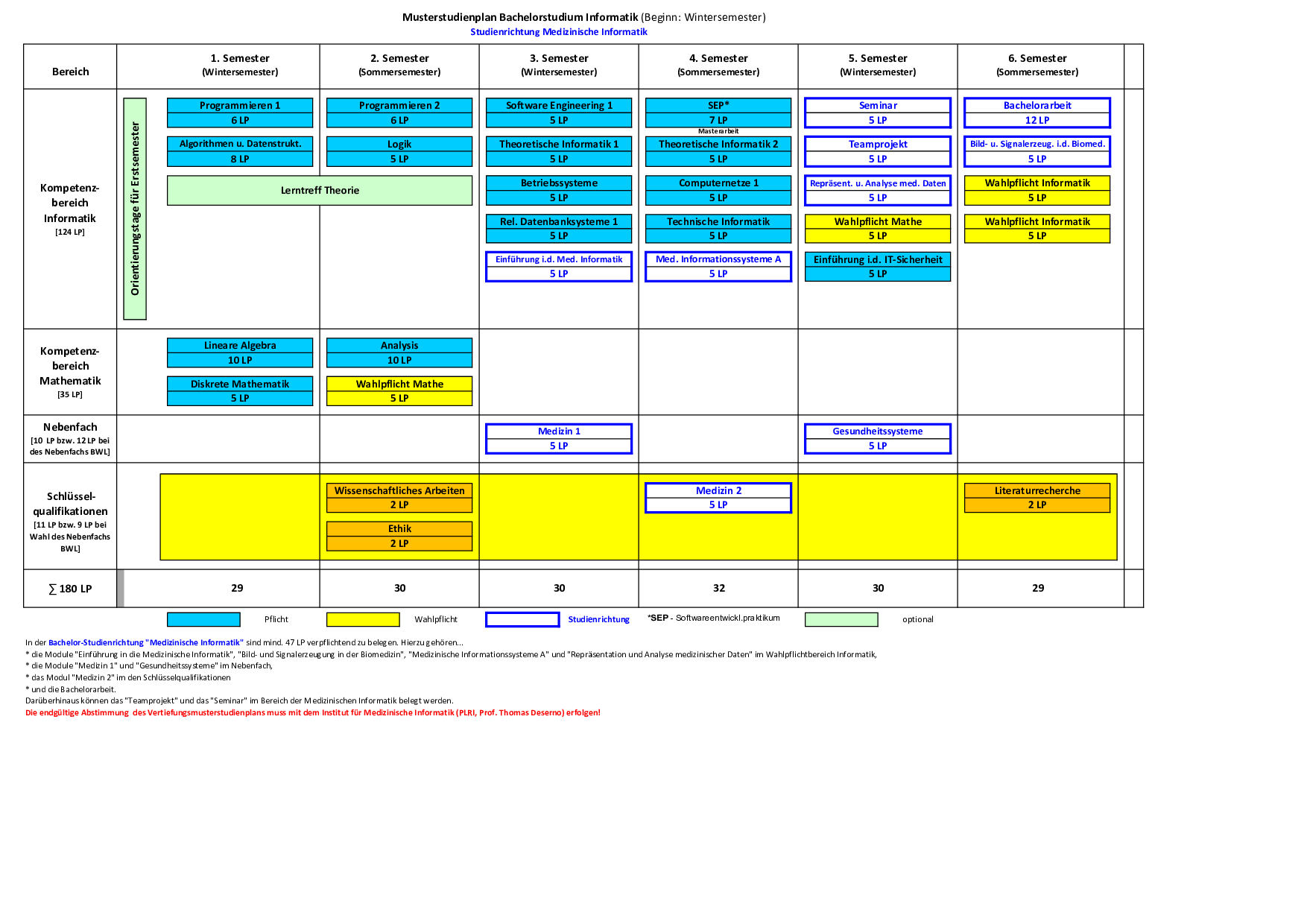
In the Computer Science Bachelor's programme at TU Braunschweig, you have the opportunity to select the specialization in Medical Informatics.
In accordance with the Bachelor's Examination Regulations (BPO 2017), this requires the completion of modules (comprising both examinations and coursework) within the field of Medical Informatics, totaling at least 47 credit points (including the Bachelor's thesis). Pursuant to § 3 Para. 4 of the BPO 2017, modules completed by the student as "additional examinations" may also be counted toward fulfilling this required minimum of 47 credit points. Additionally, the module "Medicine 2" must be completed within the Key Qualifications section.
Upon successful completion of these modules, and following a separate formal application, the specialization "Medical Informatics" will be officially designated on your Bachelor's degree certificate and transcript.
To coordinate your individual study plan with the modules of the "Medical Informatics" specialization, please contact the Peter L. Reichertz Institute for Medical Informatics (PLRI).
The following modules are offered for the Bachelor's specialization in "Medical Informatics":
| Title of Module | Credits | Semester | Suited for |
|---|---|---|---|
| Einführung in die Medizinische Informatik (INF-MI-61) | 5 LP | Winter | 3rd Semester |
| Medizinische Informationssysteme A (INF-MI-62) | 5 LP | Summer | 4th Semester |
| Repräsentation und Analyse medizinischer Daten (INF-MI-68) | 5 LP | Winter | 5th Semester |
| Bild- und Signalerzeugung in der Biomedizin (INF-MI-75) | 5 LP | Summer | 6th Semester |
Minor of Medicine:
Further information regarding the courses offered by the Peter L. Reichertz Institute for Medical Informatics can be found either in the TU Braunschweig online course catalog or on the Institute's website.
| Title of Module | Credits | Semester | Suited for |
|---|---|---|---|
| Medizin I (INF-MI-69) | 5 LP | Winter | 3rd Semester |
| Gesundheitssysteme (INF-MI-59) | 5 LP | Winter | 5th Semester |
Compulsory Modules:
Additional modules that can be completed in the field of Medical Informatics when choosing this study branch:
Further information regarding courses offered by the Peter L. Reichertz Institute for Medical Informatics can be found either in the online course catalog of TU Braunschweig or on the Institute's website.
The following applies to all minor subjects listed here:
Details regarding the content and language of individual courses, as well as their times and locations, can be found in the online course catalog by first selecting the correct semester and then entering the corresponding course number.
The following minor subjects are offered:
The minor subject includes the following modules:
Both compulsory modules must be completed.
The two following compulsory modules must be completed:
Of the three modules—"Algebra für Informatiker", "Numerik für Informatiker" and "Einführung in die Stochastik für Informatiker"—only the module can be taken, that has not yet been completed within the compulsory-elective area Mathematics. From the remaining modules, students may choose freely:
[Only in Winter Semester]
[Only in Summer Semester]
The two mandatory modules "Gesundheitssysteme" and "Medizin 1" must be completed.
The two mandatory modules "Philosophie für TechnikwissenschaftlerInnen (1)" and "Philosophie für TechnikwissenschaftlerInnen (2)" must be completed.
The following regulations apply to both modules:
Modules:
The compulsory module "Raumfahrttechnische Grundlagen" must be completed first, followed by one additional compulsory-elective module.
Both mandatory modules "Grundlagen der digitalen Signalverarbeitung" and "Sprachkommunikation" must be completed.
The courses offered within the "Key Qualifications" module are designed to enable students to contextualize their own field of study within broader societal, historical, legal, or career-oriented frameworks. For instance, students acquire knowledge of theories and methods drawn from other, unrelated academic disciplines; this way, they engage in interdisciplinary exchange and collaboration with students from fields of study outside their own.
In addition, there are specialized "training courses" intended to empower students to apply knowledge acquired in other areas more effectively, to facilitate smoother and more constructive collaboration with other.
Which courses can I take for the "Key Qualifications" requirement?
ACADEMIC WORK SKILLS
Save valuable study time through structure and systematic organization! Whether the topic is literature research, source management, copyright law, or academic writing and presentation—here you will learn how to conduct academic work properly, thereby saving yourselves a great deal of time and stress. A significant practical component provides you with the opportunity to put these skills to the test.
TRAINING IN ACTION-ORIENTED COMPETENCIES
Within the "Key Qualifications" module, students are required to complete courses totaling 5 credit points. These credits may be earned through courses selected from the "Gesamtprogramm überfachlicher Qualifikationen", or from the courses offered by the Chair of Industrial/Organizational and Social Psychology at TU Braunschweig.
POOL MODEL
For a list of courses offered during the current semester as part of the "Gesamtprogramm überfachlicher Qualifikationen" (the so-called "Pool Modell"), please visit the online course catalog. Specifically, navigate to: "Veranstaltungen" => "Vorlesungsverzeichnis" => "Besondere Verzeichnisse" => "Pool (überfachliche Qualifikation)".
SCOUT
The new SCOUT program, organized by the Institute of Industrial/Organizational and Social Psychology, aims to better integrate international students at TU Braunschweig into the daily routine of university life in Germany. As part of this program, international students are systematically paired with a "SCOUT" (a German-speaking partner) for the duration of one semester. Through both individual and group meetings, participants establish intercultural connections and build key competencies. Doing the SCOUT program can be credited once for the "Key Qualifications" module, earning 2 credit point (unfortunately, international students participating in the program are not eligible to receive these credits). SCOUT Programme
SOS – Studying Without Language Barriers
In the SOS program, German-speaking students serve as language coaches, assisting their international peers in understanding course content and acquiring both general and subject-specific language skills. The SOS program can be credited once for the "Key Qualifications" module, earning 2 credit points (unfortunately, international students cannot claim these credits). SOS Programme
LANGUAGE COURSES
You may also take courses offered by the Language Centre as part of the "Key Qualifications" module; these language courses can be credited for a maximum of 4 credits. Please note that Placement tests are required for certain language courses. Check out the Language Centre's website well before the start of semester to familiarize yourself with the applicable regulations.
Language courses may be credited starting from the following proficiency levels:
To earn credit points for language courses at a lower level (with the exception of English and German, for which the prescribed levels are strictly mandatory), you must submit a formal application to the Computer Science Examination Committee. This application must be accompanied by proof demonstrating that the language in question was not already acquired during your secondary school education.
Please note: In accordance with a resolution passed by the Computer Science Examination Committee, courses taught by Prof. Biegel may now be credited for a maximum of 3 ECTS credits each (recognized for Computer Science students within the scope of key qualifications). For the recognition of other modules not listed in the "Gesamtprogramm überfachlicher Qualifikationen" , a written application must also be submitted to the Examinations Office; the requirements stated above apply in such cases.
Please note that, to ensure successful participation in your chosen courses/modules, you must provide an active proof of academic achievement (e.g., written exam, oral exam, term paper, presentation, etc.). All achievements completed within the "Key Qualifications" module are recorded as ungraded academic credits—regardless of whether the specific achievement is designated as an examination or merely as an academic achievement in other degree programs.
For the recognition of any other modules, a written application must be submitted to the Examinations Office; the requirements stated above apply.
What cannot be included in the "Key Qualifications" module?
According to the General Examination Regulations of TU Braunschweig (§ 14), the Bachelor's thesis is intended to demonstrate that the student is capable of independently addressing a problem within their field of study—under supervision and within a specified timeframe—using scientific methods.
The Bachelor's thesis cannot be registered until the mandatory subjects of "Grundlagen der Informatik", "Grundlagen der Mathematik", and "Grundlagen der Informatik der Systeme" have been successfully completed.
The mandatory subject area "Grundlagen der Informatik" includes the module "Propädeutikum" (6 credits), which encompasses—among other things—"Literature Research".
Literature research is an academic achievement (2 credits) to be completed in preparation for the Bachelor's thesis; it is an integral component of the mandatory "Propädeutikum" module. Consequently, in terms of content, it is directly linked to the Bachelor's thesis and must be coordinated by the student with their supervising professor.
Upon successful completion of this task, the student receives a certificate from the supervising institute or professor, which must be submitted to the Computer Science Examination Office without delay. Once this certificate is received, the Bachelor's thesis may be officially registered.
The topic of the thesis may be assigned only by members of the faculty group within the Department of Computer Science or by full-time *Privatdozenten* (senior lecturers) within the Department of Computer Science. Detailed information regarding this procedure is available at the Computer Science Examination Office. Please do not attempt to independently secure a thesis topic on your own (please refer to the FAQ section for further details).
The nature of the assignment and the specific terms of reference must be definitively established at the time the thesis topic is assigned. Prior to the evaluation of the thesis, the student is required to deliver a presentation of approximately 30 minutes in duration, in which they present their work. This presentation may contribute up to 3 of the total 12 credit points to the final grade of the thesis, provided that the presentation serves to meaningfully complement the achievement of the qualification objectives associated with the chosen topic. Upon assigning the topic, the examiner shall indicate whether—and to what extent—the presentation will contribute to the final grade.
The period from the assignment of the topic to the submission of the Bachelor's thesis is three months. The topic may be changed only once, and only within four weeks of its assignment.
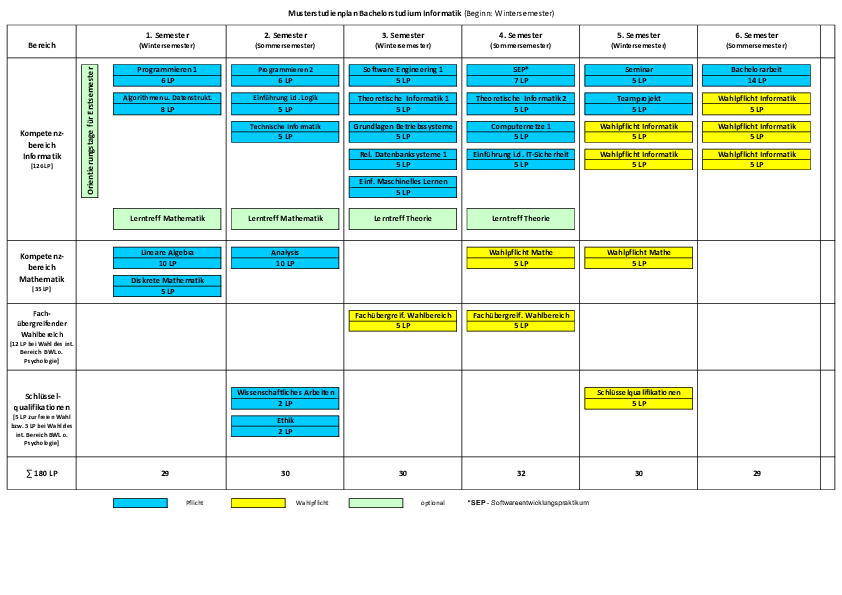
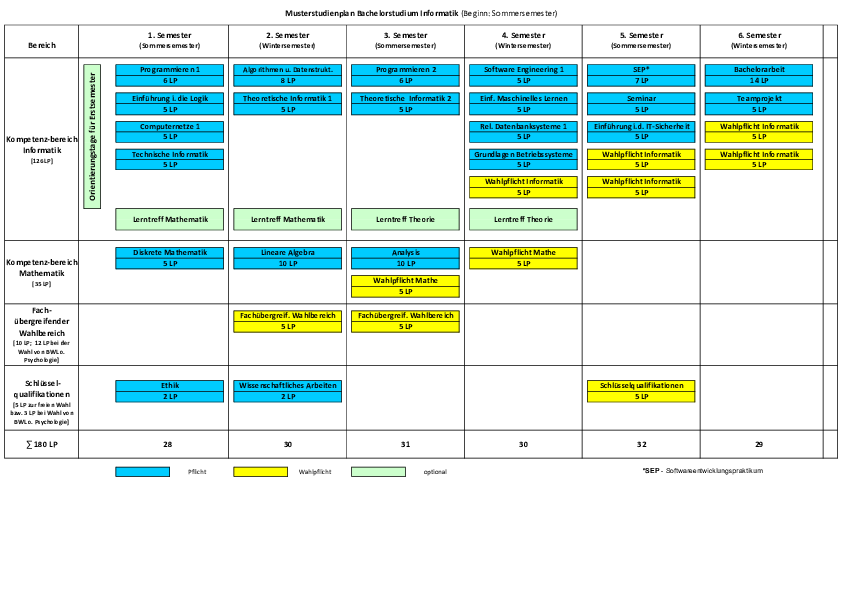
The sample timetables are intended as a structuring aid for your study programme. However, they are not binding and can be adapted by you depending on the time and effort required.
The total scope of the Bachelor's degree programme in Computer Science is 180 credit points (CP). The exact number of credit points for the modules listed below can be found in the examination regulations that apply to you
Sample timetables Bachelor BPO 2017
Click on the respective image to display the sample timetable.
We recommend that students organise a semester abroad in good time. Due to the lead time, it is advisable to plan a semester abroad from the 3rd semester onwards. Due to the wide range of options in the Bachelor's programme, it is relatively easy to have credits from abroad recognised. You can obtain further information on the recognition procedure from your international coordinator.
Information on possible partner universities can be found on the website of the International Office. Plan your semester abroad well in advance, as the application deadlines are approx. 5 (Erasmus, Europe) or 9 (rest of the world) months before the start of the semester abroad. Relevant information on formalities and funding opportunities can also be found on the website of the International Office. Please also look out for the monthly information events on Europe and overseas.
When studying, it is essential to always be quickly supplied with the most important information.
The Computer Science mailing list (cs-studs) is the central information channel and provides information on current dates and news. It is also intended to promote dialogue between students and serve as a discussion forum. It is also used to publicise company-related vacancies (e.g. jobs, internships, student traineeships).
Please make sure that your degree programme is entered correctly in your Stud.IP profile and contact Stud.IP support in good time if you have any problems.
The following degree programmes are eligible for the Computer Science seminar allocation procedure:
- Computer Science (BA/MA)
- Information Systems Engineering (BA/MA)
- Business Informatics (BA/MA)
- Data Science (MA)
In the period from Thursday, 4 July (from 12:00 noon) to Wednesday, 10 July 2024 (until 12:00 noon), applications for the lottery procedure can be submitted online via Stud.IP.
The y-number is required for login (user ID).
# Seminar search:
You can find the desired seminar by entering the title "Seminar Informatik WS 2024/25 ..." in the global search, e.g. "Seminar Informatik WS 2024/25 Information Systems".
Please note: As the current allocation procedure refers to the seminars in the winter semester 2024/25, the current summer semester 2024 must be deleted in the "Global Search" before searching for the seminar title.
Now all seminars are listed that are offered in the winter semester 2024/25 under the beginning of the title "Seminar Computer Science WS 2024/25...". Select a seminar from this list as an example and click on it (e.g. the desired seminar).
# Prioritisation
On the seminar page that now opens, select "Access to the course" from the menu on the left-hand side. A window will now open with the title "The places in this course will be allocated automatically", in which the prioritisation is to be carried out.
You can prioritise by clicking on the courses on the left-hand side ("Available courses") for your degree programme and dragging them to the right-hand side ("Selected courses"). In doing so, you should arrange the seminars dragged to the right in an order that corresponds to your individual interest in the respective seminar topic.
Once this process is complete, please don't forget to click on "Save" at the bottom of the window and then on "Close"! The current status of your application for the lottery procedure can be viewed under "My courses". As a rule, Stud.IP also always sends an automatically generated notification/email.
It is strongly recommended that you prioritise as many, if not all, of the courses admitted to or eligible for your degree programme as possible. This will increase your chances of being allocated a place on a seminar participant or waiting list!
When using the lottery procedure in Stud.IP, there is no automatic target group-specific entry in the seminars (e.g. only BA Info, Winfo, IST are allowed, but no MA programmes).
Therefore, please prioritise only those seminars that are approved for your degree programme or degree!
The authorised target groups are now indicated directly in the Stud.IP seminar title as well as on the seminar websites.
Please note: If you have mistakenly prioritised a seminar that is not intended for your degree programme or degree, you will be removed from this seminar before the deadline on 11.07. at 18:00!
It may be that you have only been allocated a place on a waiting list during the 1st phase (draw) (=> see "My events").
From Thursday, 11 July 2024 (from 18:00) until Tuesday, 16 July 2024 (until 12:00) in phase 2 of the application procedure, you have the opportunity to register for a remaining place in the first-come-first-served procedure, to withdraw completely or to withdraw from the allocated seminar and switch to a less busy seminar on a participant or waiting list place. Multiple registrations are not possible.
The binding registration and thus the confirmation of your "reservation" will only take place during the respective preliminary seminar discussion ("kick-off") with the seminar supervisor at the institute. This is also where the individual seminar topics are allocated.
The following applies: If you do not turn up to the kick-off without a valid excuse, you will not be considered for the allocation of seminar places!
By attending the preliminary seminar meeting at the institute, you are bindingly registering for the seminar with your signature on the registration list!
As the completion of a seminar is compulsory in the Bachelor's or Master's degree programme in Computer Science, students who have not yet attended a seminar will be given preference when allocating places.
If it should turn out that participation in the seminar in the winter semester 2024/25 is not possible after all, the cancellation must be made no later than 2 weeks after the start of lectures (Monday, 28 October 2024).
Please note: Cancellation is made by e-mail to the seminar supervisor, after 28 October 2024 the registration is binding! Cancellation of the seminar at a later date is no longer possible and will be counted as a failed examination attempt (grade 5.0), as the seminar is an examination.
Consulting hours
Address
Room 127
Rebenring 58a
38106 Braunschweig
Vacancies of TU Braunschweig
Career Service' Job Exchange
Merchandising
Term Dates
Courses
Degree Programmes
Information for Freshman
TUCard
Technische Universität Braunschweig
Universitätsplatz 2
38106 Braunschweig
P. O. Box: 38092 Braunschweig
GERMANY
Phone: +49 (0) 531 391-0