
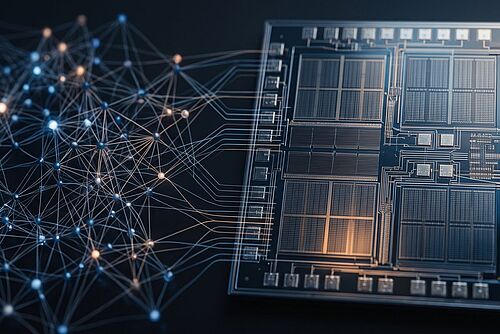
Our research combines emerging memory devices, circuit design and algorithms into energy-efficient, brain-inspired computing systems. We work along the entire chain from the physical device through the integrated circuit to the trained neural network that runs on the chip. The goal are systems that evaluate sensor data right where it is captured, with minimal energy consumption.
Ferroelectric transistors (FeFET, FeMFET) and capacitors (FeRAM) based on doped hafnium oxide (HfO2, HZO) are CMOS-compatible, non-volatile memories with very low energy consumption. We study device physics, reliability and multi-level programming as well as integration into advanced technology nodes such as 22 nm FDSOI.

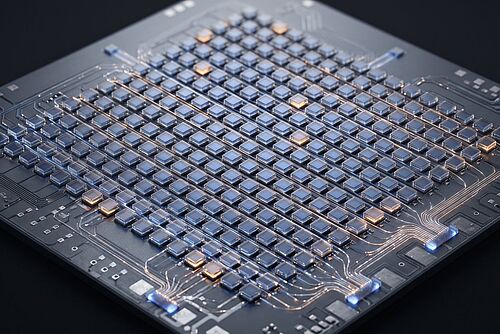
Computing in memory executes matrix-vector multiplications and associative search operations directly within the memory array. We design analog and digital compute-in-memory architectures based on ferroelectric and other emerging memories and develop the associated periphery, such as configurable sense amplifiers and converters.
Spiking neural networks process information in an event-driven and therefore extremely frugal manner. We develop CMOS neuron and synapse circuits, learning rules for on-chip adaptation and ultra-low-power ASICs for applications such as anomaly detection at the edge.
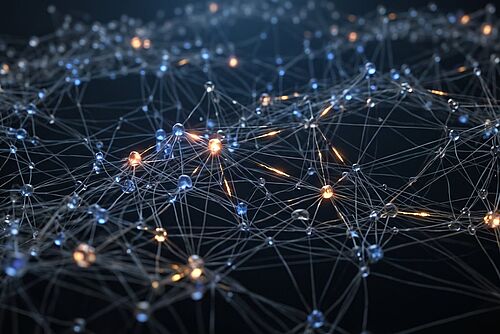
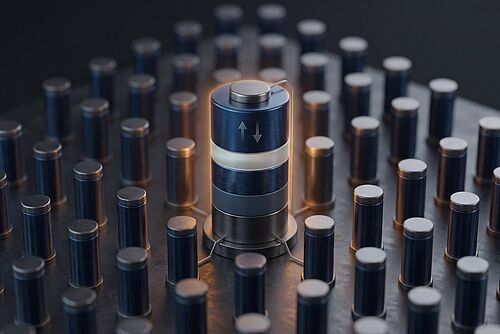
Stochastic devices such as magnetic tunnel junctions serve as entropy sources for probabilistic bits (p-bits). We use them to solve optimisation problems close to the hardware and explore hyperdimensional computing for robust, hardware-efficient classification.
We build end-to-end design flows that reach from training a neural network through automated circuit and layout synthesis to tape-out, both for open process design kits (e.g. IHP) and for industrial technologies.
The institute works closely with the Fraunhofer Institute for Photonic Microsystems IPMS in Dresden, whose 300 mm technology line enables the fabrication of ferroelectric devices and their integration into industrial CMOS processes. We also take part in national and European collaborative projects, including the EU project NeAIxt, and cooperate with industrial partners and universities in Germany and abroad.
We continuously offer Bachelor's and Master's theses as well as study and project work on our research topics, ranging from circuit design and device characterisation to the training and compression of neural networks for hardware. If you are interested, please get in touch, also with your own topic proposals. Contact persons are listed on the Team page.