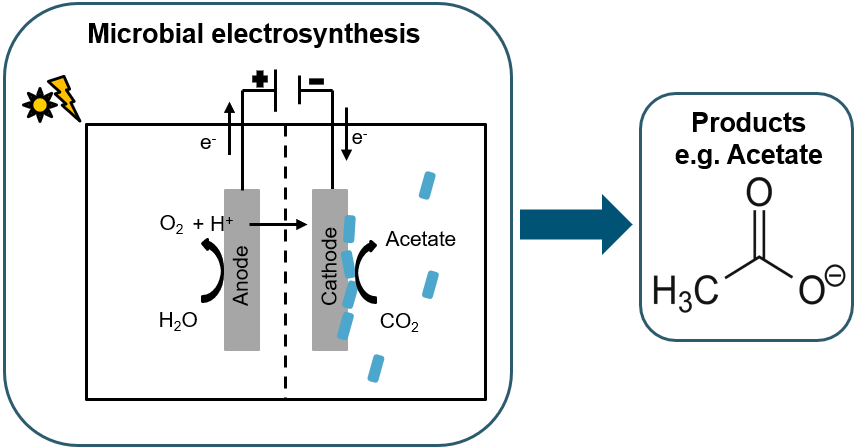

Bioelectrochemical systems have become increasingly important in recent years, particularly in light of the growing shift toward an economy based on renewable energy sources. One of the greatest challenges in this context is the storage of electrical energy generated by sources such as wind and solar power. Bioelectrosynthesis holds great potential for storing electrical energy in chemical products and for CO₂ fixation. Its appeal lies in the ability to carry out complex electrochemical transformations—such as the reduction of carbon dioxide to low-molecular-weight organic compounds—under very mild conditions and with efficient use of electrical energy.
Bioelectrochemical systems typically consist of an anode and a cathode, which may be separated by a membrane and surrounded by an electrolyte solution. Depending on the biological system, electrochemically active microorganisms transfer electrons to the anode or accept electrons from the cathode. This electron transfer is referred to as extracellular electron transfer (EET) and enables microorganisms to establish themselves on electrodes in the form of electrochemically active biofilms and to use these electrodes as electron sources or sinks. This interaction between microorganisms and electrodes offers the possibility of releasing electrical energy from oxidative microbial processes (microbial fuel cells) as well as storing electrical energy in low-molecular-weight products through reductive microbial processes (bioelectroscience). The resulting microbial electrochemical technologies (MET) thus open up avenues for the development of novel biotechnological applications and process designs.
The goal of the project is to characterize the reaction kinetics of microbial electrosynthesis in a continuous retentostat using pure and defined mixed cultures. Furthermore, the characterization of the electrochemical biofilms forming on the electrodes provides important insights into the system. Based on these investigations, scale-up and process modeling can be carried out.