
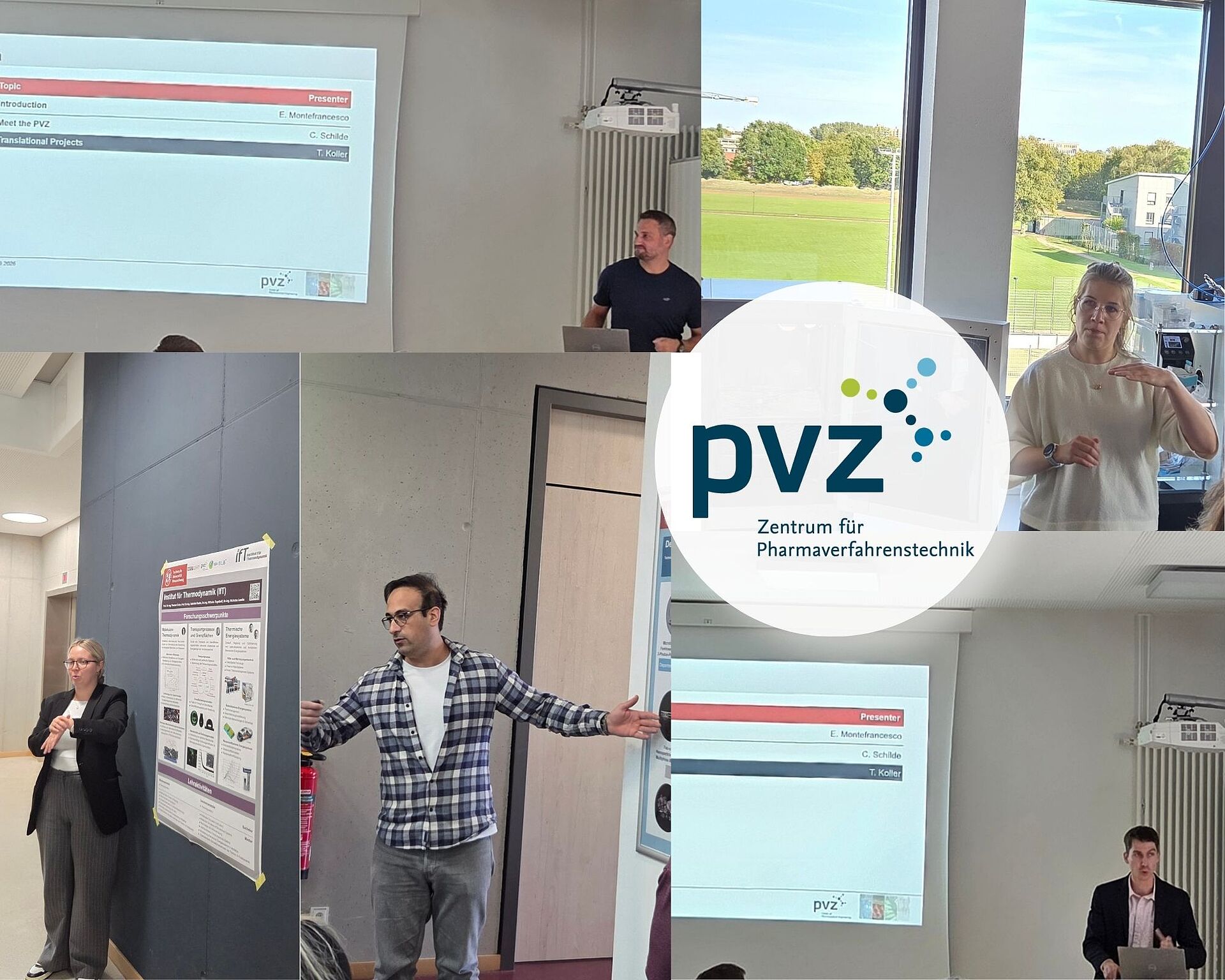
During the 61st Working Conference of Pharmaceutical and Veterinary Regulatory Officials and Scientific Staff from the State Drug Testing Agencies (PhAT) in 2026, participants gained fascinating insights into the PVZ and its diverse opportunities for research, innovation, and technology transfer. Following opening remarks by Prof. Heike Bunjes, Emanuela Montefrancesco, Carsten Schilde, and Thomas Koller presented the PVZ. Their presentation highlighted how the center is integrated into the Technical University’s core research areas as well as into the regional innovation and biotechnology ecosystem. Particular emphasis was placed on the connection between:
-
artificial intelligence and digital methods,
-
scientific process understanding,
-
projects that translate pharmaceutical research into clinical applications,
-
collaborations with industry partners and research institutions.
The subsequent tour covered several key areas of the PVZ. In the bioprocess engineering pilot plant, the PVZ’s biotechnological capabilities were demonstrated. The focus was on genetically modified microorganisms that can be used to produce active pharmaceutical ingredients on a scale ranging from a few microliters up to 100-liter pilot bioreactors. These enable the production of various active ingredients such as antibiotics, biologics (such as antibodies or insulin), and RNA (as used in COVID-19 vaccines). From cultivation in the bioreactor to cell separation using a disc separator and on to the purification of the active ingredients, participants were able to follow key process steps.
Research in this field requires a great deal of modern measurement technology, which was also a topic covered during the tour. Thermodynamic models and reliable, experimentally determined material data form an important foundation for the design, simulation, and optimization of biotechnological processes. Among other things, they enable the evaluation of thermal conductivity, diffusion behavior, and wetting properties, as well as the selection of suitable operating conditions and separation methods. In the field of imaging techniques, electron microscopy and atomic force microscopy were presented.
However, producing the active ingredient alone is not sufficient for a dosage form; it also requires the production of a form that can be ingested or administered. At the PVZ’s formulation pilot plant, visitors were able to observe the entire process chain for the formulation of solid dosage forms on a laboratory and pilot scale. The production of tablets was highlighted in particular; the presentation covered not only the traditional processes of mixing, granulation, and drying through to tableting and film coating, but also innovative and continuous processes such as melt extrusion for investigating the production of 3D-printing filament containing active pharmaceutical ingredients, which is used to manufacture customized medications.
The overview of drug manufacturing and formulation was rounded out by a tour of the laboratories at the Institute of Microtechnology (IMT), where participants were able to learn about the development and production of microfluidic systems. The application of these systems for preclinical testing of drugs was demonstrated in the neighboring laboratories of the Institute for Pharmaceutical Technology and Biopharmacy (IPhTB). Here, participants learned about the potential and importance of these testing systems in reducing the number of animal tests required during drug development.
Many thanks to everyone involved for the fascinating insights and the fruitful exchange!