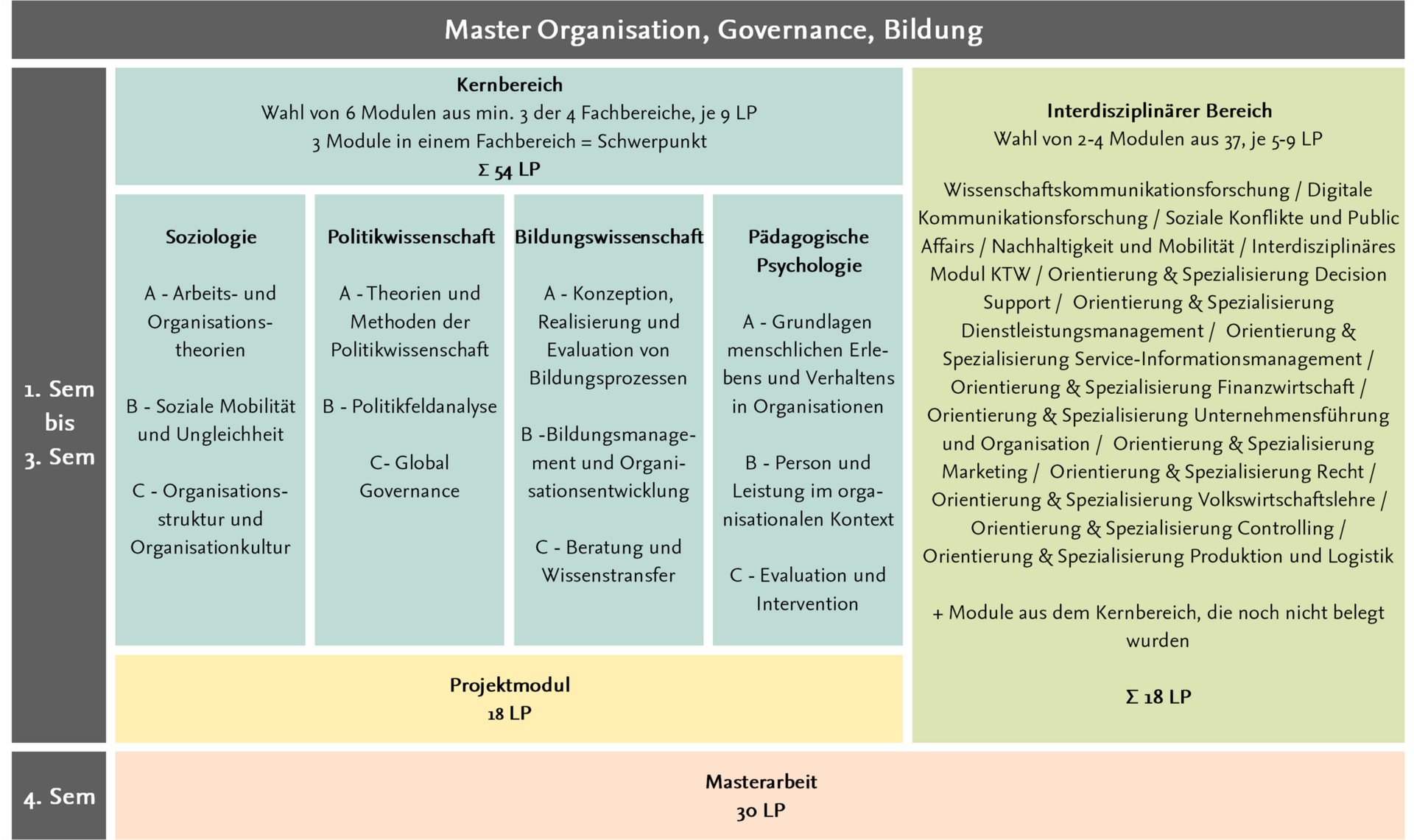
Through the study of relevant areas of sociology and political science as well as educational science and educational psychology, graduates will gain an understanding of the structure, functioning, tasks and interests of governmental and non-governmental organizations and their national and international social environment. Based on this, they will be able to develop concepts for development, legitimation and change processes in organizations, society, politics or education, and to guide and steer implementation processes. In doing so, they can draw on knowledge about specific requirements for educational processes and knowledge acquisition in organizations and politics, which the program conveys in a practice-oriented manner through project modules. The program provides the foundations for independent scientific research (doctorate).
The Core Area
The core area consists of the core modules from the four disciplines of sociology, political science, educational studies and educational psychology. In this area, you must select six modules from at least three of the four disciplines. By choosing three modules within a single discipline, you are opting for a specialisation in that subject area.
Each module is worth 9 credits and concludes with a final module examination.
Through the ‘Sociology’ specialisation, students gain in-depth knowledge of the analysis, evaluation and design of organisational change and organisational cultures. They acquire the knowledge and skills required to analyse and evaluate the labour market and mobility. Furthermore, students are equipped to develop specific organisational, human resources and professional development concepts, as well as to initiate internal organisational learning processes.
Students of the specialisation in “Political Science” are equipped to apply recent concepts of the coordination of state, market and society to problem areas in national and international politics. They learn about current concepts in cooperation and compliance research. They are qualified for specialised roles in the fields of policy consultancy and public affairs.
Through the specialisation in ‘Educational Science’, students learn to plan, design and evaluate learning and educational processes in a theory-driven manner. They develop practical skills relating to tools for educational management, human resources development and organisational development. They learn to implement consultancy approaches at both the individual and organisational levels and acquire practical skills regarding various tools for knowledge transfer.
Students on the ‘Educational Psychology’ specialisation acquire key competencies in the planning, implementation and evaluation of educational-psychological interventions. These skills are underpinned by foundational knowledge in the field of human experience and behaviour within organisational contexts.
The Interdisciplinary Area
In the interdisciplinary area, students take modules covering 18 credits. The choice ranges from core modules not yet taken to modules in economics, communication studies and the culture of technical sciences. By selecting two further core modules in the interdisciplinary area, students have the opportunity to pursue a second area of specialisation.
The Project Module
The project module focuses on the application and practical testing of the knowledge already acquired within the context of a project. The project may be integrated into the lecturers’ ongoing research projects within the programme, but students may also choose their own project topics. The project module may lead to the six-month Master’s thesis. This combination of theory and practice underscores the fact that the programme is equally research- and practice-oriented.
The Master's Thesis
The Master’s thesis is completed at the end of the programme. The aim of the Master’s thesis is to enable students to independently explore a topic in the social sciences or educational sciences and to analyse it using academic and methodological approaches. The six-month writing period is followed by a 45-minute oral defence.