
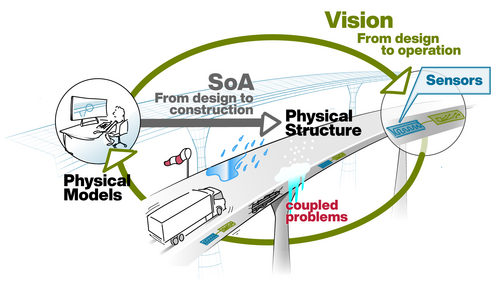
Modeling + Numerics + Machine Learning
Engineers develop models based on physical considerations and observational data to design, monitor and control infrastructures, products and processes. Realistic models can only be solved numerically with the aid of computers. Tailored machine learning approaches help us to link the information from experiments, sensing and simulations to build next generation models: digital twins.
We are always open to collaborative research with academia and industry - contact us!
Model calibration, discovery and update
Engineers often have to deal with incomplete observations. Given such incomplete information, what is the stress field inside a steel girder? How does the flow field inside a river look like? Inverse modeling and parameter identification are our strategies to relate sparse information to what remains hidden to the human eye. If the computational model that has been used to design a product, process or infrastructure, becomes outdated due to ageing or damage effects, efficient model updating strategies need to be employed.
V. Knauf Narouie, J.-H. Urrea-Quintero, Cirak, F. and H. Wessels. “Unsupervised Constitutive Model Discovery from Sparse and Noisy Data.” Computer Methods in Applied Mechanics and Engineering 452 (2026). 10.1016/j.cma.2025.118722 Open Access
J.-H. Urrea-Quintero, D. Anton, L. de Lorenzis and H. Wessels. “Automated constitutive model discovery by pairing sparse regression algorithms with model selection criteria.” Computer Methods in Applied Mechanics and Engineering 449 (2026). 10.1016/j.cma.2025.118551 Open Access
V. Narouie, H. Wessels, F. Cirak and U. Römer. “Mechanical state estimation with a Polynomial-Chaos-Based Statistical Finite Element Method." Computer Methods in Applied Mechanics and Engineering 441 (2025). 10.1016/j.cma.2025.117970 Open Access
D. Anton, J.-A. Tröger, H. Wessels, U. Römer, A. Henkes and S. Hartmann. „Deterministic and statistical calibration of constitutive models from full-field data with parametric physics-informed neural networks.” Advanced Modeling and Simulation in Engineering Sciences 12.1 (2025). 10.1186/s40323-025-00285-7 Open Access
U. Römer, S. Hartmann, J.-A. Tröger, D. Anton, H. Wessels, M. Flaschel and L. de Lorenzis. “Reduced and All-at-Once Approaches for Model Calibration and Discovery in Computational Solid Mechanics“. In Applied Mechanics Review (2025). 10.1115/1.4066118 Open Access
L. Paul, J.-H. Urrea-Quintero, U. Fiaz, A. Hussein, H. Yaghi, J. Stahlmann, U. Römer and H. Wessels. “Gaussian processes enabled model calibration in the context of deep geological disposal.” Data-Centric Engineering 6 (2025). 10.1017/dce.2025.17 Open Access
Multi-scale modeling
It is understood that the composition and structure of materials at smaller scales determines their behavior on the component scale that is relevant for designers. We develop data-driven models to exploit this understanding for the optimization of materials in virtual design loops and for their monitoring during service life.
H. Danesh and H. Wessels. "Bayesian-guided inverse design of hyperelastic microstructures: Application to stochastic metamaterials." arXiv preprint (2026). 10.48550/arXiv.2603.15917 Open Access
A. Henkes and H. Wessels. “Three-dimensional microstructure generation using generative adversarial neural networks in the context of continuum micromechanics“. In: Computer Methods in Applied Mechanics and Engineering 400 (2022). 10.1016/j.cma.2022.115497
A. Henkes, H. Wessels and R. Mahnken. “Physics informed neural networks for continuum micromechanics“. In: Computer Methods in Applied Mechanics and Engineering 393 (2022). 10.1016/j.cma.2022.114790
Additive manufacturing & multi-physics
Increased flexibility for designers is what made additive manufacturing popular. This flexibility is mostly due to the large amount of process parameters, which make process planning a complicated endeavor. With sophisticated computational methods we aim to increase this flexibility beyond what is known today, e.g. towards functionally graded materials.
A. Henkes, L. Herrmann, H. Wessels and S. Kollmannsberger. “Generative Adversarial Networks Enable OutlierDetection and Property Monitoring for Additive Manufacturing of Complex Structures”. In Engineering Applications of Artificial Intelligence (2024). 10.1016/j.engappai.2024.108993 Open Access
G. Agarwal, J.-H. Urrea-Quintero, H. Wessels and T. Wick. “Parameter identification and uncertainty propagation of hydrogel coupled diffusion-deformation using POD-based reduced-order modeling“. In: Computational Mechanics (2024). 10.1007/s00466-024-02517-w Open Access