

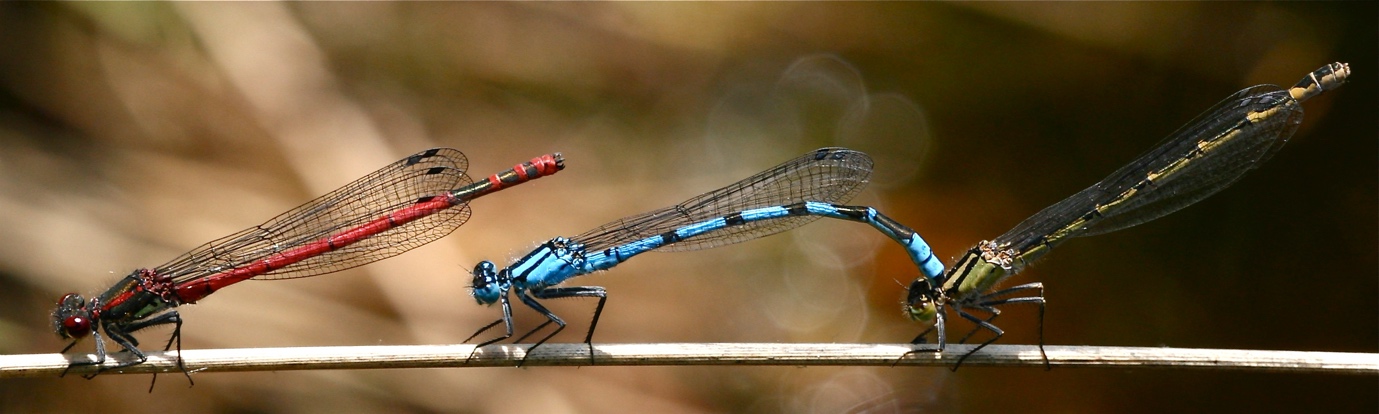
Dragonflies (Odonata) are fascinating insects with extraordinary flight capabilities and a wide range of behaviours. More than 6,000 species of dragonfly are known worldwide, and they are found on every continent except Antarctica. Dragonflies are semi-aquatic insects: their larvae live predominantly in freshwater, whilst the adult stage is terrestrial and seeks out flowing or still waters – varying according to species – for reproduction. Dragonflies are important predators in numerous habitats. In water bodies without fish, their larvae, as apex predators, can play a central role in the food chain.
We study the ecology of dragonflies, with a focus on their aquatic developmental stages. In doing so, we investigate how abiotic and biotic environmental factors influence their spatial distribution and habitat use. We are particularly interested in the processes of competition and predation between and on dragonfly larvae. Another focus is on the life cycles of various species. We investigate how dragonfly communities develop under the influence of climate change and other environmental changes, and what impact processes such as grazing around water bodies have. Together with several partners, we are also investigating the migration and dispersal patterns of dragonflies.
We study dragonflies in the field using traditional sampling methods and behavioural observations. Many of our studies are experimental in nature:
By deliberately manipulating living conditions in the laboratory and in the field, we investigate the influence of individual environmental factors. In addition, we use mathematical models to better understand ecological processes and quantify their effects.
Our research areas are predominantly in Europe and Africa. In African countries – currently mainly Nigeria and Uganda, as well as repeatedly in Namibia – we are helping to describe the diversity of dragonfly communities and the distribution of species in these countries, and are also working on identification keys.
Projects
Changing interactions in a changing climate
Dragonfly migration in northern Europe
Influence of grazing and succession on the dragonfly communities of ponds
Dragonfly biodiversity in Nigeria and Uganda
Contact: Prof. Dr. Frank Suhling
Recent publications:
Hogreve, J., Johansson, F., & Suhling, F. (2026). Temperature-driven shifts in foraging behaviour during larval development in a dragonfly. Sci Rep, 16(1), 5258. doi:10.1038/s41598-026-37523-w
Samways, M. J., Córdoba‐Aguilar, A., Deacon, C., Alves‐Martins, F., Baird, I. R. C., Barmentlo, S. H., Brasil, L. S., Bried, J. T., Clausnitzer, V., Cordero‐Rivera, A., Datto‐Liberato, F. H., De Knijf, G., Dolný, A., Futahashi, R., Guillermo‐Ferreira, R., Hassall, C., Juen, L., Khelifa, R., Lozano, F., Muzón, J., Sahlén, G., Herrera, M. S. , Simaika, J. P. , Stoks, R., Suárez‐Tovar, C. M., Suhling, F., Tsubaki Y., & Vilenica, M. (2025). Scientists' warning on the need for greater inclusion of dragonflies in global conservation. Insect Conservation and Diversity, 18(4), 465–484. doi.org/10.1111/icad.12819
Ekpah, O., & Suhling, F. (2025). Occurrence and distribution of Odonata (Insect: dragonflies and damselflies) in Nigeria. International Journal of Odonatology, 28, 146–158. doi:10.48156/1388.2025.1917346