
Changes to the examination regulations for the Master’s programme in Industrial Engineering and Mechanical Engineering will come into force in the 2026/27 winter semester.
Standard period of study: 4 Semester
Language: German
Degree: Master of Science (M.Sc.)
Application period:
1st June – 15th July (winter semester)
1st December – 15th January (summer semester)
Facts about financing your studies in Germany
Learn more...
The Master's programme is based on the undergraduate Bachelor's programmes of the Faculty of Mechanical Engineering, in particular the Bachelor's programme Industrial and Mechanical Engineering.
The diagram below shows the structure of the degree programme. (english version follows soon)
For a complete and detailed description of all the modules included in the degree programme, please refer to the module handbook (MHB) on the ‘Documents – Master’s in Industrial Engineering’ page.
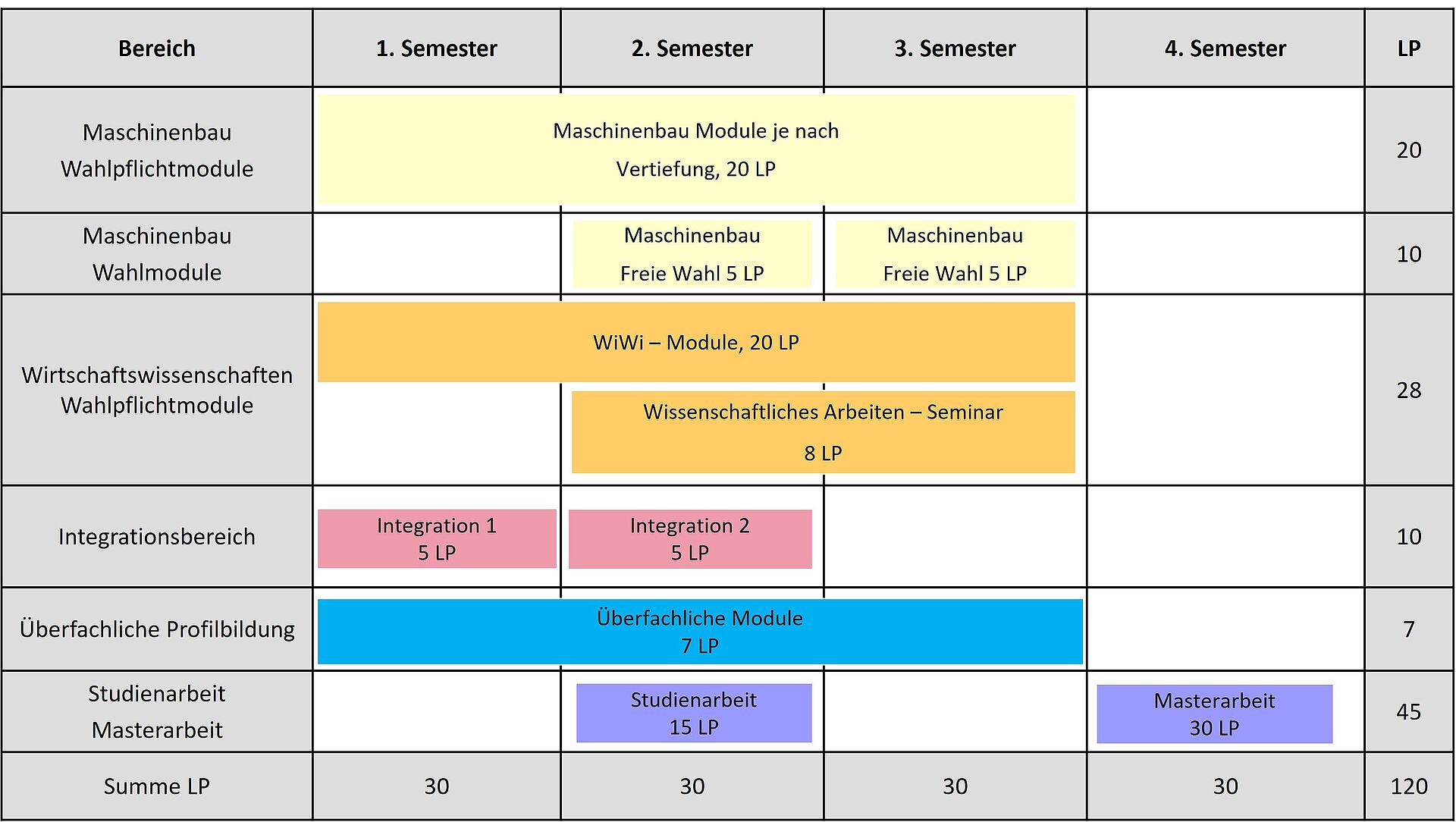
Students choose one of seven specialisations in engineering. Within the compulsory-elective catalogue for their chosen specialisation, they are free to select any combination of modules from those available. The catalogue comprises a wide range of modules, enabling students to tailor their focus within the degree programme.
In addition, within an elective area, students have the opportunity to take further modules from their specialisation or to supplement their specialist knowledge with modules from other specialisations.
In the ‘Compulsory Elective Area: Economics’, students must complete modules totalling 28 LP from a module catalogue (BPO PO4 – Appendix 1/Appendix 2).
-> 8 LP of these must be obtained by taking the module ‘Academic Work – Seminar’.
This module bridges the gap between the two disciplines involved in the degree programme – Mechanical Engineering and Economics – and prepares students for a career as an industrial engineer, a role that often lies at this interface. Here, students can take subjects such as factory planning, project management and law.
The Interdisciplinary Profile Development component is designed to help you acquire methodological and social skills, and comprises modules offering interdisciplinary and practice-oriented activities aimed at imparting interdisciplinary qualifications and skills. This ensures that, over the course of your degree, you broaden your horizons and underpin your specialist knowledge with important additional qualifications for your future career.
When choosing the ‘Interdisciplinary Profile Development’ module, students can draw on the full range of courses offered by TU Braunschweig. Any course that concludes with an examination and is not part of their own Master’s programme may be selected, e.g. training in practical skills or language courses.
The aim of the course project is to promote students’ academic work. In addition to subject-specific work, the project also requires and develops students’ rhetorical skills in presenting their findings, whilst providing practice in academic writing as part of the project, with a view to preparing for the Master’s thesis. The course project may be undertaken in either the field of economics or engineering.
The Master’s programme concludes with the final module. This module involves the preparation of a written thesis, the Master’s thesis, and a presentation of the results achieved.
The Master’s thesis is intended to demonstrate the students’ ability to produce an academic paper independently. Furthermore, this module provides training in the documentation and communication (presentation) of academic findings and equips students to successfully apply these working methods in their future professional fields upon completion of their studies.
As with the undergraduate thesis, the Master’s thesis may be written in either the engineering or economics disciplines.