

The rising number of annual satellite launches and the shift from high-cost single satellites towards mega-constellations comprised of hundreds or thousands of smaller satellites that must be placed precisely into specific orbits are presenting the satellite market with a fundamental transformation. This emerging market offers the opportunity to develop new, more efficient logistics ecosystems consisting of reusable launch vehicles, fuel depots, and dedicated In-Space Transportation Vehicles (ISTVs).
The development of these ISTVs enables precise, efficient, and flexible “last-mile delivery” in orbit. Enabling the ability to refuel at fuel depots allows these ISTVs to be fully reusable. This refueling capability paves the way for new missions to maintain existing infrastructure in Earth orbit and complex exploration missions beyond Earth orbit.
Economical operation necessitates high-performance propulsion systems. With the phased ban on hydrazine under the EU REACH Regulation, increasing demands for performance, environmental sustainability and cost efficiency can only be met by cryogenic propellants such as oxygen, methane, and hydrogen. Within the context of the described logistics ecosystem, the use of cryogenic propellants poses significant challenges with regard to propellant storage, propellant transfer, ignition, and engine operation.
Project Description
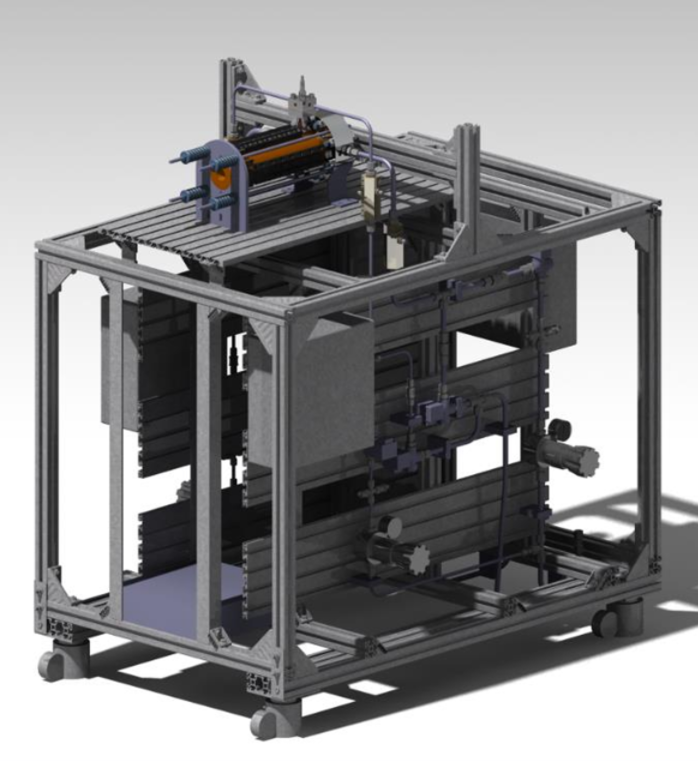
The goal of the KALTSTART project is to establish the research infrastructure necessary for the development and study of cryogenic space transportation systems. Specifically, three test stands will be built to study the storage and handling of cryogenic propellants, the reignition of the combustion chamber, and the development of cryogenic rocket engines.
To develop reusable ISTVs, cryogenic propellants must be stored for long periods in depots and on the space transporters themselves. However, the ambient temperature of the tanks is significantly higher than the boiling point of the propellants, which must be in liquid form for use in the engine. To prevent evaporation and the resulting loss of propellant, efficient insulation and cooling systems must therefore be developed.
To investigate the behavior of cryogenic propellants during storage and under active cooling, a test facility for space-like thermal environments is being set up. In addition to experiments investigating phase transitions under various operating conditions, this test facility is designed to enable the study of capillary structures for fluid acquisition in microgravity.
Re-ignition of the combustion chamber
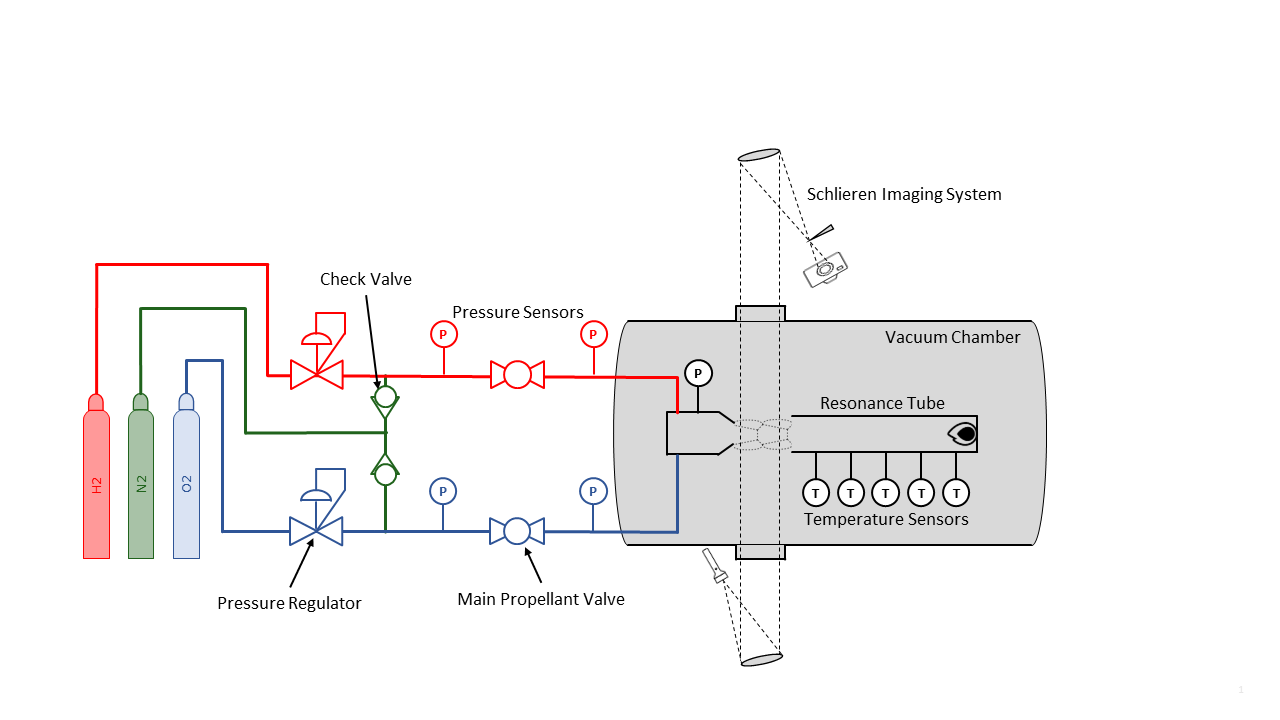
Reliably restarting cryogenic rocket engines in microgravity presents a considerable challenge. One innovative and promising approach is resonance ignition, in which a gas mixture is ignited solely by flow-induced pressure and temperature peaks within a resonance tube. The system consists of two precisely controlled solenoid valves for fuel and oxidizer, as well as a nozzle with a tuned resonance channel. When the propellants are injected abruptly, acoustic pressure waves are generated in the tube, which build up in intensity depending on the tube's geometry.
While the design of a resonant igniter is relatively simple, its operation is based on complex fluid dynamics. To investigate the exact mechanisms of heat generation caused by the flow in the resonant tube, these mechanisms will be analyzed using modern optical measurement techniques.
Cryogenic Fluid Management
To develop reusable ISTVs, cryogenic propellants must be stored for long periods in depots and on the space transporters themselves. However, the ambient temperature of the tanks is significantly higher than the boiling point of the propellants, which must be in liquid form for use in the engine. To prevent evaporation and the resulting loss of propellant, efficient insulation and cooling systems must therefore be developed.
To investigate the behavior of cryogenic propellants during storage and under active cooling, a test facility for space-like thermal environments is being set up. In addition to experiments investigating phase transitions under various operating conditions, this test facility is designed to enable the study of capillary structures for fluid acquisition in microgravity.
Re-ignition of the combustion chamber
Reliably restarting cryogenic rocket engines in microgravity presents a considerable challenge. One innovative and promising approach is resonance ignition, in which a gas mixture is ignited solely by flow-induced pressure and temperature peaks within a resonance tube. The system consists of two precisely controlled solenoid valves for fuel and oxidizer, as well as a nozzle with a tuned resonance channel. When the propellants are injected abruptly, acoustic pressure waves are generated in the tube, which build up in intensity depending on the tube's geometry.
While the design of a resonant igniter is relatively simple, its operation is based on complex fluid dynamics. To investigate the exact mechanisms of heat generation caused by the flow in the resonant tube, these mechanisms will be analyzed using modern optical measurement techniques.