Experimental Lab for Proximity Operations and Space Situational Awareness, ELISSA
Objectives and Scope of ELISSA
Achieving high Technology Readiness Levels (TRLs) necessitates using high-accuracy testing environments capable of modelling and simulating the behaviour of spacecraft and their subsystems. The ELISSA lab at the Institute of Space Systems is designed for exactly this purpose by providing a testing environment capable of providing the following capabilities:
Emulation of microgravity and contact dynamics of satellites in orbit using free-floating satellite mock-ups, called “Free-Flyers”, lifted by an active air cushion
Precise position and attitude dynamics sensing and control using a state-of-the-art motion capture system
Emulation of satellite subsystems and payloads using 3D-printed and computer-controlled models
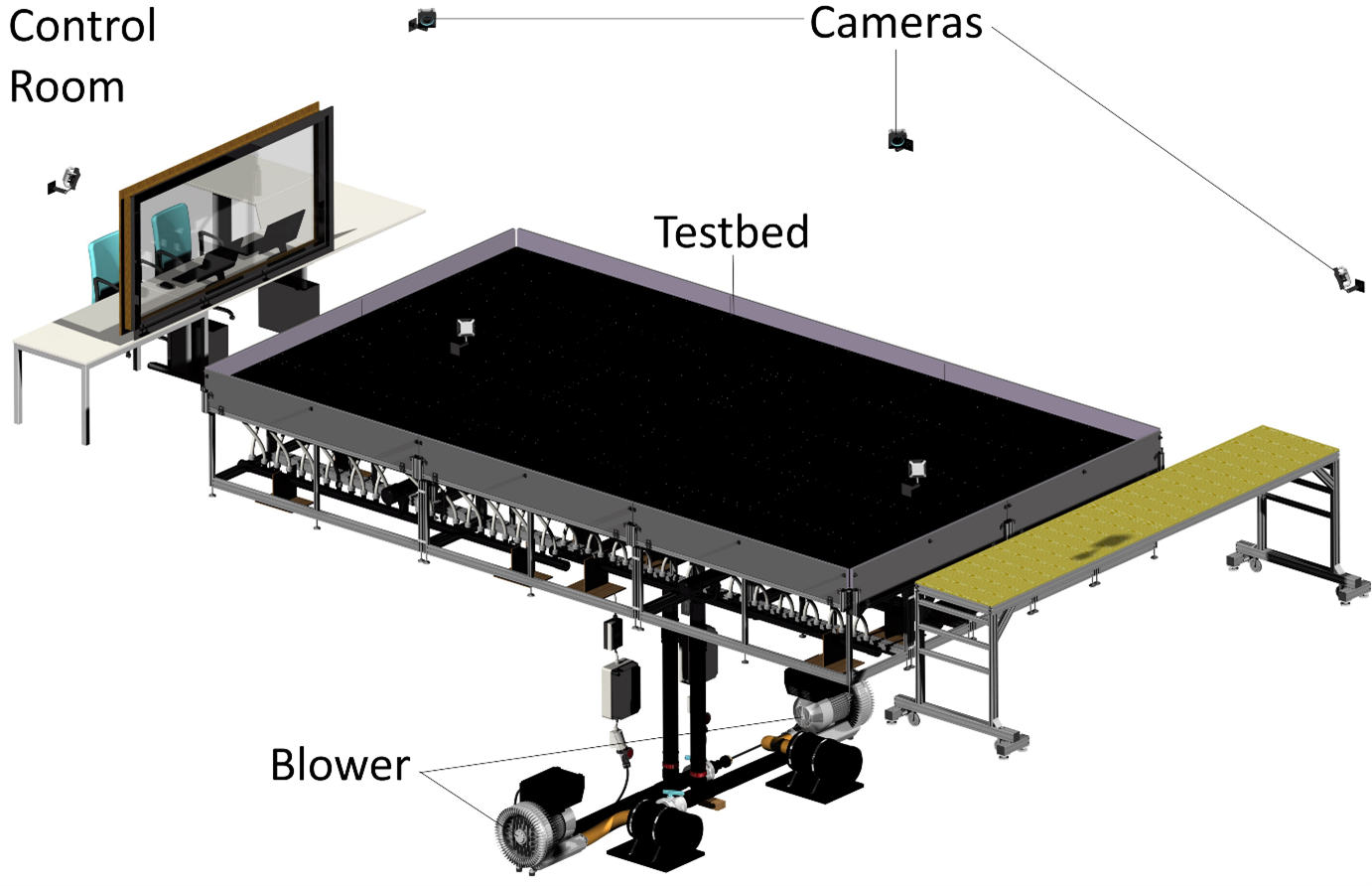
The ELISSA lab consists of four subsystems spread out across three rooms (the air-bearing room, the control room, and the air supply room):
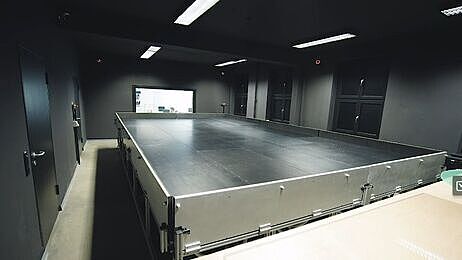
The aeromechanical subsystem consists of the active air-bearing table (located in the air-bearing room) and two pumps (located in the air supply room) and is responsible for generating the air cushion necessary to enable the Free-Flyers to float across the table. Unlike passive air-bearing tables, which require the Free-Flyers to generate their own air cushion using onboard pressurized gas, the active air-bearing table enables long-duration experiments limited only by the capacity of on-board electrical energy storage. Thus, experiment duration limit is on the scale of hours instead of minutes.
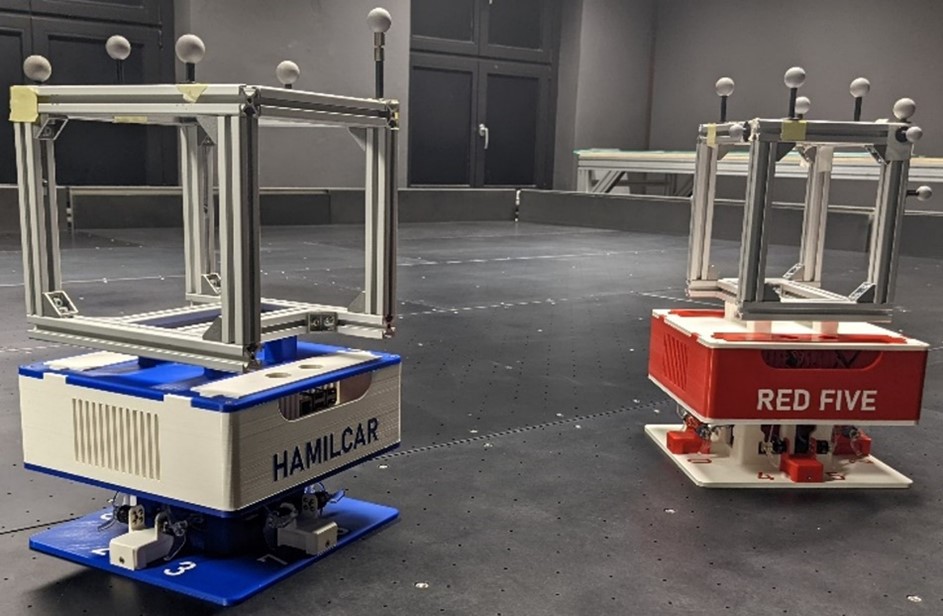
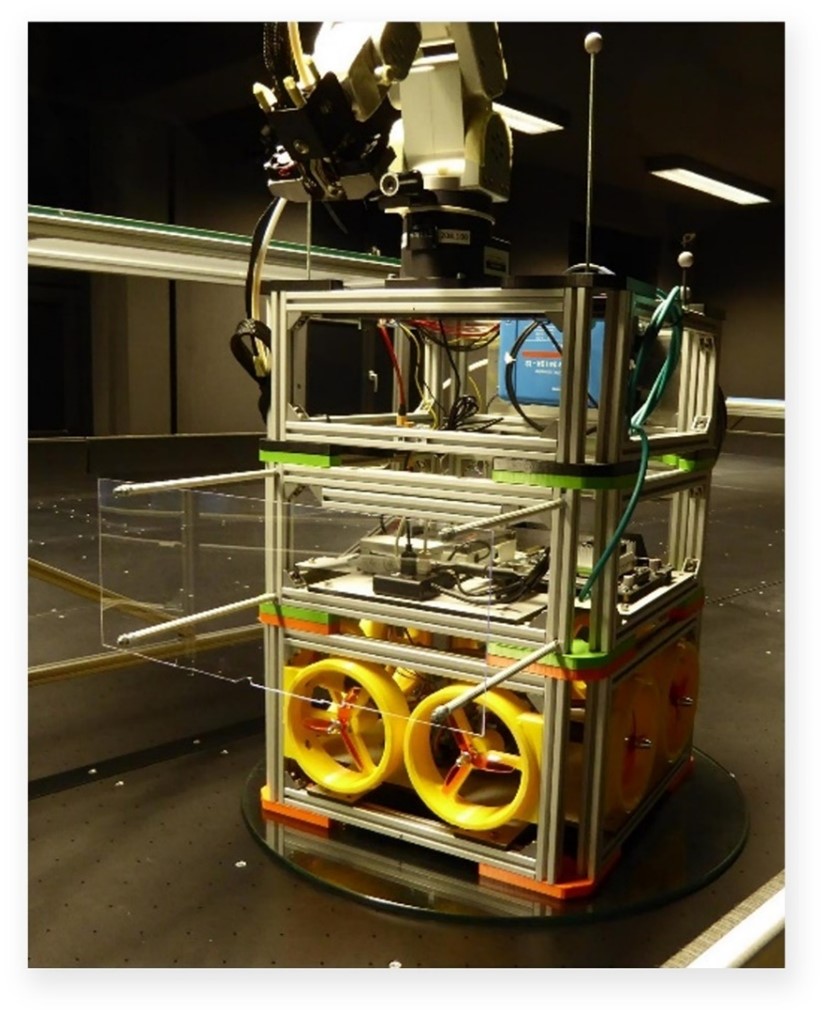
The Free-Flyer subsystem consists of the satellite mock-ups placed on the table to emulate satellites. They feature both autonomous and operator-in-the-loop modes, depending on the experiment requirements. Each Free-Flyer features a propulsion subsystem, an on-board computing and control subsystem, and a payload adapter. Integration of different types of actuators and payloads is possible depending on the experiment setup. Currently, the lab features two size-classes of Free-Flyer. The larger Hannibal class (base 40x40 cm, mass up to 16 kg) and the smaller Hamilcar class (base 25x25 cm, mass up to 6 kg). A third class with a 3U CubeSat format is currently in development and expected to be commissioned in 2027.
The Motion Capture subsystem is located in the air-bearing table room and consists of six OptiTrack cameras attached to a network. Using special reflective markers, the cameras are capable of locating the Free-Flyers with a high rotational and positional accuracy (<1 mm) and low latency.
The Mission Control subsystem is located in the adjacent control room and contains all devices needed for remote control and operations of the laboratory, as well as ground support equipment for the Free-Flyers.
Figure 1: Architektur von ELISSA
Current use cases of ELISSA include:
Contact dynamics experiments, for example testing of Gecko-Docking-Mechanisms
Rendezvous and capture tests for active space debris removal
Verification of navigation and control algorithms
Additive in-space manufacturing
Other possible use cases of ELISSA include:
Formation flying of multiple satellites
Solar panel extension tests
On-Orbit Servicing and teleoperations
Robotic assembly and maintenance
Figure 2: Freeflyer der Hamilcar-Klasse
Figure 3: Freeflyer der Hannibal-Klasse
Publication
C. Trentlage, J. Yang, M. K. Ben Larbi, C. A. de Alba Padilla, and E. Stoll, “The ELISSA Laboratory: Free-Floating Satellites for Space-Related Research,” in Deutscher Luft- und Raumfahrtkongress, Friedrichshafen, Germany, Sep. 2018.