
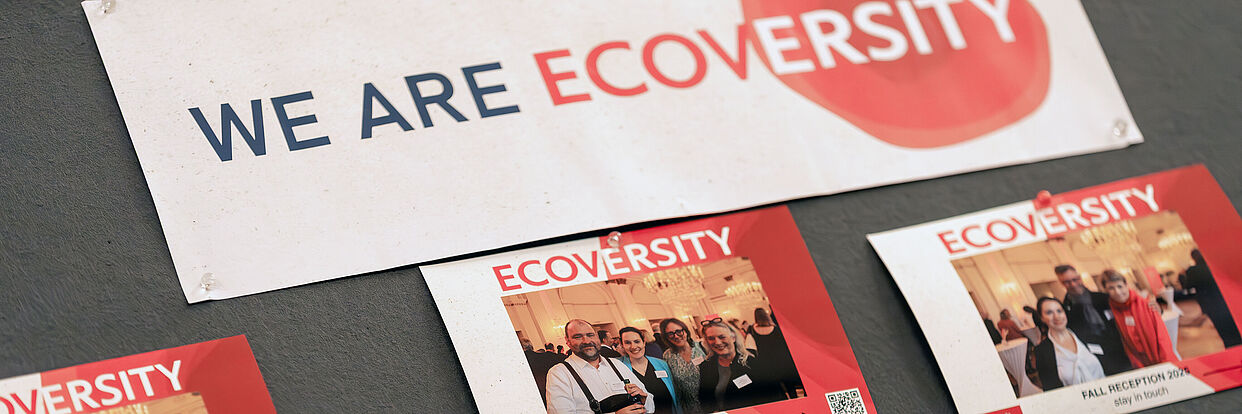
On this page, we introduce you to the many different members of the Ecoverse. If you don't see yours listed here, please feel free to contact us. We'll then add you to the list.
We regularly provide information on current funding opportunities and programmes that support the transition to an Ecoversity. Please feel free to contact us if you have any ideas or requests. We offer personalised advice and support to help turn good ideas into reality quickly.
The Braunschweig region is one of the most research-intensive locations in Europe. In 2004, the association “ForschungRegion Braunschweig e.V.” was founded with the aim of linking up knowledge, promoting innovation in a sustainable manner and strengthening Braunschweig’s position as a leading centre of science.
The Technische Universität Braunschweig is one of around 30 member institutions from the fields of science, business and culture, and also works closely with them as part of the Ecoversity Initiative.
The success of our Ecoversity depends on the commitment of our people. We need researchers, lecturers, staff and students who think beyond disciplinary boundaries and enjoy collaborating with internal and external partners to overcome challenges. They contribute to research and teaching, their studies, transfer projects, academic self-administration, science management and administration.
People who work in an interdisciplinary and transdisciplinary capacity within the scientific ecosystem of TU Braunschweig, actively drive forward processes of transformation and, in doing so, seek to forge trusting partnerships with industry, politics, culture and society, are known as changemakers.
Topic Areas are scientific fields which, given their strengths and potential for innovation, are expected to yield groundbreaking innovations that will enable the vision of an Ecoversity to be realised.
Through its current Topic Areas, TU Braunschweig creates synergies between any two of the four successfully established core research areas, thereby fostering solutions to complex challenges.
The Topic Area BrightBrain: Illuminating the Brain was developed on the basis of the two core research areas "Metrology" and "Engineering for Health". BrightBrain aims to develop concepts, methods and tools that can significantly advance biomedical research. In doing so, the Technical University of Braunschweig draws on the enormous potential of its interdisciplinary expertise in the life sciences, mechanical engineering, electrical engineering, information technology and physics, as well as its network of universities and non-university research institutions.
The research priorities "City of the Future" and "Mobility" form the basis for the ReSpace! topic area. Here, researchers, partner institutions and spaces are interconnected through research activities in order to explore anew the potential of three-dimensionality for spaces that are "response-able" (a term combining "sense of responsibility" and "capacity for action"). Our aim is to create adaptable spaces that can respond to changing ecological, economic and social requirements and the resulting ethical challenges, as they are based on responsible planning and decision-making.
TU Braunschweig is committed to tapping into the full potential of our region, collaborating with local, national, and global partners to establish a thriving scientific ecosystem. The primary objectives include driving innovation through cutting-edge research, and fostering a conducive environment that attracts, empowers, and retains changemakers at various levels.
To achieve these goals and incorporate diverse, international perspectives into our approach, an International Ecoversity Advisory Board has been established. Comprising leading international experts, our university members, and non-university research institutions, this Advisory Board provides insightful advice to the university's executive board on achieving our strategic goals.
| Board Member | Institution |
|---|---|
| Prof. Tim Bedford | University of Strathcyclyde |
| Prof. Cornelia Denz | Physikalisch-Technische Bundesanstalt |
| Dr. Paul Dodd | UC Davis |
| Kai Gehring | Former Chairman of the Committee on Education, Research and Technology Assessment of the German Parliament |
| Prof. Dr. h. c. Reinald Löhner | George Mason University |
| Dr. Despina Moschou | University of Bath |
| Prof. Josef Penninger | Helmholtz-Zentrum für Infektionsforschung |
| Prof. Dr. - Ing. Jens Schneider | Technische Universität Wien |
| Prof. H. G. C. Henri Werij | Technische Universität Delft |
| Board Member | Institution |
|---|---|
| Max Bierwagen | TU BS - Studierende |
| Prof. Melanie Brinkmann | TU BS - FK2 & HZI |
| Prof. Klaus Dilger | TU BS - FK4 & OHLF |
| Prof. Eduard Jorswieck | TU BS - FK5 |
| Kassandra Kampen | TU BS - WiMi Senat |
| Prof. Simone Kauffeld | TU BS - Hochschulrat |
| Prof. Astrid Lampert | TU BS - FK4 & Sprecherin NFL |
| Prof. Markus Magnor | TU BS - FK1 |
| Dr. Hoda Mohagheghi | TU BS - MTV |
| Prof. Anne Paschke | TU BS - FK1 |
| Prof. Sebastian Stiller | TU BS - FK1 |
| Prof. Klaus Thiele | TU BS - FK3 |
| Prof. Christian Thomsen | TU BS - Hochschulrat (TU Berlin) |
| Prof. Thomas Vietor | TU BS - FK4 |
| Lisa-Marie Wünsch | TU BS - Studierende |