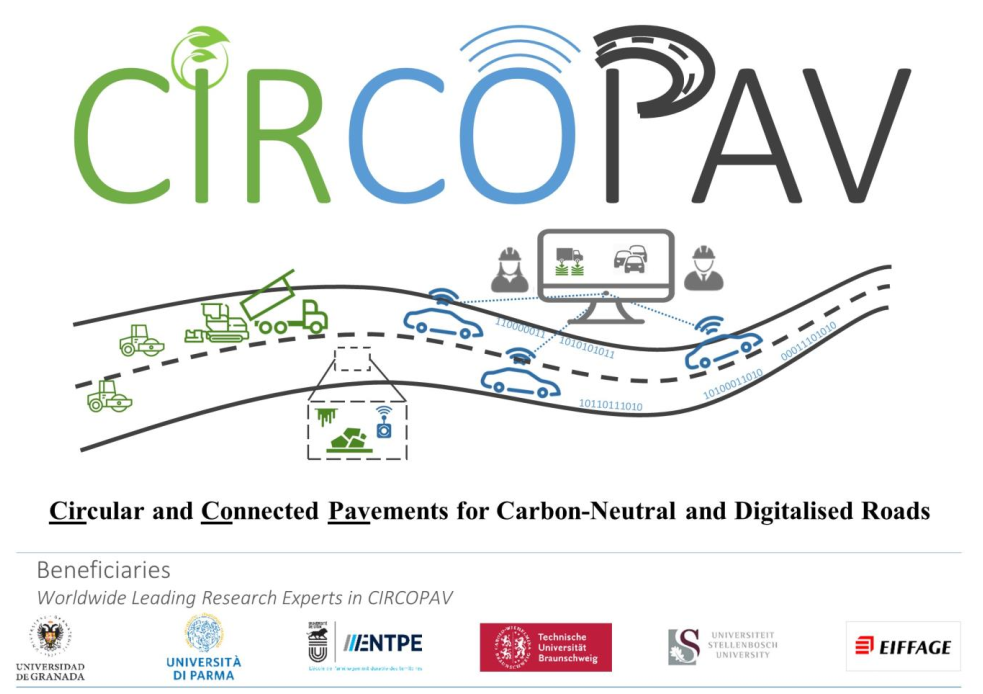
The Circular and Connected Pavements for Carbon-Neutral and Digitalized Roads (CIRCOPAV) Doctoral Training Network and aims to provide high-level international, inter-disciplinary and inter-sectorial and training to ten doctoral candidates among 8 universities, 8 industrial companies and a road administration, across 8 countries and 3 continents. For this, transportation, construction engineering, sustainability, electronics and data science sectors are to be combined to create a new generation of creative, entrepreneurial and innovative leaders for the next generation of roads.
The network is divided in 5 Work Packages (WP): (1) Smart and Connected Assets, (2) Climate Neutral and Resilient Pavements, (3) Training and Career Development, (4) Communication, Dissemination and Exploitation, (5) Management. From these, TU Braunschweig is mainly responsible for Training and Career Development of PhD Candidates. WP1 is related to the 5 first PhD projects responsible for “Real-time Wireless Monitoring”, and “Sensor Networks for Roads & bridges” while WP2 is related to the 5 later PhD projects responsible for “Climate Neutral and Circular Pavements”, and “Climate Change Resiliency” objectives. Among the 10 PhD projects, TU Braunschweig hosts the PhD Candidates M.Sc. Lucas Sassaki Vieira da Silva, for the 3rd project, “Interactive Analysis System for the Management of Pavements” (I_AM_PAVE), and M.Sc. Marcela Maria Toscano Krau for the 9th project, “Sustainable green infrastructure for climate neutral cities” (SpongePave), which are respectively parts of WP1 and WP2. Considering all the PhD projects, CIRCOPAV will achieve two main targets: (1) road network digitalization to create smart and automated pavements, and (2) pavement sustainability to mitigate their carbon footprint and make them climate change resilient, to respond to future transport and climate demands. These targets are directly in line with Horizon Europe’s goal to transition to a green and digital economy and will be achieved via intelligent and connected (e.g. sensors and IoT networks) and sustainable technologies (e.g. low emission materials and manufacturing and climate change resilient designs and materials).
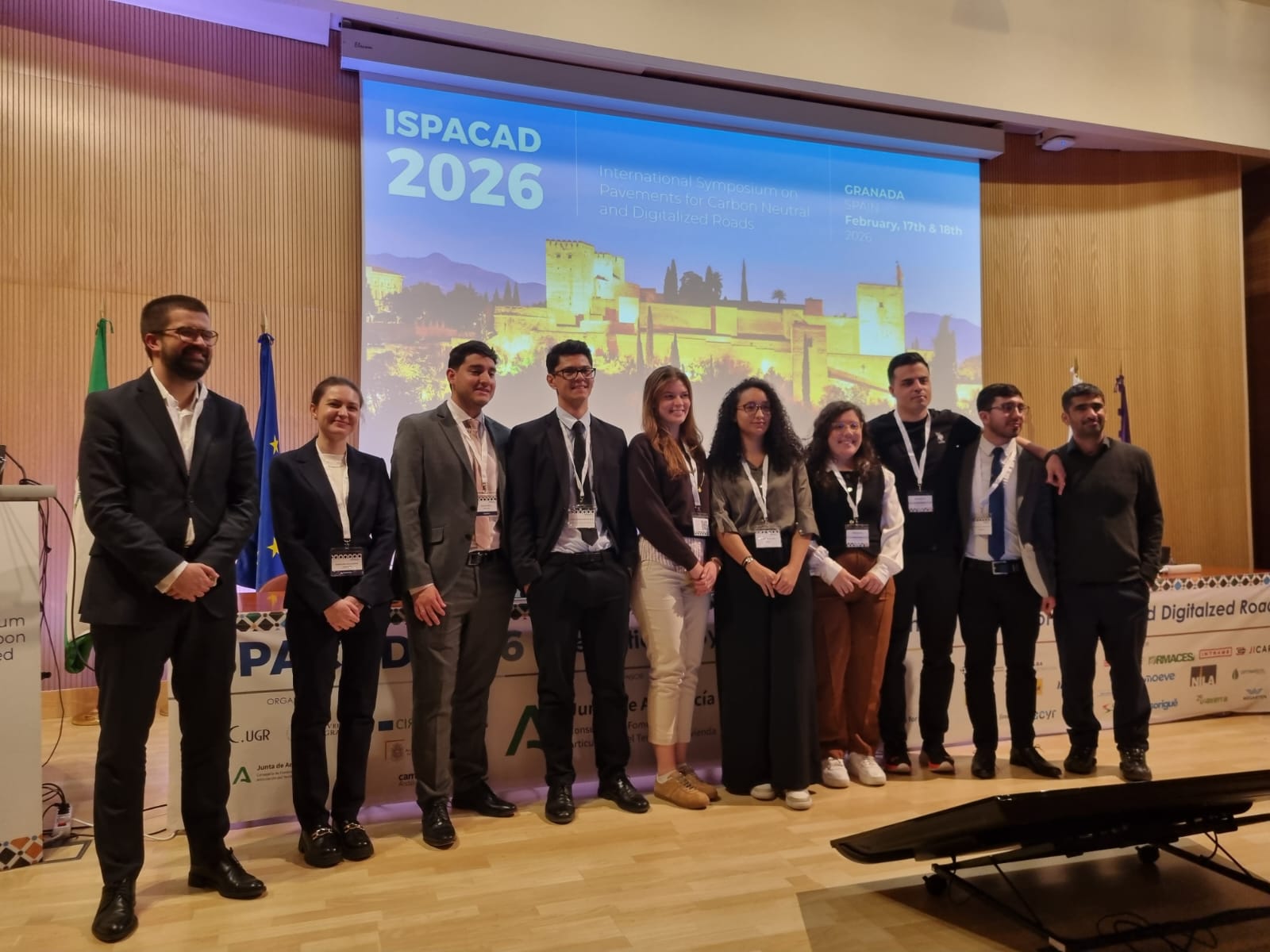
During the project, the team had regular meetings during training weeks where the doctoral candidates had the opportunity to exchange progress, become feedback and high level training on diverse areas for personal and professional development. Both the initial and final project’s meeting were held on the University of Granada in Spain during the ISPACAD conferences in 2023 and 2026, while the other training weeks happened in other countries such as Italy and France, and events such as the CAPSA 2023 (South Africa), and E&E Congress 2024 (Hungary).
CIRCOPAV is funded by the European Union’s Horizon Europe research and innovation programme under the Marie Skłodowska-Curie Grant Agreement No 101072820.