

Contact person: Maximilian Tobaben
Funded by: DFG
Summary of the overall project:
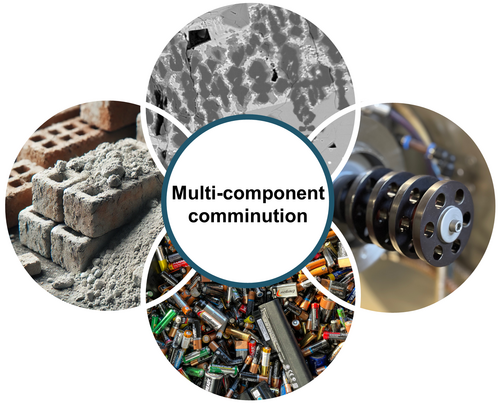
The comminution of multicomponent systems is highly relevant to numerous industrial applications, for example in the processing of ores and recycled materials as well as in the production of composite cements. In contrast to the comminution of single-component materials, the process behaviour of multicomponent systems is largely determined by the interactions between the components involved. Differences in material properties, particle sizes, breakage behaviour, and concentration may cause individual components to be preferentially or more slowly comminuted and to mutually influence their comminution behaviour. In the case of abrasive materials, grinding media and mill wear may additionally introduce further components into the system and thereby affect its behaviour.
For single-component materials in the submicron particle size range, a comprehensive understanding of both process and material behaviour already exists. For multicomponent systems, however, further research is required to understand how the individual components influence one another during the comminution process and under which process conditions targeted and selective comminution of individual components can be achieved. A key prerequisite for this is the component-specific determination of particle size distributions, as only on this basis can the comminution behaviour of individual components and its evolution over time be described.
Within the DFG project “Dynamic Simulation of Multicomponent Comminution” the interactions between the individual components are therefore to be systematically identified and quantified. The project will investigate how material properties, composition, and process parameters affect the comminution behaviour of the respective components and the resulting selectivity.
Based on these findings, the behaviour of multicomponent systems will be modelled. The objective is to develop or extend process models capable of describing and predicting component-specific comminution behaviour as well as the underlying interactions between the individual components. These models will subsequently be used to identify suitable process conditions under which the selectivity of the comminution process can be deliberately maximized.