

Technische Universität Braunschweig
  • Study & Teaching
    • Beginning your Studies
      • Prospective Students
      • Degree Programmes
      • Application
      • Why TU Braunschweig?
    • During your Studies
      • Fresher's Hub
      • Term Dates
      • Courses
      • Practical Information
      • Beratungsnavi
      • Additional Qualifications
      • Financing and Costs
      • Special Circumstances
      • Health and Well-being
      • Campus life
    • At the End of your Studies
      • Discontinuation and Credentials Certification
      • After graduation
      • Alumni
    • For Teaching Staff
      • Strategy, Offers and Information
      • Learning Management System Stud.IP
    • Contact
      • Study Service Centre
      • Academic Advice Service
      • Student Office
      • Career Service
  • Research
    • Research Profile
      • Core Research Areas
      • Clusters of Excellence at TU Braunschweig
      • Research Projects
      • Research Centres
      • Professors‘ Research Profiles
    • Early Career Researchers
      • Support in the early stages of an academic career
      • PhD-Students
      • Postdocs
      • Junior research group leaders
      • Junior Professorship and Tenure-Track
      • Habilitation
      • Service Offers for Scientists
    • Research Data & Transparency
      • Transparency in Research
      • Research Data
      • Open Access Strategy
      • Digital Research Announcement
    • Research Funding
      • Research funding
    • Contact
      • Research Services
      • Academy for Graduates
  • International
    • International Students
      • Why Braunschweig?
      • Degree seeking students
      • Exchange Studies
      • TU Braunschweig Summer School
      • Refugees
      • International Student Support
      • International Career Service
    • Going Abroad
      • Studying abroad
      • Internships abroad
      • Teaching and research abroad
      • Working abroad
    • International Researchers
      • Welcome Support for International Researchers
      • Service for Host Institutes
    • Language and intercultural competence training
      • Learning German
      • Learning Foreign Languages
      • Intercultural Communication
    • International Profile
      • Internationalisation
      • International Cooperations
      • Strategic partnerships
      • International networks
    • International House
      • About us
      • Contact & Office Hours
      • News and Events
      • International Days
      • 5th Student Conference: Internationalisation of Higher Education
      • Newsletter, Podcast & Videos
      • Job Advertisements
  • TU Braunschweig
    • Our Profile
      • Aims & Values
      • Regulations and Guidelines
      • Alliances & Partners
      • The University Development Initiative 2030
      • Ecoversity – the TU Braunschweig as a university ecosystem
      • Facts & Figures
      • Our History
    • Career
      • Working at TU Braunschweig
      • Vacancies
      • Information and Offers for New Employees
    • Economy & Business
      • Entrepreneurship
      • Friends & Supporters
    • General Public
      • Check-in for Students
      • The Student House
      • Access to the University Library
    • Media Services
      • Communications and Press Service
      • Services for media
      • Film and photo permits
      • Advices for scientists
      • Topics and stories
    • Contact
      • General Contact
      • Getting here
  • Organisation
    • Presidency & Administration
      • Executive Board
      • Designated Offices
      • Administration
      • Committees
    • Faculties
      • Carl-Friedrich-Gauß-Fakultät
      • Faculty of Life Sciences
      • Faculty of Architecture, Civil Engineering and Environmental Sciences
      • Faculty of Mechanical Engineering
      • Faculty of Electrical Engineering, Information Technology, Physics
      • Faculty of Humanities and Education
    • Institutes
      • Institutes from A to Z
    • Facilities
      • University Library
      • Gauß-IT-Zentrum
      • Professional and Personnel Development
      • International House
      • The Project House of the TU Braunschweig
      • Transfer Service
      • University Sports Center
      • Facilities from A to Z
    • Equal Opportunity Office
      • Equal Opportunity Office
      • Family
      • Diversity for Students
  • Search
  • Quicklinks
    • People Search
    • Webmail
    • cloud.TU Braunschweig
    • Messenger
    • Cafeteria
    • TUconnect (student platform)
    • Courses
    • Emergency
    • Stud.IP
    • Library Catalogue
    • IT Services
    • Information Portal (employees)
    • Link Collection
    • DE
    • EN
    • Instagram
    • YouTube
    • LinkedIn
    • Mastodon
    • Bluesky
Menu
  • Organisation
  • Faculties
  • Faculty of Humanities and Education
  • Institutes
  • Interdisziplinary Perspectives on XR in Education
  • Lecture series
Logo Institut für Fachdidaktik der Naturwissenschaften Abteilung Biologie und Biologiedidaktik der TU Braunschweig
Summer term 2026
  • Lecture series
    • Summer term 2026
    • Winter semester 2025/26

Summer term 2026

The lecture series Virtual Education, Real Worlds? will continue in the summer semester of 2026. This semester will again feature exciting lectures on the use of XR in university teaching and selected research areas.

PD. Dr. Dagmar Hilfert-Rüppell (21.04.2026)

Beyond the keyhole – 360° videos in teacher training

360° videos provide realistic insights into teaching situations and enable trainee teachers to experience learning processes immersively, "right in the middle of things" rather than just "being there". The freely selectable perspective allows complex teaching processes, such as the approach and interaction of pupils during experiments or aspects of classroom management, to be observed and reflected upon from different angles. The event focuses on practical examples from teacher training, findings on effectiveness and acceptance, and technical and didactic design issues. The discussion will focus on how 360° videos can promote professional teaching perception and thus diagnostic and reflective skills, and what challenges arise in production and implementation. The aim of the lecture is to critically explore the potential and limitations of 360° videos and to provide impetus for future-oriented teacher training that looks beyond the traditional "keyhole" of classroom observation.


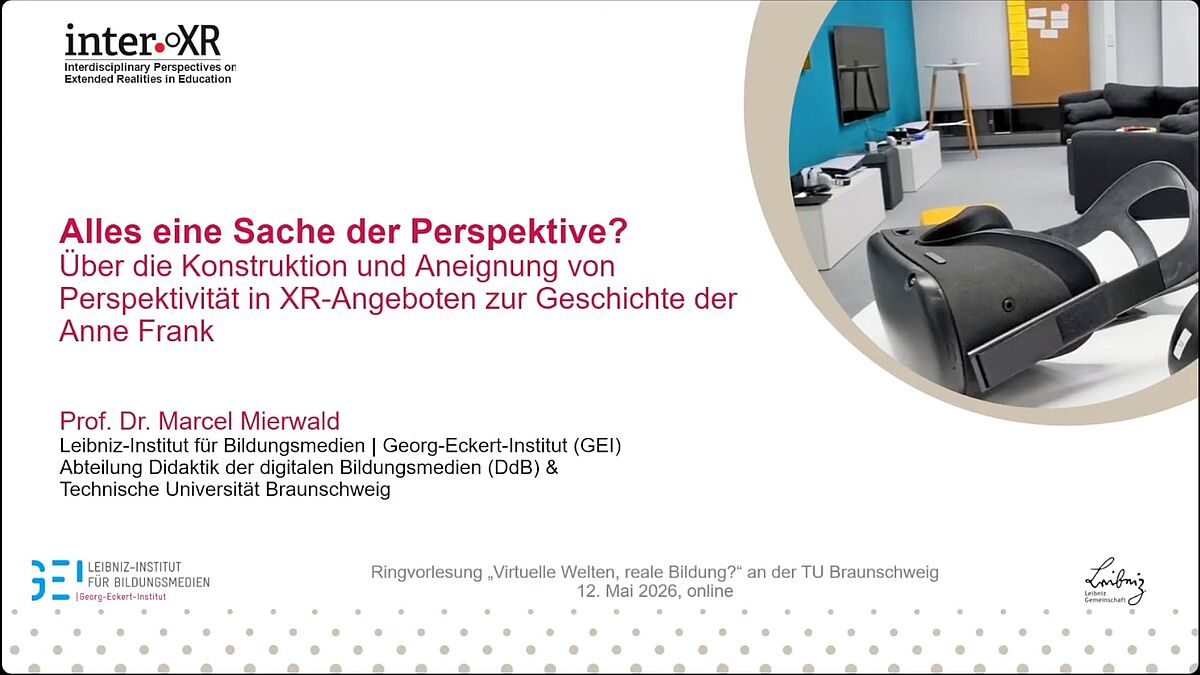
Prof. Dr. Marcel Mierwald (12.05.2026)

Is it all a matter of perspective? On the construction and appropriation of perspectivity in XR offerings on the history of Anne Frank

Augmented reality (AR) and virtual reality (VR) are linked to the concept of perspectivity in many ways. After all, they are digital educational media that ‘present’ virtual objects and environments to users. This is achieved through various technical means and using a range of media and content design tools. In this way, they can influence what we see and, in the case of history as a subject, possibly also shape historical knowledge and thinking about the past. The lecture will use two XR applications (an AR and a VR app) on the history of Anne Frank as examples to illustrate how perspectivity is constructed in such offerings and appropriated by learners. To this end, a history-didactic conceptualisation of perspectivity for XR applications will first be presented. Against this theoretical background, an exploratory study employing a mixed-methods approach will then be presented. This study investigated how teacher training students (N = 22) at Basement, the digital lab of the Leibniz Institute for Educational Media | GEI, appropriated perspectivity at the level of both the application and its use from an AR and VR app on the history of Anne Frank. The findings regarding the perception of the media offering’s perspectivity and the positioning of users within it, as well as the influence on their adoption of historical perspectives and historical empathy, provide nuanced insights into the varying effects of the XR applications used.

Prof. Dr. Raphael Zender (09.06.2026)

XR in schools: opportunities, risks and guidelines for reflective use

The lecture focuses on the use of immersive technologies in schools and asks when and how learning opportunities with XR are pedagogically useful for schoolchildren. The focus is on typical potentials – such as motivating learning approaches, the simulation of dangerous or difficult-to-access situations, spatial visualisations and collaborative virtual learning spaces – as well as risks and challenges such as side effects, access barriers, data protection and the digital divide. On this basis, guidelines for responsible use in schools and teaching are developed – from didactic design principles to questions of school and media development to the involvement of parents and extracurricular partners.


Prof. Dr. Vanessa Carlow (23.06.2026)

XR for better participation in urban development

How are immersive technologies changing the way we design, analyse and communicate about cities? 
This talk explores the potential of Extended Reality (XR) to open up new approaches to urban planning concepts, design and decision-making processes. Through interactive and spatially immersive simulations, planning content can not only be visualised, but also directly experienced and critically reflected upon.
XR is understood not merely as a technical visualisation tool, but as a methodological approach that can fundamentally influence design processes, evaluation criteria and participation formats. At the same time, XR opens up new perspectives on spatial perception and decision-making processes and contributes to a deeper understanding of the interactions between space, experience and evaluation. 
Drawing on specific research and teaching projects from the Institute for Sustainable Urbanism, the presentation demonstrates how XR-supported formats are being tested in teaching, research and participatory processes, and highlights the opportunities as well as the organisational, didactic and technical challenges associated with their implementation.
The lecture invites participants to critically reflect on the role of immersive technologies in the context of the digital transformation of urban planning and to consider together future forms of design, communication and decision-making.


Dr Stefanie Lenzer (14.07.2026)

Potential and challenges of immersive VR environments for diversity sensitivity in chemistry laboratories

Photo credits on this page

For All Visitors

Vacancies of TU Braunschweig
Career Service' Job Exchange 
Merchandising

For Students

Term Dates
Courses
Degree Programmes
Information for Freshman
TUCard

Internal Tools

Glossary (GER-EN)
Change your Personal Data

Contact

Technische Universität Braunschweig
Universitätsplatz 2
38106 Braunschweig

P. O. Box: 38092 Braunschweig
GERMANY

Phone: +49 (0) 531 391-0

Getting here

© Technische Universität Braunschweig
Legal Notice Privacy Accessibility

TU Braunschweig uses the software Matomo for anonymised web analysis. The data serve to optimise the web offer.
You can find more information in our data protection declaration.